

3 Introduction to Computational Fluid Dynamics and Ocean Modelling
89
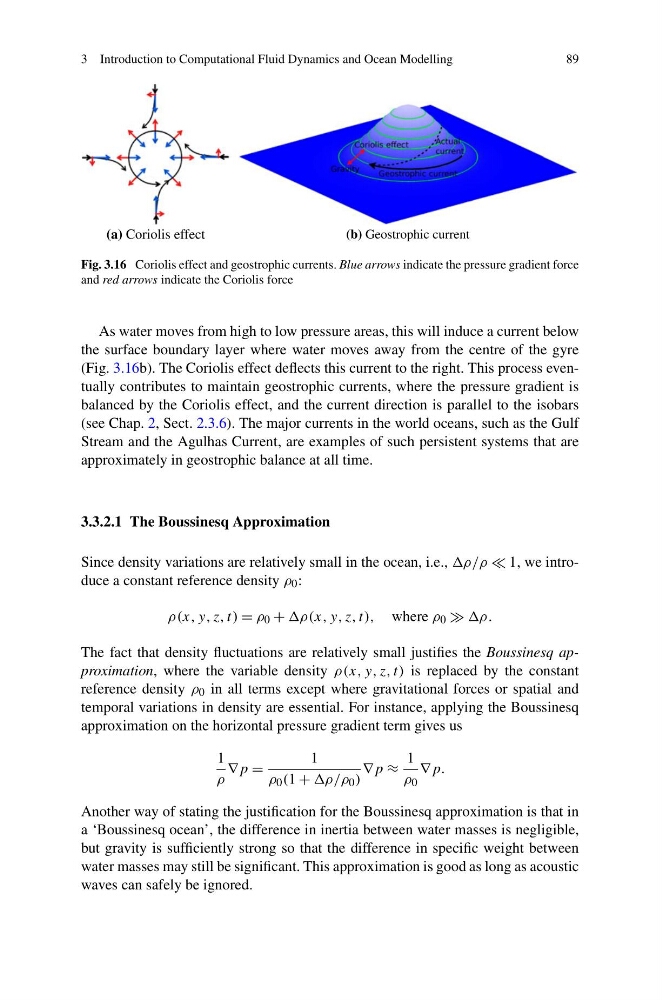
Fig. 3.16 Coriolis effect and geostrophic currents. Blue arrows indicate the pressure gradient force
and red arrows indicate the Coriolis force
As water moves from high to low pressure areas, this will induce a current below
the surface boundary layer where water moves away from the centre of the gyre
(Fig. 3.16b). The Coriolis effect deflects this current to the right. This process eventually contributes to maintain geostrophic currents, where the pressure gradient is
balanced by the Coriolis effect, and the current direction is parallel to the isobars
(see Chap. 2, Sect. 2.3.6). The major currents in the world oceans, such as the Gulf
Stream and the Agulhas Current, are examples of such persistent systems that are
approximately in geostrophic balance at all time.
3.3.2.1 The Boussinesq Approximation
Since density variations are relatively small in the ocean, i.e., 1, we introduce a constant reference density ρ 0 :
ρ(x, y, z, t) = ρ 0 + ρ(x, y, z, t), where ρ 0 ρ.
The fact that density fluctuations are relatively small justifies the Boussinesq approximation, where the variable density ρ(x, y, z, t) is replaced by the constant
reference density ρ 0 in all terms except where gravitational forces or spatial and
temporal variations in density are essential. For instance, applying the Boussinesq
approximation on the horizontal pressure gradient term gives us
1
ρ
∇p =
1
ρ 0 (1 + 0 )
∇p ≈
1
ρ 0
∇p.
Another way of stating the justification for the Boussinesq approximation is that in
a ‘Boussinesq ocean’, the difference in inertia between water masses is negligible,
but gravity is sufficiently strong so that the difference in specific weight between
water masses may still be significant. This approximation is good as long as acoustic
waves can safely be ignored.
89
Fig. 3.16 Coriolis effect and geostrophic currents. Blue arrows indicate the pressure gradient force
and red arrows indicate the Coriolis force
As water moves from high to low pressure areas, this will induce a current below
the surface boundary layer where water moves away from the centre of the gyre
(Fig. 3.16b). The Coriolis effect deflects this current to the right. This process eventually contributes to maintain geostrophic currents, where the pressure gradient is
balanced by the Coriolis effect, and the current direction is parallel to the isobars
(see Chap. 2, Sect. 2.3.6). The major currents in the world oceans, such as the Gulf
Stream and the Agulhas Current, are examples of such persistent systems that are
approximately in geostrophic balance at all time.
3.3.2.1 The Boussinesq Approximation
Since density variations are relatively small in the ocean, i.e., 1, we introduce a constant reference density ρ 0 :
ρ(x, y, z, t) = ρ 0 + ρ(x, y, z, t), where ρ 0 ρ.
The fact that density fluctuations are relatively small justifies the Boussinesq approximation, where the variable density ρ(x, y, z, t) is replaced by the constant
reference density ρ 0 in all terms except where gravitational forces or spatial and
temporal variations in density are essential. For instance, applying the Boussinesq
approximation on the horizontal pressure gradient term gives us
1
ρ
∇p =
1
ρ 0 (1 + 0 )
∇p ≈
1
ρ 0
∇p.
Another way of stating the justification for the Boussinesq approximation is that in
a ‘Boussinesq ocean’, the difference in inertia between water masses is negligible,
but gravity is sufficiently strong so that the difference in specific weight between
water masses may still be significant. This approximation is good as long as acoustic
waves can safely be ignored.