

88
T. Torsvik
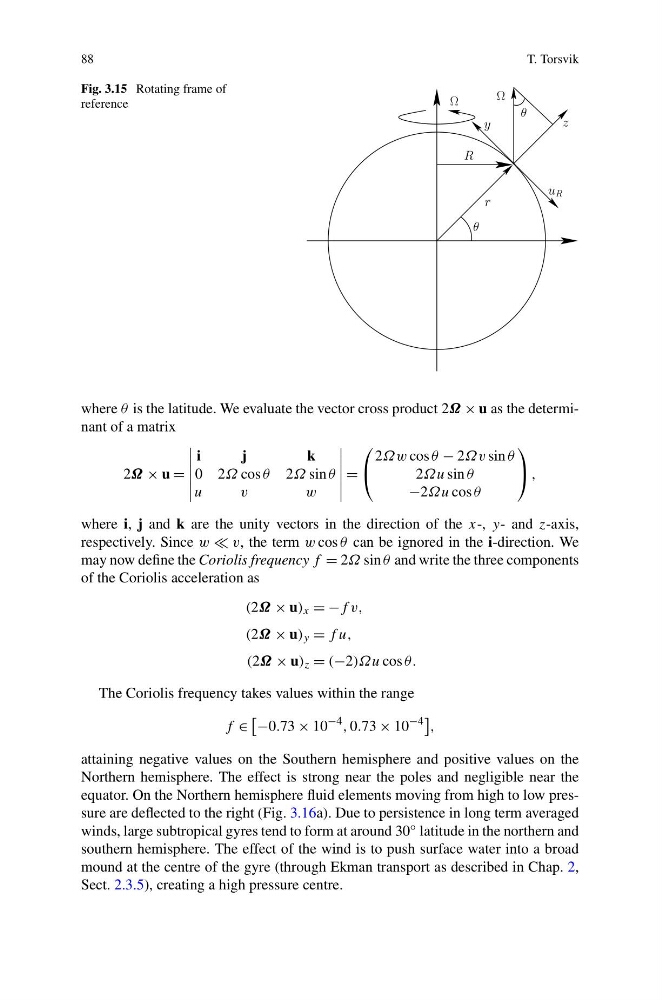
Fig. 3.15 Rotating frame of
reference
where θ is the latitude. We evaluate the vector cross product 2Ω × u as the determinant of a matrix
2Ω × u =
i
j
k
0 2Ω cos θ 2Ω sin θ
u
v
w
=
⎛
⎝
2Ωw cos θ − 2Ωv sin θ
2Ωu sin θ
−2Ωu cos θ
⎞
⎠ ,
where i, j and k are the unity vectors in the direction of the x-, y- and z-axis,
respectively. Since w v, the term w cos θ can be ignored in the i-direction. We
may now define the Coriolis frequency f = 2Ω sin θ and write the three components
of the Coriolis acceleration as
(2Ω × u) x = −f v,
(2Ω × u) y = f u,
(2Ω × u) z = (−2)Ωu cos θ.
The Coriolis frequency takes values within the range
f ∈
−0.73 × 10
−4 , 0.73 × 10
−4
,
attaining negative values on the Southern hemisphere and positive values on the
Northern hemisphere. The effect is strong near the poles and negligible near the
equator. On the Northern hemisphere fluid elements moving from high to low pressure are deflected to the right (Fig. 3.16a). Due to persistence in long term averaged
winds, large subtropical gyres tend to form at around 30 ◦ latitude in the northern and
southern hemisphere. The effect of the wind is to push surface water into a broad
mound at the centre of the gyre (through Ekman transport as described in Chap. 2,
Sect. 2.3.5), creating a high pressure centre.
T. Torsvik
Fig. 3.15 Rotating frame of
reference
where θ is the latitude. We evaluate the vector cross product 2Ω × u as the determinant of a matrix
2Ω × u =
i
j
k
0 2Ω cos θ 2Ω sin θ
u
v
w
=
⎛
⎝
2Ωw cos θ − 2Ωv sin θ
2Ωu sin θ
−2Ωu cos θ
⎞
⎠ ,
where i, j and k are the unity vectors in the direction of the x-, y- and z-axis,
respectively. Since w v, the term w cos θ can be ignored in the i-direction. We
may now define the Coriolis frequency f = 2Ω sin θ and write the three components
of the Coriolis acceleration as
(2Ω × u) x = −f v,
(2Ω × u) y = f u,
(2Ω × u) z = (−2)Ωu cos θ.
The Coriolis frequency takes values within the range
f ∈
−0.73 × 10
−4 , 0.73 × 10
−4
,
attaining negative values on the Southern hemisphere and positive values on the
Northern hemisphere. The effect is strong near the poles and negligible near the
equator. On the Northern hemisphere fluid elements moving from high to low pressure are deflected to the right (Fig. 3.16a). Due to persistence in long term averaged
winds, large subtropical gyres tend to form at around 30 ◦ latitude in the northern and
southern hemisphere. The effect of the wind is to push surface water into a broad
mound at the centre of the gyre (through Ekman transport as described in Chap. 2,
Sect. 2.3.5), creating a high pressure centre.