

3 Introduction to Computational Fluid Dynamics and Ocean Modelling
91
In addition to these equations we need balance equations for temperature T and
salinity S
DT
Dt
=
heat flux sources and sinks,
DS
Dt
=
salinity sources and sinks
and finally an equation of state
ρ = ρ(T , S, p)
to specify the dependence between density, pressure, temperature and salinity. The
equation of state is an internationally agreed standard for sea water, published by the
Joint Panel on Oceanographic Tables and Standards (JPOTS), derived from curve
fitting through laboratory measurements of temperature, salinity, and pressure. The
currently accepted equation of state consists of three polynomials with 41 constants
(JPOTS 1991).
3.3.3 Ocean Turbulence
Turbulence is an essential feature of ocean dynamics. It is difficult to give a precise definition of the term ‘turbulence’, but it is generally accepted that turbulence
involves a state of highly energetic, rotational and irregular motion that results in
a rapid transfer of momentum, heat and dissolved matter greatly exceeding transfer rates achievable by molecular processes alone. By generating relatively large
gradients of velocity at small scales (typically 1 mm to 1 cm), turbulence facilitates the transfer of kinetic energy into heat through viscous dissipation. The first
substantial scientific study of turbulent motion was published by Reynolds (1883),
who demonstrated that the transition between a smooth, laminar flow and turbulent
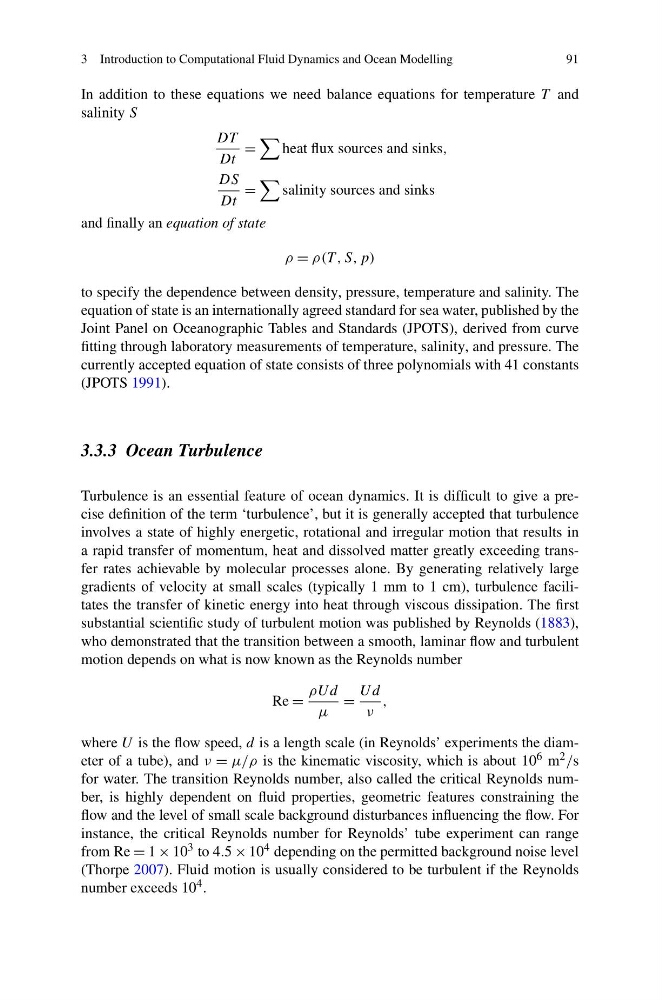
motion depends on what is now known as the Reynolds number
Re =
ρU d
μ
=
Ud
ν
,
where U is the flow speed, d is a length scale (in Reynolds’ experiments the diameter of a tube), and ν = μ/ρ is the kinematic viscosity, which is about 10 6 m 2 /s
for water. The transition Reynolds number, also called the critical Reynolds number, is highly dependent on fluid properties, geometric features constraining the
flow and the level of small scale background disturbances influencing the flow. For
instance, the critical Reynolds number for Reynolds’ tube experiment can range
from Re = 1 × 10 3 to 4.5 × 10 4 depending on the permitted background noise level
(Thorpe 2007). Fluid motion is usually considered to be turbulent if the Reynolds
number exceeds 10 4 .
91
In addition to these equations we need balance equations for temperature T and
salinity S
DT
Dt
=
heat flux sources and sinks,
DS
Dt
=
salinity sources and sinks
and finally an equation of state
ρ = ρ(T , S, p)
to specify the dependence between density, pressure, temperature and salinity. The
equation of state is an internationally agreed standard for sea water, published by the
Joint Panel on Oceanographic Tables and Standards (JPOTS), derived from curve
fitting through laboratory measurements of temperature, salinity, and pressure. The
currently accepted equation of state consists of three polynomials with 41 constants
(JPOTS 1991).
3.3.3 Ocean Turbulence
Turbulence is an essential feature of ocean dynamics. It is difficult to give a precise definition of the term ‘turbulence’, but it is generally accepted that turbulence
involves a state of highly energetic, rotational and irregular motion that results in
a rapid transfer of momentum, heat and dissolved matter greatly exceeding transfer rates achievable by molecular processes alone. By generating relatively large
gradients of velocity at small scales (typically 1 mm to 1 cm), turbulence facilitates the transfer of kinetic energy into heat through viscous dissipation. The first
substantial scientific study of turbulent motion was published by Reynolds (1883),
who demonstrated that the transition between a smooth, laminar flow and turbulent
motion depends on what is now known as the Reynolds number
Re =
ρU d
μ
=
Ud
ν
,
where U is the flow speed, d is a length scale (in Reynolds’ experiments the diameter of a tube), and ν = μ/ρ is the kinematic viscosity, which is about 10 6 m 2 /s
for water. The transition Reynolds number, also called the critical Reynolds number, is highly dependent on fluid properties, geometric features constraining the
flow and the level of small scale background disturbances influencing the flow. For
instance, the critical Reynolds number for Reynolds’ tube experiment can range
from Re = 1 × 10 3 to 4.5 × 10 4 depending on the permitted background noise level
(Thorpe 2007). Fluid motion is usually considered to be turbulent if the Reynolds
number exceeds 10 4 .