

66
G.-M.Lange
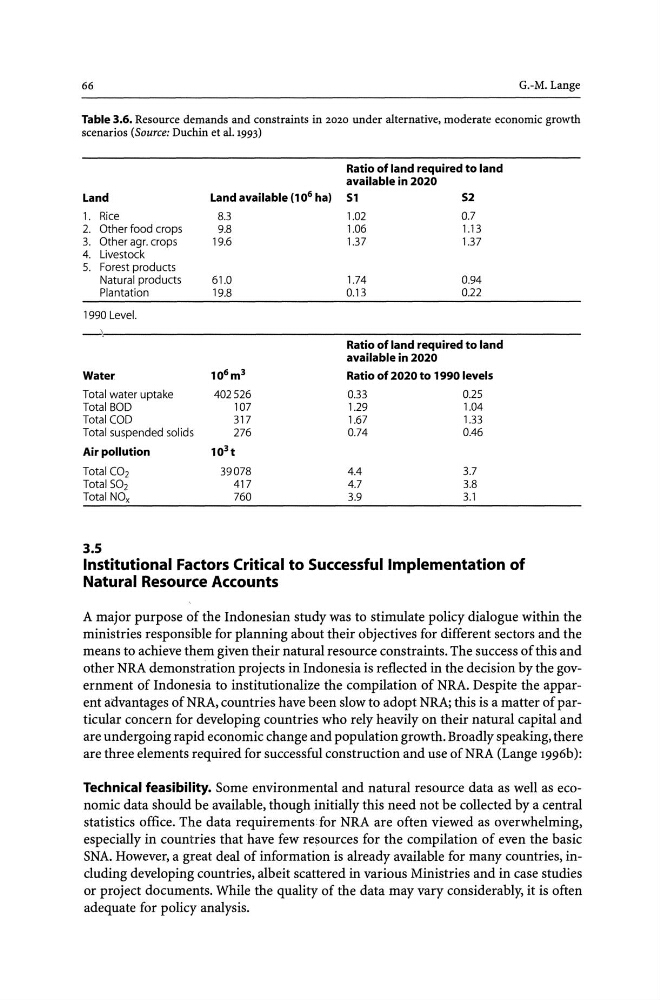
Table 3.6. Resource demands and constraints in 2020 under alternative, moderate economic growth
scenarios (Source: Duchin et al.1993)
Land
1. Rice
2. Other food crops
3. Other agr. crops
4. Livestock
5. Forest products
Natural products
Plantation
1990 Level.
Water
Total water uptake
Total BOD
Total COD
Total suspended solids
Air pollution
Total CO2
Total S02
Total NOx
3.5
Ratio of land required to land
available in 2020
Land available (10 6 hal 51
52
8.3
9.8
19.6
61.0
19.8
10 6 m 3
402526
107
317
276
10 3 t
39078
417
760
1.02
0.7
1.06
1.13
1.37
1.37
1.74
0.94
0.13
0.22
Ratio of land required to land
available in 2020
Ratio of 2020 to 1990 levels
0.33
0.25
1.29
1.04
1.67
1.33
0.74
0.46
4.4
4.7
3.9
3.7
3.8
3.1
Institutional Factors Critical to Successful Implementation of
Natural Resource Accounts
A major purpose of the Indonesian study was to stimulate policy dialogue within the
ministries responsible for planning about their objectives for different sectors and the
means to achieve them given their natural resource constraints. The success of this and
other NRA demonstration projects in Indonesia is reflected in the decision by the government of Indonesia to institutionalize the compilation of NRA. Despite the apparent advantages of NRA, countries have been slow to adopt NRA; this is a matter of particular concern for developing countries who rely heavily on their natural capital and
are undergoing rapid economic change and population growth. Broadly speaking, there
are three elements required for successful construction and use ofNRA (Lange 1996b):
Technical feasibility. Some environmental and natural resource data as well as economic data should be available, though initially this need not be collected by a central
statistics office. The data requirements for NRA are often viewed as overwhelming,
especially in countries that have few resources for the compilation of even the basic
SNA. However, a great deal of information is already available for many countries, including developing countries, albeit scattered in various Ministries and in case studies
or project documents. While the quality of the data may vary considerably, it is often
adequate for policy analysis.
G.-M.Lange
Table 3.6. Resource demands and constraints in 2020 under alternative, moderate economic growth
scenarios (Source: Duchin et al.1993)
Land
1. Rice
2. Other food crops
3. Other agr. crops
4. Livestock
5. Forest products
Natural products
Plantation
1990 Level.
Water
Total water uptake
Total BOD
Total COD
Total suspended solids
Air pollution
Total CO2
Total S02
Total NOx
3.5
Ratio of land required to land
available in 2020
Land available (10 6 hal 51
52
8.3
9.8
19.6
61.0
19.8
10 6 m 3
402526
107
317
276
10 3 t
39078
417
760
1.02
0.7
1.06
1.13
1.37
1.37
1.74
0.94
0.13
0.22
Ratio of land required to land
available in 2020
Ratio of 2020 to 1990 levels
0.33
0.25
1.29
1.04
1.67
1.33
0.74
0.46
4.4
4.7
3.9
3.7
3.8
3.1
Institutional Factors Critical to Successful Implementation of
Natural Resource Accounts
A major purpose of the Indonesian study was to stimulate policy dialogue within the
ministries responsible for planning about their objectives for different sectors and the
means to achieve them given their natural resource constraints. The success of this and
other NRA demonstration projects in Indonesia is reflected in the decision by the government of Indonesia to institutionalize the compilation of NRA. Despite the apparent advantages of NRA, countries have been slow to adopt NRA; this is a matter of particular concern for developing countries who rely heavily on their natural capital and
are undergoing rapid economic change and population growth. Broadly speaking, there
are three elements required for successful construction and use ofNRA (Lange 1996b):
Technical feasibility. Some environmental and natural resource data as well as economic data should be available, though initially this need not be collected by a central
statistics office. The data requirements for NRA are often viewed as overwhelming,
especially in countries that have few resources for the compilation of even the basic
SNA. However, a great deal of information is already available for many countries, including developing countries, albeit scattered in various Ministries and in case studies
or project documents. While the quality of the data may vary considerably, it is often
adequate for policy analysis.