

Urayaw
1950
~'5 ,.
S' TOKYO
BAY
Kisalazu
Futuu
YokosuQ
o
10 'Skm
1980
Yokohama
YokosuQ
K. Takao . B.T. Bower
Funabashl
tft 7J ·"
d
TOKYO
BAY
Funsu
Narashlno
Chlba
• 1oca1ion
oIba,h"'9
b".d,.,
_ reclaimed land
1950-1980
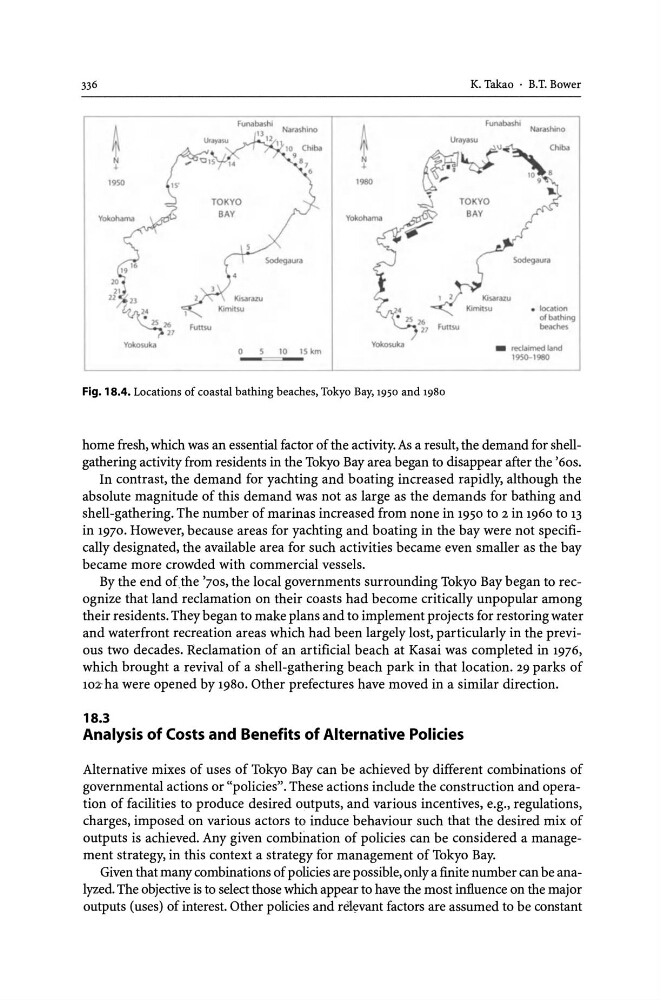
Fig. 18.4. Locations of coastal bathing beaches, Tokyo Bay, 1950 and 1980
home fresh, which was an essential factor of the activity. As a result, the demand for shellgathering activity from residents in the Tokyo Bay area began to disappear after the '60S.
In contrast, the demand for yachting and boating increased rapidly, although the
absolute magnitude of this demand was not as large as the demands for bathing and
shell-gathering. The number of marinas increased from none in 1950 to 2 in 1960 to 13
in 1970. However, because areas for yachting and boating in the bay were not specifically designated, the available area for such activities became even smaller as the bay
became more crowded with commercial vessels.
By the end of. the '70S, the local governments surrounding Tokyo Bay began to recognize that land reclamation on their coasts had become critically unpopular among
their residents. They began to make plans and to implement projects for restoring water
and waterfront recreation areas which had been largely lost, particularly in the previous two decades. Reclamation of an artificial beach at Kasai was completed in 1976,
which brought a revival of a shell-gathering beach park in that location. 29 parks of
102'ha were opened by 1980. Other prefectures have moved in a similar direction.
18.3
Analysis of Costs and Benefits of Alternative Policies
Alternative mixes of uses of Tokyo Bay can be achieved by different combinations of
governmental actions or "policies". These actions include the construction and operation of facilities to produce desired outputs, and various incentives, e.g., regulations,
charges, imposed on various actors to induce behaviour such that the desired mix of
outputs is achieved. Any given combination of policies can be considered a management strategy, in this context a strategy for management of Tokyo Bay.
Given that many combinations of policies are possible, only a finite number can be analyzed. The objective is to select those which appear to have the most influence on the major
outputs (uses) of interest. Other policies and rel~vant factors are assumed to be constant
1950
~'5 ,.
S' TOKYO
BAY
Kisalazu
Futuu
YokosuQ
o
10 'Skm
1980
Yokohama
YokosuQ
K. Takao . B.T. Bower
Funabashl
tft 7J ·"
d
TOKYO
BAY
Funsu
Narashlno
Chlba
• 1oca1ion
oIba,h"'9
b".d,.,
_ reclaimed land
1950-1980
Fig. 18.4. Locations of coastal bathing beaches, Tokyo Bay, 1950 and 1980
home fresh, which was an essential factor of the activity. As a result, the demand for shellgathering activity from residents in the Tokyo Bay area began to disappear after the '60S.
In contrast, the demand for yachting and boating increased rapidly, although the
absolute magnitude of this demand was not as large as the demands for bathing and
shell-gathering. The number of marinas increased from none in 1950 to 2 in 1960 to 13
in 1970. However, because areas for yachting and boating in the bay were not specifically designated, the available area for such activities became even smaller as the bay
became more crowded with commercial vessels.
By the end of. the '70S, the local governments surrounding Tokyo Bay began to recognize that land reclamation on their coasts had become critically unpopular among
their residents. They began to make plans and to implement projects for restoring water
and waterfront recreation areas which had been largely lost, particularly in the previous two decades. Reclamation of an artificial beach at Kasai was completed in 1976,
which brought a revival of a shell-gathering beach park in that location. 29 parks of
102'ha were opened by 1980. Other prefectures have moved in a similar direction.
18.3
Analysis of Costs and Benefits of Alternative Policies
Alternative mixes of uses of Tokyo Bay can be achieved by different combinations of
governmental actions or "policies". These actions include the construction and operation of facilities to produce desired outputs, and various incentives, e.g., regulations,
charges, imposed on various actors to induce behaviour such that the desired mix of
outputs is achieved. Any given combination of policies can be considered a management strategy, in this context a strategy for management of Tokyo Bay.
Given that many combinations of policies are possible, only a finite number can be analyzed. The objective is to select those which appear to have the most influence on the major
outputs (uses) of interest. Other policies and rel~vant factors are assumed to be constant