

CHAPTER 14 • Tourist Development in the Costa Brava (Girona, Spain)
259
15000
0--0 Total Catalonia (x 105)
~
. . - . L'Alt Emporda
::J
12000
A---.to. Baix Emporda
..c
III
_ _ Girones
Qj
III
::J
........--.r Pia de L'Estany
0
9000
..r:.
-
+----+ La Selva
0
"Qj
..c
6000
E
::J
Z
.!lOOO
0
<1900
1901-39
40's
50's
60's
70's
80's
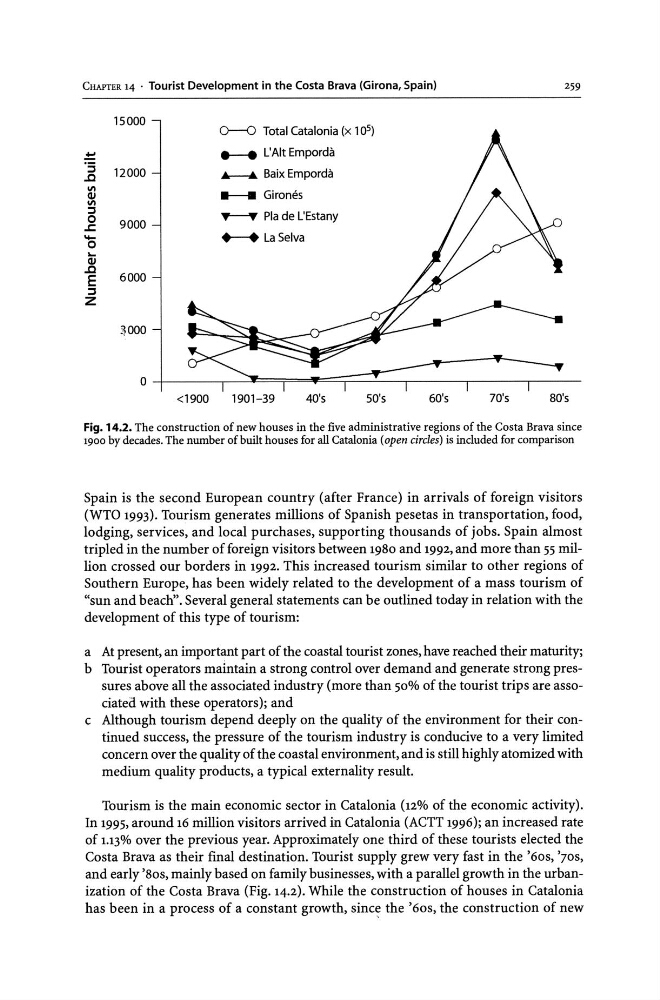
Fig. 14.2. The construction of new houses in the five administrative regions of the Costa Brava since
1900 by decades. The number of built houses for all Catalonia (open circles) is included for comparison
Spain is the second European country (after France) in arrivals of foreign visitors
(WTO 1993). Tourism generates millions of Spanish pesetas in transportation, food,
lodging, services, and local purchases, supporting thousands of jobs. Spain almost
tripled in the number of foreign visitors between 1980 and 1992, and more than 55 million crossed our borders in 1992. This increased tourism similar to other regions of
Southern Europe, has been widely related to the development of a mass tourism of
"sun and beach". Several general statements can be outlined today in relation with the
development of this type of tourism:
a At present, an important part of the coastal tourist zones, have reached their maturity;
b Tourist operators maintain a strong control over demand and generate strong pressures above all the associated industry (more than 50% of the tourist trips are associated with these operators); and
c Although tourism depend deeply on the quality of the environment for their continued success, the pressure of the tourism industry is conducive to a very limited
concern over the quality of the coastal environment, and is still highly atomized with
medium quality products, a typical externality result.
Tourism is the main economic sector in Catalonia (12% of the economic activity).
In 1995, around 16 million visitors arrived in Catalonia (ACTT 1996); an increased rate
of 1.13% over the previous year. Approximately one third of these tourists elected the
Costa Brava as their final destination. Tourist supply grew very fast in the '60S, '70S,
and early '80S, mainly based on family businesses, with a parallel growth in the urbanization of the Costa Brava (Fig. 14.2). While the construction of houses in Catalonia
has been in a process of a constant growth, sinc~ the '60S, the construction of new
259
15000
0--0 Total Catalonia (x 105)
~
. . - . L'Alt Emporda
::J
12000
A---.to. Baix Emporda
..c
III
_ _ Girones
Qj
III
::J
........--.r Pia de L'Estany
0
9000
..r:.
-
+----+ La Selva
0
"Qj
..c
6000
E
::J
Z
.!lOOO
0
<1900
1901-39
40's
50's
60's
70's
80's
Fig. 14.2. The construction of new houses in the five administrative regions of the Costa Brava since
1900 by decades. The number of built houses for all Catalonia (open circles) is included for comparison
Spain is the second European country (after France) in arrivals of foreign visitors
(WTO 1993). Tourism generates millions of Spanish pesetas in transportation, food,
lodging, services, and local purchases, supporting thousands of jobs. Spain almost
tripled in the number of foreign visitors between 1980 and 1992, and more than 55 million crossed our borders in 1992. This increased tourism similar to other regions of
Southern Europe, has been widely related to the development of a mass tourism of
"sun and beach". Several general statements can be outlined today in relation with the
development of this type of tourism:
a At present, an important part of the coastal tourist zones, have reached their maturity;
b Tourist operators maintain a strong control over demand and generate strong pressures above all the associated industry (more than 50% of the tourist trips are associated with these operators); and
c Although tourism depend deeply on the quality of the environment for their continued success, the pressure of the tourism industry is conducive to a very limited
concern over the quality of the coastal environment, and is still highly atomized with
medium quality products, a typical externality result.
Tourism is the main economic sector in Catalonia (12% of the economic activity).
In 1995, around 16 million visitors arrived in Catalonia (ACTT 1996); an increased rate
of 1.13% over the previous year. Approximately one third of these tourists elected the
Costa Brava as their final destination. Tourist supply grew very fast in the '60S, '70S,
and early '80S, mainly based on family businesses, with a parallel growth in the urbanization of the Costa Brava (Fig. 14.2). While the construction of houses in Catalonia
has been in a process of a constant growth, sinc~ the '60S, the construction of new