

260
R. Sarda . M. Fluvia
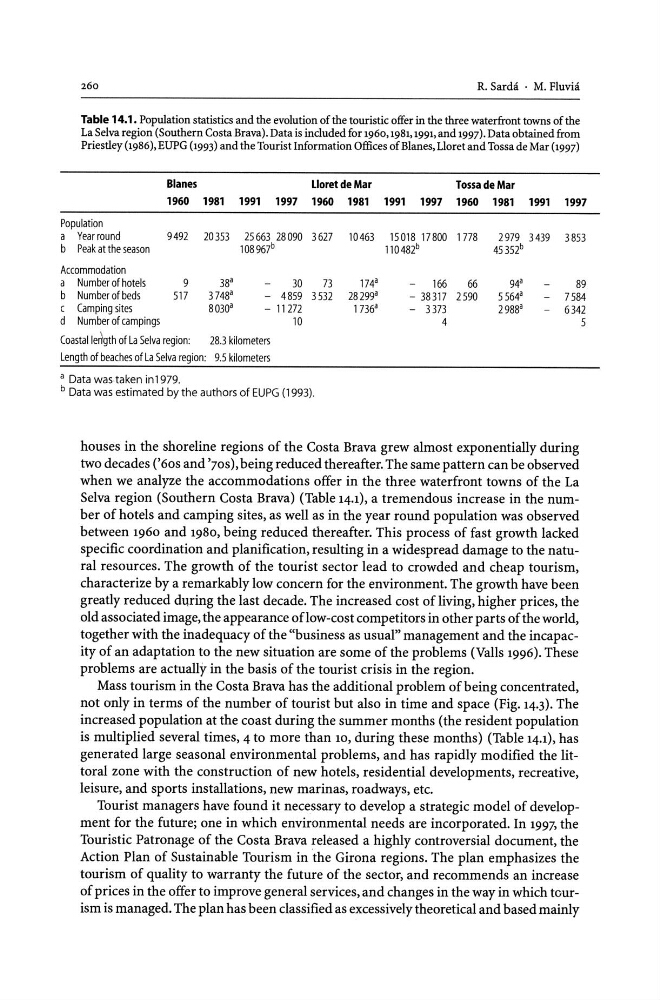
Table 14.1. Population statistics and the evolution of the touristic offer in the three waterfront towns of the
La Selva region (Southern Costa Brava). Data is included for 1960, 1981, 1991, and 1997). Data obtained from
Priestley (1986), EUPG (1993) and the Tourist Information Offices of Blanes, Lloret and Tossa de Mar (1997)
Blanes
Lloret de Mar
Tossade Mar
1960 1981 1991 1997 1960 1981 1991 1997 1960 1981 1991 1997
Population
a Year round
9492 20353 25663 28090 3627 10463 1501817800 1778
2979 3439 3853
b Peak at the season
108967 b
110 482 b
45352 b
Accommodation
a Number of hotels
9
38'
30
73
174'
166
66
94'
89
b Number of beds
517
3748'
- 4859 3532 28299'
- 38317 2590
5564'
7584
c Camping sites
8030'
- 11272
1736'
- 3373
2988'
6342
d Number of cam pings
10
4
5
Coastallerigth of La Selva region:
28.3 kilometers
Length of beaches ofLa Selva region: 9.5 kilometers
a Data was taken in1979.
b Data was estimated by the authors of EUPG (1993).
houses in the shoreline regions of the Costa Brava grew almost exponentially during
two decades (' 60S and '70S), being reduced thereafter. The same pattern can be observed
when we analyze the accommodations offer in the three waterfront towns of the La
Selva region (Southern Costa Brava) (Table 14.1), a tremendous increase in the number of hotels and camping sites, as well as in the year round population was observed
between 1960 and 1980, being reduced thereafter. This process of fast growth lacked
specific coordination and planification, resulting in a widespread damage to the natural resources. The growth of the tourist sector lead to crowded and cheap tourism,
characterize by a remarkably low concern for the environment. The growth have been
greatly reduced dllring the last decade. The increased cost of living, higher prices, the
old associated image, the appearance oflow-cost competitors in other parts of the world,
together with the inadequacy of the "business as usual" management and the incapacity of an adaptation to the new situation are some of the problems (Valls 1996). These
problems are actually in the basis of the tourist crisis in the region.
Mass tourism in the Costa Brava has the additional problem of being concentrated,
not only in terms of the number of tourist but also in time and space (Fig. 14.3). The
increased population at the coast during the summer months (the resident population
is multiplied several times, 4 to more than 10, during these months) (Table 14.1), has
generated large seasonal environmental problems, and has rapidly modified the littoral zone with the construction of new hotels, residential developments, recreative,
leisure, and sports installations, new marinas, roadways, etc.
Tourist managers have found it necessary to develop a strategic model of development for the future; one in which environmental needs are incorporated. In 1997, the
Touristic Patronage of the Costa Brava released a highly controversial document, the
Action Plan of Sustainable Tourism in the Girona regions. The plan emphasizes the
tourism of quality to warranty the future of the sector, and recommends an increase
of prices in the offer to improve general services, and changes in the way in which tourism is managed. The plan has been classified as excessively theoretical and based mainly
R. Sarda . M. Fluvia
Table 14.1. Population statistics and the evolution of the touristic offer in the three waterfront towns of the
La Selva region (Southern Costa Brava). Data is included for 1960, 1981, 1991, and 1997). Data obtained from
Priestley (1986), EUPG (1993) and the Tourist Information Offices of Blanes, Lloret and Tossa de Mar (1997)
Blanes
Lloret de Mar
Tossade Mar
1960 1981 1991 1997 1960 1981 1991 1997 1960 1981 1991 1997
Population
a Year round
9492 20353 25663 28090 3627 10463 1501817800 1778
2979 3439 3853
b Peak at the season
108967 b
110 482 b
45352 b
Accommodation
a Number of hotels
9
38'
30
73
174'
166
66
94'
89
b Number of beds
517
3748'
- 4859 3532 28299'
- 38317 2590
5564'
7584
c Camping sites
8030'
- 11272
1736'
- 3373
2988'
6342
d Number of cam pings
10
4
5
Coastallerigth of La Selva region:
28.3 kilometers
Length of beaches ofLa Selva region: 9.5 kilometers
a Data was taken in1979.
b Data was estimated by the authors of EUPG (1993).
houses in the shoreline regions of the Costa Brava grew almost exponentially during
two decades (' 60S and '70S), being reduced thereafter. The same pattern can be observed
when we analyze the accommodations offer in the three waterfront towns of the La
Selva region (Southern Costa Brava) (Table 14.1), a tremendous increase in the number of hotels and camping sites, as well as in the year round population was observed
between 1960 and 1980, being reduced thereafter. This process of fast growth lacked
specific coordination and planification, resulting in a widespread damage to the natural resources. The growth of the tourist sector lead to crowded and cheap tourism,
characterize by a remarkably low concern for the environment. The growth have been
greatly reduced dllring the last decade. The increased cost of living, higher prices, the
old associated image, the appearance oflow-cost competitors in other parts of the world,
together with the inadequacy of the "business as usual" management and the incapacity of an adaptation to the new situation are some of the problems (Valls 1996). These
problems are actually in the basis of the tourist crisis in the region.
Mass tourism in the Costa Brava has the additional problem of being concentrated,
not only in terms of the number of tourist but also in time and space (Fig. 14.3). The
increased population at the coast during the summer months (the resident population
is multiplied several times, 4 to more than 10, during these months) (Table 14.1), has
generated large seasonal environmental problems, and has rapidly modified the littoral zone with the construction of new hotels, residential developments, recreative,
leisure, and sports installations, new marinas, roadways, etc.
Tourist managers have found it necessary to develop a strategic model of development for the future; one in which environmental needs are incorporated. In 1997, the
Touristic Patronage of the Costa Brava released a highly controversial document, the
Action Plan of Sustainable Tourism in the Girona regions. The plan emphasizes the
tourism of quality to warranty the future of the sector, and recommends an increase
of prices in the offer to improve general services, and changes in the way in which tourism is managed. The plan has been classified as excessively theoretical and based mainly