

CHAPTER 12 • Integrated Coastal Zone Management (lCZM) in Indonesia
231
Table 12.4. Failure and success in communication: a suntnlary for ICZM in Indonesia with special
reference to the results of P-3 Oseanologi LIPI (A view from mangrove ecologist) (Note: Good communication need not imply that the parties are agreed as to the present situation or on priorities for
the future)
Level of understanding reached
Virtual incomprehension
(apathy or hostility likely)
Narrow comprehension
(misunderstandings likely)
Wide comprehension
(successful communication likely)
Possible reason
Widely different assumptions (unrecognised);
Unthinking rejection of alternative views;
Foreign or second language barrier;
Use of highly technical words, long words, abbreviations
without explanation;
Speaking for too long, too fast, too quietly;
"Waffling", mixing with irrelevant material;
Intentional "blinding" with "science";
Patronising and/or servile attitudes;
Not attending.
Scope of subject not introduced;
Easy dismissal of alternative explanations;
Not seeing the food for the species;
Not appreciating facts relevant to the situation;
Not being aware of limitations;
Inability to adapt ideas for other circumstances.
Using straight forward language;
Using practical examples;
Recognising limits on present knowledge;
Setting subject in its background;
Recognising mutual contribution;
Building on existing methods;
Talking in terms ofthe listener's interests.
resources survey and to link it with the coastal zone development. At government
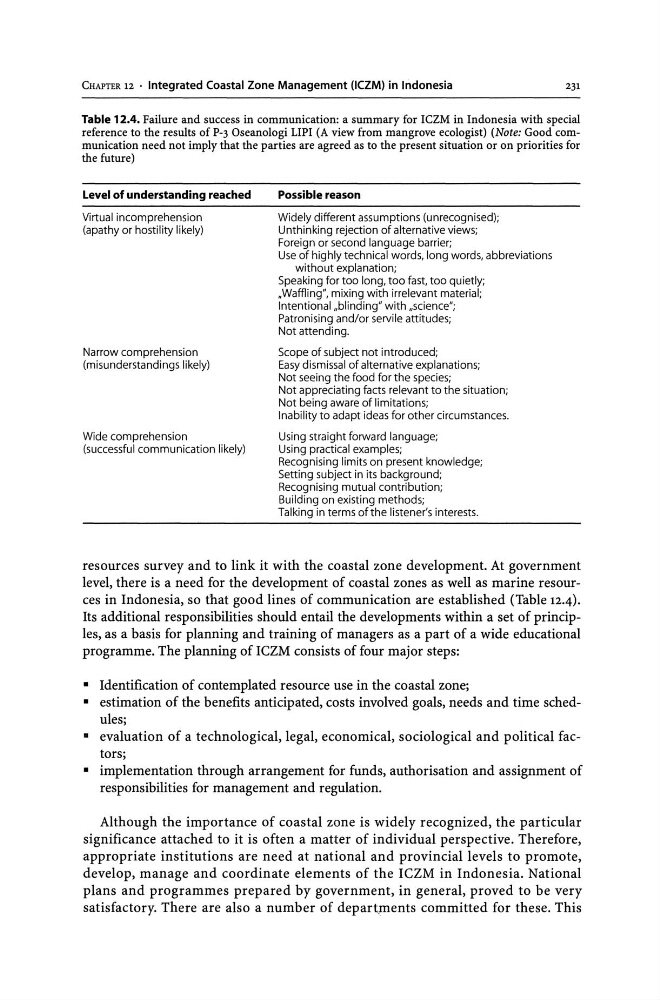
level, there is a need for the development of coastal zones as well as marine resources in Indonesia, so that good lines of communication are established (Table 12-4).
Its additional responsibilities should entail the developments within a set of principles, as a basis for planning and training of managers as a part of a wide educational
programme. The planning of ICZM consists of four major steps:
• Identification of contemplated resource use in the coastal zone;
• estimation of the benefits anticipated, costs involved goals, needs and time schedules;
• evaluation of a technological, legal, economical, sociological and political factors;
• implementation through arrangement for funds, authorisation and assignment of
responsibilities for management and regulation.
Although the importance of coastal zone is widely recognized, the particular
significance attached to it is often a matter of individual perspective. Therefore,
appropriate institutions are need at national and provincial levels to promote,
develop, manage and coordinate elements of the ICZM in Indonesia. National
plans and programmes prepared by government, in general, proved to be very
satisfactory. There are also a number of depart,ments committed for these. This
231
Table 12.4. Failure and success in communication: a suntnlary for ICZM in Indonesia with special
reference to the results of P-3 Oseanologi LIPI (A view from mangrove ecologist) (Note: Good communication need not imply that the parties are agreed as to the present situation or on priorities for
the future)
Level of understanding reached
Virtual incomprehension
(apathy or hostility likely)
Narrow comprehension
(misunderstandings likely)
Wide comprehension
(successful communication likely)
Possible reason
Widely different assumptions (unrecognised);
Unthinking rejection of alternative views;
Foreign or second language barrier;
Use of highly technical words, long words, abbreviations
without explanation;
Speaking for too long, too fast, too quietly;
"Waffling", mixing with irrelevant material;
Intentional "blinding" with "science";
Patronising and/or servile attitudes;
Not attending.
Scope of subject not introduced;
Easy dismissal of alternative explanations;
Not seeing the food for the species;
Not appreciating facts relevant to the situation;
Not being aware of limitations;
Inability to adapt ideas for other circumstances.
Using straight forward language;
Using practical examples;
Recognising limits on present knowledge;
Setting subject in its background;
Recognising mutual contribution;
Building on existing methods;
Talking in terms ofthe listener's interests.
resources survey and to link it with the coastal zone development. At government
level, there is a need for the development of coastal zones as well as marine resources in Indonesia, so that good lines of communication are established (Table 12-4).
Its additional responsibilities should entail the developments within a set of principles, as a basis for planning and training of managers as a part of a wide educational
programme. The planning of ICZM consists of four major steps:
• Identification of contemplated resource use in the coastal zone;
• estimation of the benefits anticipated, costs involved goals, needs and time schedules;
• evaluation of a technological, legal, economical, sociological and political factors;
• implementation through arrangement for funds, authorisation and assignment of
responsibilities for management and regulation.
Although the importance of coastal zone is widely recognized, the particular
significance attached to it is often a matter of individual perspective. Therefore,
appropriate institutions are need at national and provincial levels to promote,
develop, manage and coordinate elements of the ICZM in Indonesia. National
plans and programmes prepared by government, in general, proved to be very
satisfactory. There are also a number of depart,ments committed for these. This