

treatment to reduce marram to a density of 1 % cover or less. The leaves browned
and died following the initial application of herbicide, during the winter of 1999.
However, regrowth occurred from surviving rhizome during November and
December 1999, particularly along the stoss face of the foredune. The rate of sand
loss from the stoss face of the foredune has increased since 2004, with concomitant
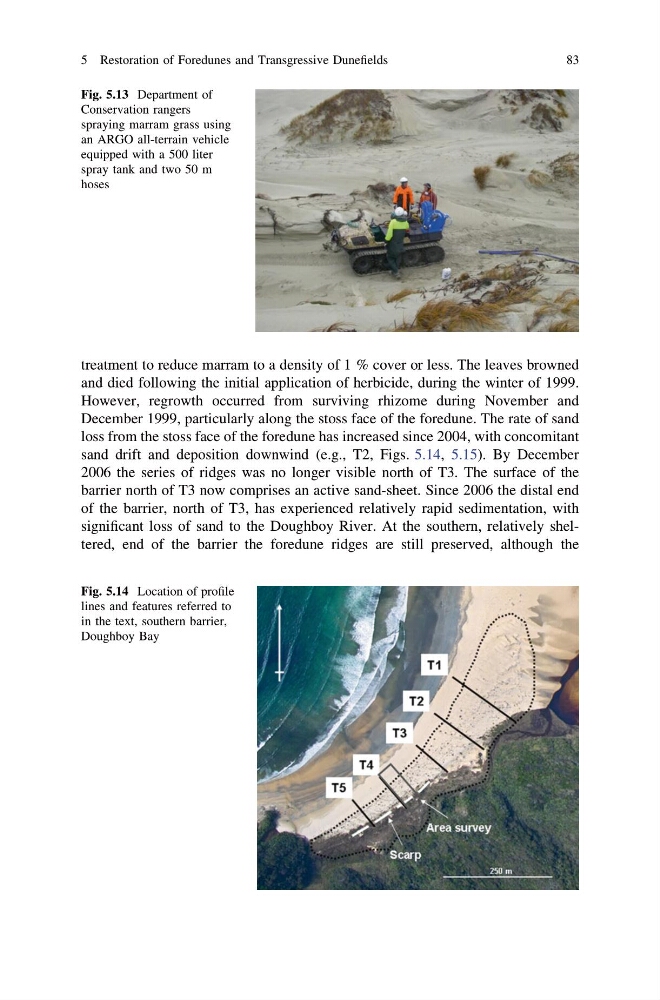
sand drift and deposition downwind (e.g., T2, Figs. 5.14, 5.15). By December
2006 the series of ridges was no longer visible north of T3. The surface of the
barrier north of T3 now comprises an active sand-sheet. Since 2006 the distal end
of the barrier, north of T3, has experienced relatively rapid sedimentation, with
significant loss of sand to the Doughboy River. At the southern, relatively sheltered, end of the barrier the foredune ridges are still preserved, although the
Fig. 5.13 Department of
Conservation rangers
spraying marram grass using
an ARGO all-terrain vehicle
equipped with a 500 liter
spray tank and two 50 m
hoses
Fig. 5.14 Location of profile
lines and features referred to
in the text, southern barrier,
Doughboy Bay
5 Restoration of Foredunes and Transgressive Dunefields
83
and died following the initial application of herbicide, during the winter of 1999.
However, regrowth occurred from surviving rhizome during November and
December 1999, particularly along the stoss face of the foredune. The rate of sand
loss from the stoss face of the foredune has increased since 2004, with concomitant
sand drift and deposition downwind (e.g., T2, Figs. 5.14, 5.15). By December
2006 the series of ridges was no longer visible north of T3. The surface of the
barrier north of T3 now comprises an active sand-sheet. Since 2006 the distal end
of the barrier, north of T3, has experienced relatively rapid sedimentation, with
significant loss of sand to the Doughboy River. At the southern, relatively sheltered, end of the barrier the foredune ridges are still preserved, although the
Fig. 5.13 Department of
Conservation rangers
spraying marram grass using
an ARGO all-terrain vehicle
equipped with a 500 liter
spray tank and two 50 m
hoses
Fig. 5.14 Location of profile
lines and features referred to
in the text, southern barrier,
Doughboy Bay
5 Restoration of Foredunes and Transgressive Dunefields
83