

period 2004–2010. This process is ongoing owing to the persistence of the marram
seed bank (Konlechner and Hilton 2010).
There is no evidence that elements of the herbicide remain in the sand following
prolonged use, consistent with the manufacturer’s advice, which is that Gallant
breaks down rapidly after application. This issue has not been evaluated; however,
we have noticed vigorous recruitment of native plant seedlings in areas where
marram has received aerial spraying for 3 years. It is likely that any residual
chemical would be rapidly washed through the sand because of the high rainfall
and high permeability of the sandy soils.
Observations of marram decay were made over 4 years (1999–2004) in a series
of 14 permanent 2 9 1-m quadrats spaced across the southern barrier (see
Woodley and Hilton 2003; Hilton et al. 2009). Five stages of decay were apparent.
Permanent transects were established across the barrier to determine gross changes
in barrier morphology (Fig. 5.14). Profiles were surveyed annually, from 1998
(prior to the operation) to 2007 using a dumpy level or a total station. The
topography and vegetation cover of one area (approximately 40 9 140 m) was
surveyed annually using a total station from 2002 to 2007. Digital terrain models
were derived using a total station and topography and vegetation cover within the
area was mapped and the data presented using SURFER
TM . The shelter afforded
by different stages of Marram decay was also observed using an anemometer array
and is reported elsewhere (Woodley and Hilton 2003).
5.4.3 Barrier and Dune Development Following Marram
Eradication
The morphology of the southern barrier changed slowly following the aerial
application of herbicide in February 1999. Substantial sedimentation did not
commence until the winter of 2006 and then only north of Transect 4 (henceforth
‘‘T4’’). This slow response of the barrier to de-vegetation was due to the slow rate
of decay of in situ marram rhizome. In addition, it took 3 years of herbicide
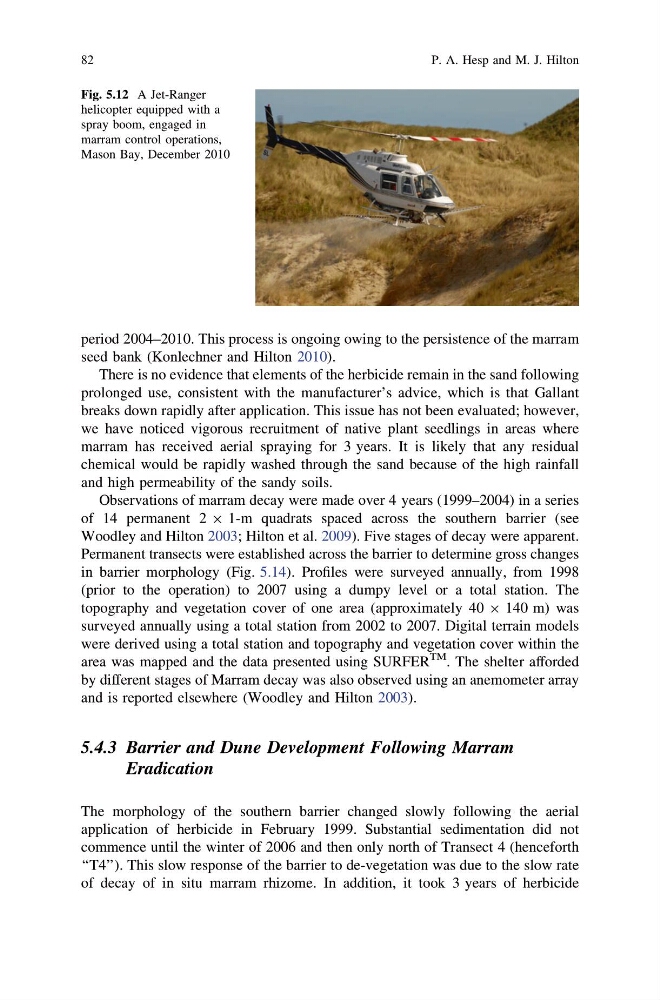
Fig. 5.12 A Jet-Ranger
helicopter equipped with a
spray boom, engaged in
marram control operations,
Mason Bay, December 2010
82
P. A. Hesp and M. J. Hilton
seed bank (Konlechner and Hilton 2010).
There is no evidence that elements of the herbicide remain in the sand following
prolonged use, consistent with the manufacturer’s advice, which is that Gallant
breaks down rapidly after application. This issue has not been evaluated; however,
we have noticed vigorous recruitment of native plant seedlings in areas where
marram has received aerial spraying for 3 years. It is likely that any residual
chemical would be rapidly washed through the sand because of the high rainfall
and high permeability of the sandy soils.
Observations of marram decay were made over 4 years (1999–2004) in a series
of 14 permanent 2 9 1-m quadrats spaced across the southern barrier (see
Woodley and Hilton 2003; Hilton et al. 2009). Five stages of decay were apparent.
Permanent transects were established across the barrier to determine gross changes
in barrier morphology (Fig. 5.14). Profiles were surveyed annually, from 1998
(prior to the operation) to 2007 using a dumpy level or a total station. The
topography and vegetation cover of one area (approximately 40 9 140 m) was
surveyed annually using a total station from 2002 to 2007. Digital terrain models
were derived using a total station and topography and vegetation cover within the
area was mapped and the data presented using SURFER
TM . The shelter afforded
by different stages of Marram decay was also observed using an anemometer array
and is reported elsewhere (Woodley and Hilton 2003).
5.4.3 Barrier and Dune Development Following Marram
Eradication
The morphology of the southern barrier changed slowly following the aerial
application of herbicide in February 1999. Substantial sedimentation did not
commence until the winter of 2006 and then only north of Transect 4 (henceforth
‘‘T4’’). This slow response of the barrier to de-vegetation was due to the slow rate
of decay of in situ marram rhizome. In addition, it took 3 years of herbicide
Fig. 5.12 A Jet-Ranger
helicopter equipped with a
spray boom, engaged in
marram control operations,
Mason Bay, December 2010
82
P. A. Hesp and M. J. Hilton