

The above-mentioned ecosystem services have not been studied in as much
detail as is needed. For instance, the literature on ecosystem services (ISI Web of
Science January 2012) displayed 3,070 publications that mention ecosystem
services in the title, abstract, or key words. Of these, 271 focus on the coast, and
this includes the beach, coastal dunes, and any other coastal ecosystem such as
wetlands, marshes and mangrove forests. Less than 30 studies referred to ecosystem services of coastal dunes and the beach.
We located a total of only 18 studies where ecosystem services from the beach
and coastal dunes have been analyzed and their economic value has been
calculated (Table 18.2). Most of them (11; 55 %) focus on the beach; 6 (30 %)
deal exclusively with coastal dunes and only 2 (10 %) with the beach and coastal
dunes as an integrated system. We found only one study (5 %) that took place in
wet slacks. In this set of studies, the ecosystem services that have been studied on
the beach and coastal dunes are: aesthetic/recreational/cultural (cultural); disturbance/prevention/protection (regulatory), and carbon sequestration (supporting;
Table 18.2). To our knowledge, no ecosystem services that deal with provisioning
have been studied, so far, for the beach and coastal dunes, probably because here,
some ecosystem services (aesthetic, protection) are more heavily exploited (and
apparently considered more relevant) than others (pollination, water cycle, nutrient
cycle, and others mentioned in Table 18.1). However, the above does not mean
that these are the only ecosystem services of coastal ecosystems, but that a handful
of them are of greater interest to humans than the others. In addition, it is interesting to note that it is necessary to consider if losing these ecosystem services
after land use change (urbanization, for example, instead of tourism) is compensated for by the value gain. Such a valuation is currently being performed.
The economic values of ecosystem services that we found in the literature were
estimated in different years, in different countries, and with a variety of methodologies. This heterogeneity in how economic values were assessed made it necessary to standardize them in order to be able to compare studies. Thus, the
economic values estimated for ecosystem services from different ecosystems were
adjusted to US$ currency using the consumer price index (CPI) and the purchasing
power parity (PPP) for 2010, obtained from US government statistics (US
Department of Labor). We thus adjusted the original values estimated in the 18
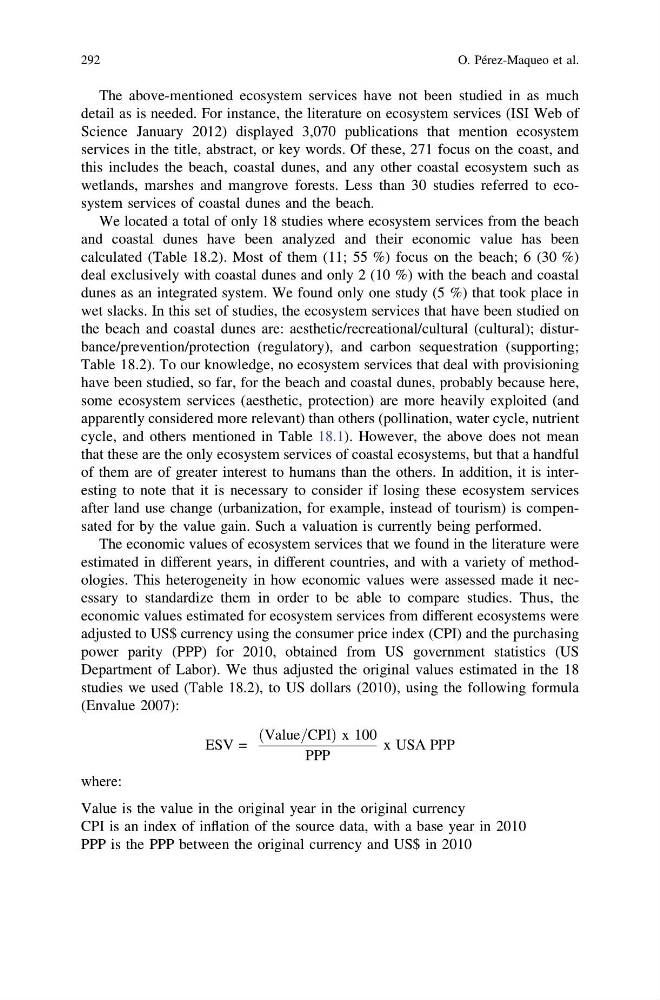
studies we used (Table 18.2), to US dollars (2010), using the following formula
(Envalue 2007):
ESV =
Value=CPI
ð
Þx 100
PPP
x USA PPP
where:
Value is the value in the original year in the original currency
CPI is an index of inflation of the source data, with a base year in 2010
PPP is the PPP between the original currency and US$ in 2010
292
O. Pérez-Maqueo et al.
detail as is needed. For instance, the literature on ecosystem services (ISI Web of
Science January 2012) displayed 3,070 publications that mention ecosystem
services in the title, abstract, or key words. Of these, 271 focus on the coast, and
this includes the beach, coastal dunes, and any other coastal ecosystem such as
wetlands, marshes and mangrove forests. Less than 30 studies referred to ecosystem services of coastal dunes and the beach.
We located a total of only 18 studies where ecosystem services from the beach
and coastal dunes have been analyzed and their economic value has been
calculated (Table 18.2). Most of them (11; 55 %) focus on the beach; 6 (30 %)
deal exclusively with coastal dunes and only 2 (10 %) with the beach and coastal
dunes as an integrated system. We found only one study (5 %) that took place in
wet slacks. In this set of studies, the ecosystem services that have been studied on
the beach and coastal dunes are: aesthetic/recreational/cultural (cultural); disturbance/prevention/protection (regulatory), and carbon sequestration (supporting;
Table 18.2). To our knowledge, no ecosystem services that deal with provisioning
have been studied, so far, for the beach and coastal dunes, probably because here,
some ecosystem services (aesthetic, protection) are more heavily exploited (and
apparently considered more relevant) than others (pollination, water cycle, nutrient
cycle, and others mentioned in Table 18.1). However, the above does not mean
that these are the only ecosystem services of coastal ecosystems, but that a handful
of them are of greater interest to humans than the others. In addition, it is interesting to note that it is necessary to consider if losing these ecosystem services
after land use change (urbanization, for example, instead of tourism) is compensated for by the value gain. Such a valuation is currently being performed.
The economic values of ecosystem services that we found in the literature were
estimated in different years, in different countries, and with a variety of methodologies. This heterogeneity in how economic values were assessed made it necessary to standardize them in order to be able to compare studies. Thus, the
economic values estimated for ecosystem services from different ecosystems were
adjusted to US$ currency using the consumer price index (CPI) and the purchasing
power parity (PPP) for 2010, obtained from US government statistics (US
Department of Labor). We thus adjusted the original values estimated in the 18
studies we used (Table 18.2), to US dollars (2010), using the following formula
(Envalue 2007):
ESV =
Value=CPI
ð
Þx 100
PPP
x USA PPP
where:
Value is the value in the original year in the original currency
CPI is an index of inflation of the source data, with a base year in 2010
PPP is the PPP between the original currency and US$ in 2010
292
O. Pérez-Maqueo et al.