

Zealand (Hesp and Hilton, Chap. 5, this volume); Italy (Acosta et al., Chap. 12,
this volume); USA (Pickart, Chap. 10, this volume; Feagin, Chap. 6, this volume);
Netherlands (Arens et al., Chap. 7, this volume; Grootjans et al., Chap. 15, this
volume); Denmark (Vestergaard, Chap. 4, this volume), and Spain (MuñozReinoso et al., Chap. 9, this volume). We also gathered additional information in
order to have a larger set of data with which we could analyze the costs of coastal
dune restoration. Finally, we carried out an analysis of the conservation benefits in
terms of ecosystem services, versus the costs of restoring beaches and coastal
dunes, to determine the best management option for our sandy coasts.
18.2 Ecosystem Services
Natural ecosystems provide a variety of direct and indirect services and intangible
benefits to humans and other living organisms (Costanza et al. 1997), and because
of their relevance to society, these ecosystem services, goods and their economic
value have become a focus of interest for scientists, policy makers, and stakeholders over the last decade (Troy and Wilson 2006). The provision of ecosystem
services is directly related to the functionality of natural ecosystems upon which
ecological processes and ecosystem structures depend (de Groot et al. 2002). Thus,
the better preserved natural ecosystems are, the more ecosystem services they can
provide to society (Balvanera et al. 2001).
To gather information on the ecosystem services provided by the beach and
coastal dunes, we performed a literature search including the databases environmental valuation reference inventory (EVRI), Envalue, and ecosystem services
database (ESD) (McComb et al. 2006) and applicable gray literature (government
statistics and graduate theses) (Shuang 2007; Mendoza-González 2009; LithgowSerrano 2007). Based on these databases and the published literature we determined specific ecosystem services from the beach and coastal dunes. Using the
Millennium Ecosystem Assessment ecosystem services classification (supporting,
provisioning, regulatory, and cultural) the ecosystem services provided by the
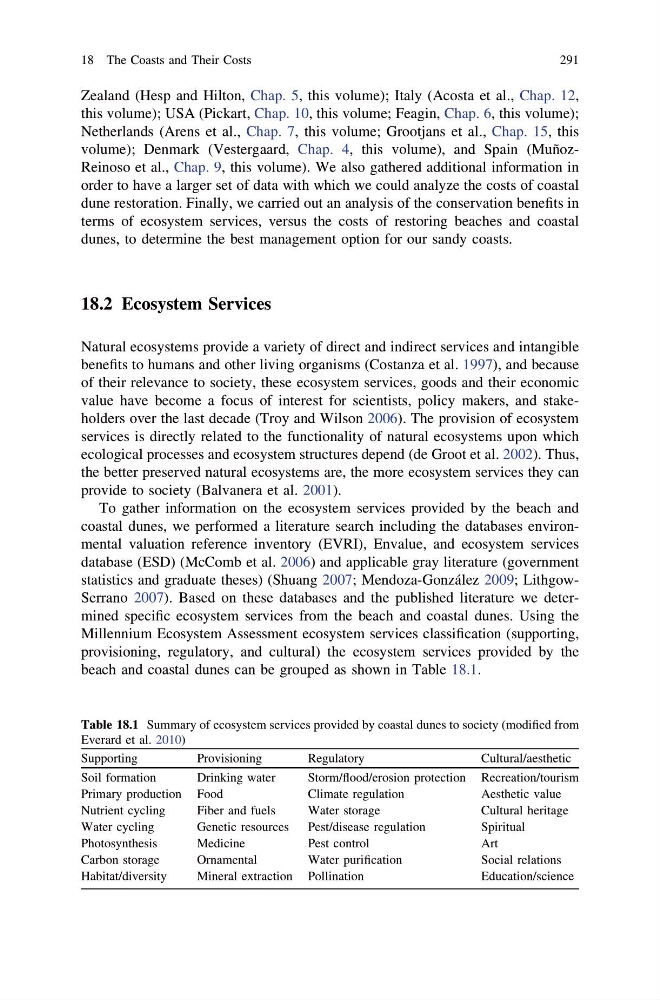
beach and coastal dunes can be grouped as shown in Table 18.1.
Table 18.1 Summary of ecosystem services provided by coastal dunes to society (modified from
Everard et al. 2010)
Supporting
Provisioning
Regulatory
Cultural/aesthetic
Soil formation
Drinking water
Storm/flood/erosion protection Recreation/tourism
Primary production Food
Climate regulation
Aesthetic value
Nutrient cycling
Fiber and fuels
Water storage
Cultural heritage
Water cycling
Genetic resources Pest/disease regulation
Spiritual
Photosynthesis
Medicine
Pest control
Art
Carbon storage
Ornamental
Water purification
Social relations
Habitat/diversity
Mineral extraction Pollination
Education/science
18 The Coasts and Their Costs
291
this volume); USA (Pickart, Chap. 10, this volume; Feagin, Chap. 6, this volume);
Netherlands (Arens et al., Chap. 7, this volume; Grootjans et al., Chap. 15, this
volume); Denmark (Vestergaard, Chap. 4, this volume), and Spain (MuñozReinoso et al., Chap. 9, this volume). We also gathered additional information in
order to have a larger set of data with which we could analyze the costs of coastal
dune restoration. Finally, we carried out an analysis of the conservation benefits in
terms of ecosystem services, versus the costs of restoring beaches and coastal
dunes, to determine the best management option for our sandy coasts.
18.2 Ecosystem Services
Natural ecosystems provide a variety of direct and indirect services and intangible
benefits to humans and other living organisms (Costanza et al. 1997), and because
of their relevance to society, these ecosystem services, goods and their economic
value have become a focus of interest for scientists, policy makers, and stakeholders over the last decade (Troy and Wilson 2006). The provision of ecosystem
services is directly related to the functionality of natural ecosystems upon which
ecological processes and ecosystem structures depend (de Groot et al. 2002). Thus,
the better preserved natural ecosystems are, the more ecosystem services they can
provide to society (Balvanera et al. 2001).
To gather information on the ecosystem services provided by the beach and
coastal dunes, we performed a literature search including the databases environmental valuation reference inventory (EVRI), Envalue, and ecosystem services
database (ESD) (McComb et al. 2006) and applicable gray literature (government
statistics and graduate theses) (Shuang 2007; Mendoza-González 2009; LithgowSerrano 2007). Based on these databases and the published literature we determined specific ecosystem services from the beach and coastal dunes. Using the
Millennium Ecosystem Assessment ecosystem services classification (supporting,
provisioning, regulatory, and cultural) the ecosystem services provided by the
beach and coastal dunes can be grouped as shown in Table 18.1.
Table 18.1 Summary of ecosystem services provided by coastal dunes to society (modified from
Everard et al. 2010)
Supporting
Provisioning
Regulatory
Cultural/aesthetic
Soil formation
Drinking water
Storm/flood/erosion protection Recreation/tourism
Primary production Food
Climate regulation
Aesthetic value
Nutrient cycling
Fiber and fuels
Water storage
Cultural heritage
Water cycling
Genetic resources Pest/disease regulation
Spiritual
Photosynthesis
Medicine
Pest control
Art
Carbon storage
Ornamental
Water purification
Social relations
Habitat/diversity
Mineral extraction Pollination
Education/science
18 The Coasts and Their Costs
291