

women in our survey were willing to pay $2.84 more than men. Because the
percentage of women in our survey was lower than the percentage of women in the
general Israeli population, we recalculated the total WTP in question 2 based on
the product of this additional WTP for women and the actual percentage of women
in the population. This adjustment resulted in a slightly higher WTP value for
question 2 than in the original results.
17.4.2 The Mean Willingness to Pay
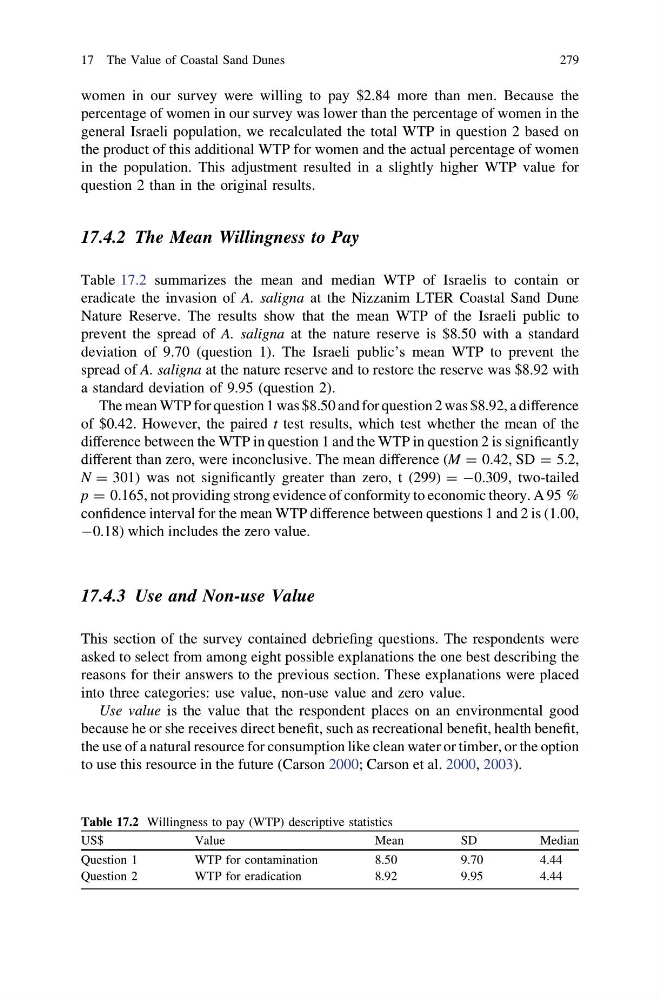
Table 17.2 summarizes the mean and median WTP of Israelis to contain or
eradicate the invasion of A. saligna at the Nizzanim LTER Coastal Sand Dune
Nature Reserve. The results show that the mean WTP of the Israeli public to
prevent the spread of A. saligna at the nature reserve is $8.50 with a standard
deviation of 9.70 (question 1). The Israeli public’s mean WTP to prevent the
spread of A. saligna at the nature reserve and to restore the reserve was $8.92 with
a standard deviation of 9.95 (question 2).
The mean WTP for question 1 was $8.50 and for question 2 was $8.92, a difference
of $0.42. However, the paired t test results, which test whether the mean of the
difference between the WTP in question 1 and the WTP in question 2 is significantly
different than zero, were inconclusive. The mean difference (M = 0.42, SD = 5.2,
N = 301) was not significantly greater than zero, t (299) = -0.309, two-tailed
p = 0.165, not providing strong evidence of conformity to economic theory. A 95 %
confidence interval for the mean WTP difference between questions 1 and 2 is (1.00,
-0.18) which includes the zero value.
17.4.3 Use and Non-use Value
This section of the survey contained debriefing questions. The respondents were
asked to select from among eight possible explanations the one best describing the
reasons for their answers to the previous section. These explanations were placed
into three categories: use value, non-use value and zero value.
Use value is the value that the respondent places on an environmental good
because he or she receives direct benefit, such as recreational benefit, health benefit,
the use of a natural resource for consumption like clean water or timber, or the option
to use this resource in the future (Carson 2000; Carson et al. 2000, 2003).
Table 17.2 Willingness to pay (WTP) descriptive statistics
US$
Value
Mean
SD
Median
Question 1
WTP for contamination
8.50
9.70
4.44
Question 2
WTP for eradication
8.92
9.95
4.44
17 The Value of Coastal Sand Dunes
279
percentage of women in our survey was lower than the percentage of women in the
general Israeli population, we recalculated the total WTP in question 2 based on
the product of this additional WTP for women and the actual percentage of women
in the population. This adjustment resulted in a slightly higher WTP value for
question 2 than in the original results.
17.4.2 The Mean Willingness to Pay
Table 17.2 summarizes the mean and median WTP of Israelis to contain or
eradicate the invasion of A. saligna at the Nizzanim LTER Coastal Sand Dune
Nature Reserve. The results show that the mean WTP of the Israeli public to
prevent the spread of A. saligna at the nature reserve is $8.50 with a standard
deviation of 9.70 (question 1). The Israeli public’s mean WTP to prevent the
spread of A. saligna at the nature reserve and to restore the reserve was $8.92 with
a standard deviation of 9.95 (question 2).
The mean WTP for question 1 was $8.50 and for question 2 was $8.92, a difference
of $0.42. However, the paired t test results, which test whether the mean of the
difference between the WTP in question 1 and the WTP in question 2 is significantly
different than zero, were inconclusive. The mean difference (M = 0.42, SD = 5.2,
N = 301) was not significantly greater than zero, t (299) = -0.309, two-tailed
p = 0.165, not providing strong evidence of conformity to economic theory. A 95 %
confidence interval for the mean WTP difference between questions 1 and 2 is (1.00,
-0.18) which includes the zero value.
17.4.3 Use and Non-use Value
This section of the survey contained debriefing questions. The respondents were
asked to select from among eight possible explanations the one best describing the
reasons for their answers to the previous section. These explanations were placed
into three categories: use value, non-use value and zero value.
Use value is the value that the respondent places on an environmental good
because he or she receives direct benefit, such as recreational benefit, health benefit,
the use of a natural resource for consumption like clean water or timber, or the option
to use this resource in the future (Carson 2000; Carson et al. 2000, 2003).
Table 17.2 Willingness to pay (WTP) descriptive statistics
US$
Value
Mean
SD
Median
Question 1
WTP for contamination
8.50
9.70
4.44
Question 2
WTP for eradication
8.92
9.95
4.44
17 The Value of Coastal Sand Dunes
279