

Non-use value is the value that the respondent places on an environmental good,
even though he or she receives no direct benefit. Non-use values include bequest
value for future generations, as well as the satisfaction of knowing that a resource
is there, called existence value (Carson 2000; Carson et al. 2000, 2003).
Zero-value is the value a respondent places on an environmental good when he
or she does not feel that it is their job to pay for the environmental good, or when
he or she sees no value in preserving or protecting the environmental good.
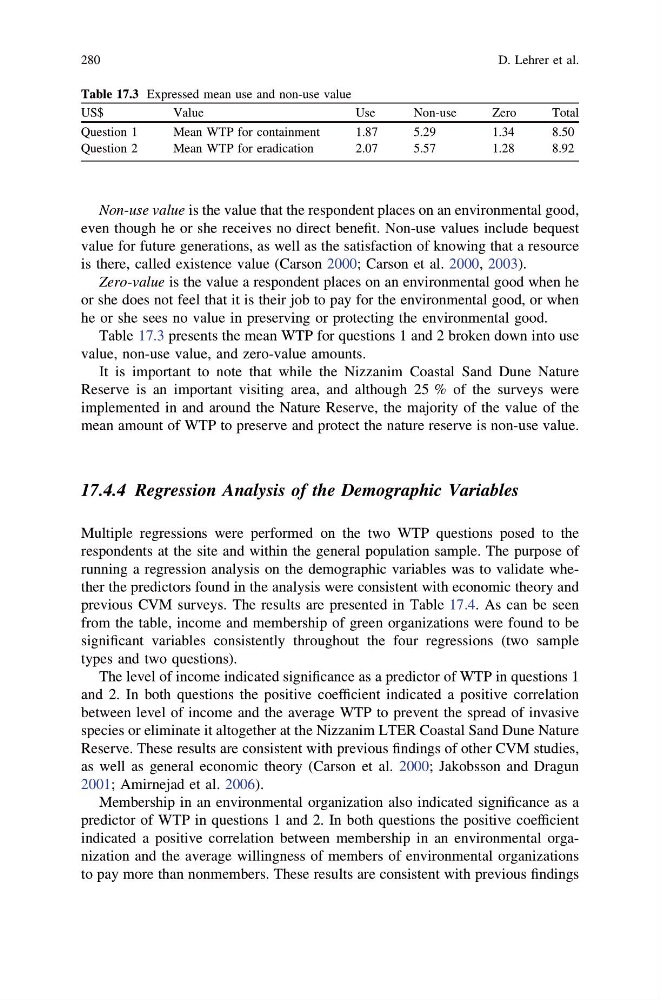
Table 17.3 presents the mean WTP for questions 1 and 2 broken down into use
value, non-use value, and zero-value amounts.
It is important to note that while the Nizzanim Coastal Sand Dune Nature
Reserve is an important visiting area, and although 25 % of the surveys were
implemented in and around the Nature Reserve, the majority of the value of the
mean amount of WTP to preserve and protect the nature reserve is non-use value.
17.4.4 Regression Analysis of the Demographic Variables
Multiple regressions were performed on the two WTP questions posed to the
respondents at the site and within the general population sample. The purpose of
running a regression analysis on the demographic variables was to validate whether the predictors found in the analysis were consistent with economic theory and
previous CVM surveys. The results are presented in Table 17.4. As can be seen
from the table, income and membership of green organizations were found to be
significant variables consistently throughout the four regressions (two sample
types and two questions).
The level of income indicated significance as a predictor of WTP in questions 1
and 2. In both questions the positive coefficient indicated a positive correlation
between level of income and the average WTP to prevent the spread of invasive
species or eliminate it altogether at the Nizzanim LTER Coastal Sand Dune Nature
Reserve. These results are consistent with previous findings of other CVM studies,
as well as general economic theory (Carson et al. 2000; Jakobsson and Dragun
2001; Amirnejad et al. 2006).
Membership in an environmental organization also indicated significance as a
predictor of WTP in questions 1 and 2. In both questions the positive coefficient
indicated a positive correlation between membership in an environmental organization and the average willingness of members of environmental organizations
to pay more than nonmembers. These results are consistent with previous findings
Table 17.3 Expressed mean use and non-use value
US$
Value
Use
Non-use
Zero
Total
Question 1
Mean WTP for containment
1.87
5.29
1.34
8.50
Question 2
Mean WTP for eradication
2.07
5.57
1.28
8.92
280
D. Lehrer et al.
even though he or she receives no direct benefit. Non-use values include bequest
value for future generations, as well as the satisfaction of knowing that a resource
is there, called existence value (Carson 2000; Carson et al. 2000, 2003).
Zero-value is the value a respondent places on an environmental good when he
or she does not feel that it is their job to pay for the environmental good, or when
he or she sees no value in preserving or protecting the environmental good.
Table 17.3 presents the mean WTP for questions 1 and 2 broken down into use
value, non-use value, and zero-value amounts.
It is important to note that while the Nizzanim Coastal Sand Dune Nature
Reserve is an important visiting area, and although 25 % of the surveys were
implemented in and around the Nature Reserve, the majority of the value of the
mean amount of WTP to preserve and protect the nature reserve is non-use value.
17.4.4 Regression Analysis of the Demographic Variables
Multiple regressions were performed on the two WTP questions posed to the
respondents at the site and within the general population sample. The purpose of
running a regression analysis on the demographic variables was to validate whether the predictors found in the analysis were consistent with economic theory and
previous CVM surveys. The results are presented in Table 17.4. As can be seen
from the table, income and membership of green organizations were found to be
significant variables consistently throughout the four regressions (two sample
types and two questions).
The level of income indicated significance as a predictor of WTP in questions 1
and 2. In both questions the positive coefficient indicated a positive correlation
between level of income and the average WTP to prevent the spread of invasive
species or eliminate it altogether at the Nizzanim LTER Coastal Sand Dune Nature
Reserve. These results are consistent with previous findings of other CVM studies,
as well as general economic theory (Carson et al. 2000; Jakobsson and Dragun
2001; Amirnejad et al. 2006).
Membership in an environmental organization also indicated significance as a
predictor of WTP in questions 1 and 2. In both questions the positive coefficient
indicated a positive correlation between membership in an environmental organization and the average willingness of members of environmental organizations
to pay more than nonmembers. These results are consistent with previous findings
Table 17.3 Expressed mean use and non-use value
US$
Value
Use
Non-use
Zero
Total
Question 1
Mean WTP for containment
1.87
5.29
1.34
8.50
Question 2
Mean WTP for eradication
2.07
5.57
1.28
8.92
280
D. Lehrer et al.