

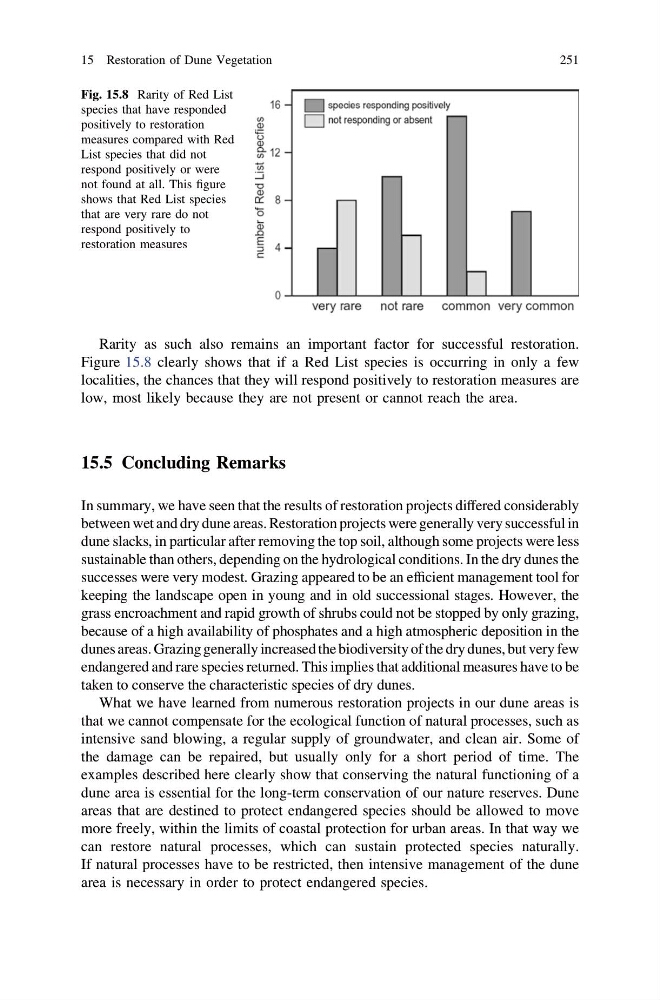
Rarity as such also remains an important factor for successful restoration.
Figure 15.8 clearly shows that if a Red List species is occurring in only a few
localities, the chances that they will respond positively to restoration measures are
low, most likely because they are not present or cannot reach the area.
15.5 Concluding Remarks
In summary, we have seen that the results of restoration projects differed considerably
between wet and dry dune areas. Restoration projects were generally very successful in
dune slacks, in particular after removing the top soil, although some projects were less
sustainable than others, depending on the hydrological conditions. In the dry dunes the
successes were very modest. Grazing appeared to be an efficient management tool for
keeping the landscape open in young and in old successional stages. However, the
grass encroachment and rapid growth of shrubs could not be stopped by only grazing,
because of a high availability of phosphates and a high atmospheric deposition in the
dunes areas. Grazing generally increased the biodiversity of the dry dunes, but very few
endangered and rare species returned. This implies that additional measures have to be
taken to conserve the characteristic species of dry dunes.
What we have learned from numerous restoration projects in our dune areas is
that we cannot compensate for the ecological function of natural processes, such as
intensive sand blowing, a regular supply of groundwater, and clean air. Some of
the damage can be repaired, but usually only for a short period of time. The
examples described here clearly show that conserving the natural functioning of a
dune area is essential for the long-term conservation of our nature reserves. Dune
areas that are destined to protect endangered species should be allowed to move
more freely, within the limits of coastal protection for urban areas. In that way we
can restore natural processes, which can sustain protected species naturally.
If natural processes have to be restricted, then intensive management of the dune
area is necessary in order to protect endangered species.
Fig. 15.8 Rarity of Red List
species that have responded
positively to restoration
measures compared with Red
List species that did not
respond positively or were
not found at all. This figure
shows that Red List species
that are very rare do not
respond positively to
restoration measures
15 Restoration of Dune Vegetation
251
Figure 15.8 clearly shows that if a Red List species is occurring in only a few
localities, the chances that they will respond positively to restoration measures are
low, most likely because they are not present or cannot reach the area.
15.5 Concluding Remarks
In summary, we have seen that the results of restoration projects differed considerably
between wet and dry dune areas. Restoration projects were generally very successful in
dune slacks, in particular after removing the top soil, although some projects were less
sustainable than others, depending on the hydrological conditions. In the dry dunes the
successes were very modest. Grazing appeared to be an efficient management tool for
keeping the landscape open in young and in old successional stages. However, the
grass encroachment and rapid growth of shrubs could not be stopped by only grazing,
because of a high availability of phosphates and a high atmospheric deposition in the
dunes areas. Grazing generally increased the biodiversity of the dry dunes, but very few
endangered and rare species returned. This implies that additional measures have to be
taken to conserve the characteristic species of dry dunes.
What we have learned from numerous restoration projects in our dune areas is
that we cannot compensate for the ecological function of natural processes, such as
intensive sand blowing, a regular supply of groundwater, and clean air. Some of
the damage can be repaired, but usually only for a short period of time. The
examples described here clearly show that conserving the natural functioning of a
dune area is essential for the long-term conservation of our nature reserves. Dune
areas that are destined to protect endangered species should be allowed to move
more freely, within the limits of coastal protection for urban areas. In that way we
can restore natural processes, which can sustain protected species naturally.
If natural processes have to be restricted, then intensive management of the dune
area is necessary in order to protect endangered species.
Fig. 15.8 Rarity of Red List
species that have responded
positively to restoration
measures compared with Red
List species that did not
respond positively or were
not found at all. This figure
shows that Red List species
that are very rare do not
respond positively to
restoration measures
15 Restoration of Dune Vegetation
251