

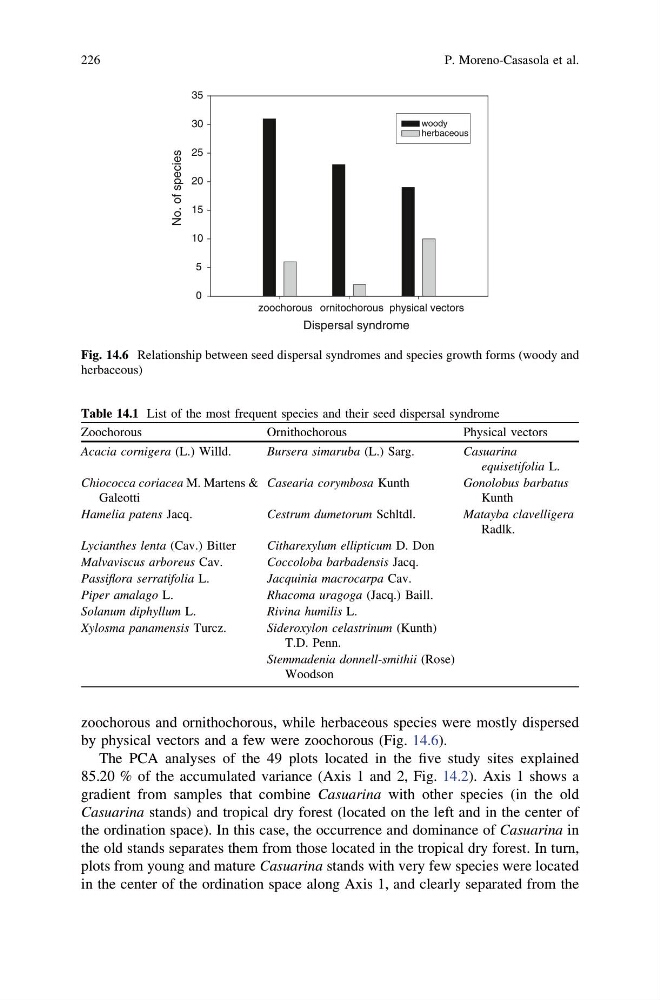
zoochorous and ornithochorous, while herbaceous species were mostly dispersed
by physical vectors and a few were zoochorous (Fig. 14.6).
The PCA analyses of the 49 plots located in the five study sites explained
85.20 % of the accumulated variance (Axis 1 and 2, Fig. 14.2). Axis 1 shows a
gradient from samples that combine Casuarina with other species (in the old
Casuarina stands) and tropical dry forest (located on the left and in the center of
the ordination space). In this case, the occurrence and dominance of Casuarina in
the old stands separates them from those located in the tropical dry forest. In turn,
plots from young and mature Casuarina stands with very few species were located
in the center of the ordination space along Axis 1, and clearly separated from the
Dispersal syndrome
zoochorous ornitochorous physical vectors
No. of species
0
5
10
15
20
25
30
35
woody
herbaceous
Fig. 14.6 Relationship between seed dispersal syndromes and species growth forms (woody and
herbaceous)
Table 14.1 List of the most frequent species and their seed dispersal syndrome
Zoochorous
Ornithochorous
Physical vectors
Acacia cornigera (L.) Willd.
Bursera simaruba (L.) Sarg.
Casuarina
equisetifolia L.
Chiococca coriacea M. Martens &
Galeotti
Casearia corymbosa Kunth
Gonolobus barbatus
Kunth
Hamelia patens Jacq.
Cestrum dumetorum Schltdl.
Matayba clavelligera
Radlk.
Lycianthes lenta (Cav.) Bitter
Citharexylum ellipticum D. Don
Malvaviscus arboreus Cav.
Coccoloba barbadensis Jacq.
Passiflora serratifolia L.
Jacquinia macrocarpa Cav.
Piper amalago L.
Rhacoma uragoga (Jacq.) Baill.
Solanum diphyllum L.
Rivina humilis L.
Xylosma panamensis Turcz.
Sideroxylon celastrinum (Kunth)
T.D. Penn.
Stemmadenia donnell-smithii (Rose)
Woodson
226
P. Moreno-Casasola et al.
by physical vectors and a few were zoochorous (Fig. 14.6).
The PCA analyses of the 49 plots located in the five study sites explained
85.20 % of the accumulated variance (Axis 1 and 2, Fig. 14.2). Axis 1 shows a
gradient from samples that combine Casuarina with other species (in the old
Casuarina stands) and tropical dry forest (located on the left and in the center of
the ordination space). In this case, the occurrence and dominance of Casuarina in
the old stands separates them from those located in the tropical dry forest. In turn,
plots from young and mature Casuarina stands with very few species were located
in the center of the ordination space along Axis 1, and clearly separated from the
Dispersal syndrome
zoochorous ornitochorous physical vectors
No. of species
0
5
10
15
20
25
30
35
woody
herbaceous
Fig. 14.6 Relationship between seed dispersal syndromes and species growth forms (woody and
herbaceous)
Table 14.1 List of the most frequent species and their seed dispersal syndrome
Zoochorous
Ornithochorous
Physical vectors
Acacia cornigera (L.) Willd.
Bursera simaruba (L.) Sarg.
Casuarina
equisetifolia L.
Chiococca coriacea M. Martens &
Galeotti
Casearia corymbosa Kunth
Gonolobus barbatus
Kunth
Hamelia patens Jacq.
Cestrum dumetorum Schltdl.
Matayba clavelligera
Radlk.
Lycianthes lenta (Cav.) Bitter
Citharexylum ellipticum D. Don
Malvaviscus arboreus Cav.
Coccoloba barbadensis Jacq.
Passiflora serratifolia L.
Jacquinia macrocarpa Cav.
Piper amalago L.
Rhacoma uragoga (Jacq.) Baill.
Solanum diphyllum L.
Rivina humilis L.
Xylosma panamensis Turcz.
Sideroxylon celastrinum (Kunth)
T.D. Penn.
Stemmadenia donnell-smithii (Rose)
Woodson
226
P. Moreno-Casasola et al.