

completed in 2010. Percentage cover of perennial species was estimated in 10-m
2
plots systematically distributed among the three strata. Only plots with greater than
5 % cover were included to avoid sampling in blowouts.
10.4 Results
In the Lanphere restoration, Ammophila was largely dead after 2 years of treatment, although there continued to be sparse resprouts requiring some treatment for
a third year. After that, maintenance of the project was accomplished through
annual ‘‘sweeps’’ for any remaining resprouts or new occurrences. Native species
recovery was observed as early as the year after initial treatment, and the manual
method allowed these plants to be avoided while treatments continued. Ammophila
mortality took longer at Ma-le’l due to the less intensive treatment application.
However, by year 5, Ammophila cover was less than 1 %. In both projects,
Carpobrotus cover was reduced to less than 1 % after 5 years. More so than
Ammophila, Carpobrotus has continued to reinvade from adjacent sites, requiring
re-treatment at an interval of 3–5 years.
Leymus mound survival was 61 % after 1 year. In the second year (2011), when
the original mounds could no longer be distinguished, there were live plants in
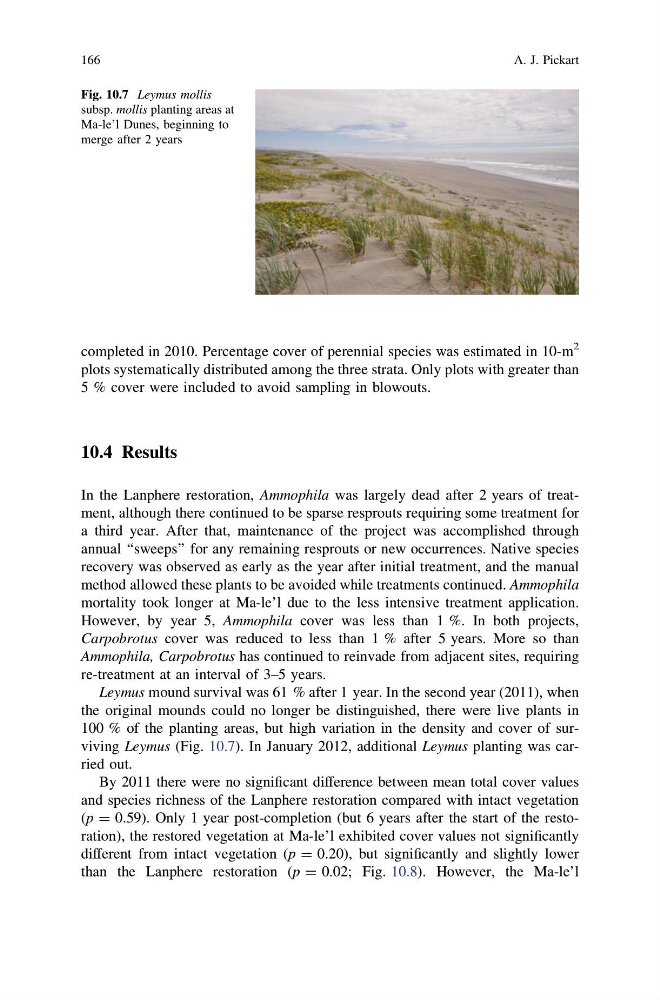
100 % of the planting areas, but high variation in the density and cover of surviving Leymus (Fig. 10.7). In January 2012, additional Leymus planting was carried out.
By 2011 there were no significant difference between mean total cover values
and species richness of the Lanphere restoration compared with intact vegetation
(p = 0.59). Only 1 year post-completion (but 6 years after the start of the restoration), the restored vegetation at Ma-le’l exhibited cover values not significantly
different from intact vegetation (p = 0.20), but significantly and slightly lower
than the Lanphere restoration (p = 0.02; Fig. 10.8). However, the Ma-le’l
Fig. 10.7 Leymus mollis
subsp. mollis planting areas at
Ma-le’l Dunes, beginning to
merge after 2 years
166
A. J. Pickart
2
plots systematically distributed among the three strata. Only plots with greater than
5 % cover were included to avoid sampling in blowouts.
10.4 Results
In the Lanphere restoration, Ammophila was largely dead after 2 years of treatment, although there continued to be sparse resprouts requiring some treatment for
a third year. After that, maintenance of the project was accomplished through
annual ‘‘sweeps’’ for any remaining resprouts or new occurrences. Native species
recovery was observed as early as the year after initial treatment, and the manual
method allowed these plants to be avoided while treatments continued. Ammophila
mortality took longer at Ma-le’l due to the less intensive treatment application.
However, by year 5, Ammophila cover was less than 1 %. In both projects,
Carpobrotus cover was reduced to less than 1 % after 5 years. More so than
Ammophila, Carpobrotus has continued to reinvade from adjacent sites, requiring
re-treatment at an interval of 3–5 years.
Leymus mound survival was 61 % after 1 year. In the second year (2011), when
the original mounds could no longer be distinguished, there were live plants in
100 % of the planting areas, but high variation in the density and cover of surviving Leymus (Fig. 10.7). In January 2012, additional Leymus planting was carried out.
By 2011 there were no significant difference between mean total cover values
and species richness of the Lanphere restoration compared with intact vegetation
(p = 0.59). Only 1 year post-completion (but 6 years after the start of the restoration), the restored vegetation at Ma-le’l exhibited cover values not significantly
different from intact vegetation (p = 0.20), but significantly and slightly lower
than the Lanphere restoration (p = 0.02; Fig. 10.8). However, the Ma-le’l
Fig. 10.7 Leymus mollis
subsp. mollis planting areas at
Ma-le’l Dunes, beginning to
merge after 2 years
166
A. J. Pickart