

over time. However, after detecting less stability post-eradication compared with
the Lanphere project, revegetation was added in the third year. Culms of the native
dune grass L. mollis subsp. mollis with attached rhizomes or rhizome buds were
harvested from a large nearby stand and planted during the winter months in 4-m
2
grids of 49 hills (two culms per hill) at spacings of 65 cm. The revegetated patches
were distributed strategically along the foredune in areas of less stability and their
position mapped with a GeoXT using ArcPad 7.1.
Carpobrotus control was also carried out using manual methods. The more
aggressive hybrids form dense carpets that can be rolled up like a carpet. Shovels
are used to sever rhizomes. When the plants are more scattered they are dug with a
shovel and pulled, attempting to remove as much of the rhizome as possible.
Several re-treatments are required to achieve complete mortality. As with
Ammophila, the bulk of the labor is expended in the first treatment. Carpobrotus is
difficult to burn owing to its high water content. Piles were dragged on tarps or in
contractor bags to the beach and transported to a green-waste site by a four-wheeldrive truck.
Monitoring was carried out on both projects, including detailed labor tracking
for the Lanphere project. Vegetation cover (total and by species) was sampled in
0.25-m
2 (Lanphere) or 1-m
2 (Ma-le’l) systematically placed plots. Sampling
occurred at 1- to 2-year intervals through 2002 at Lanphere, and annually (still
ongoing) at Ma-le’l, allowing documentation of progress toward the objectives of
vegetation cover and species diversity. Surviving Leymus mounds were recorded
in the summer following each planting. By the second summer, individual mounds
could no longer be distinguished and the presence or absence of live Leymus in
each grid was recorded.
In 2011 a new sampling design was implemented to estimate cover and species
composition along a temporal gradient: the oldest vegetation that predated restoration and was never invaded, vegetation that originated as the result of restoration
completed at the Lanphere Dunes in 1998, and the newly restored Ma-le’l Dunes
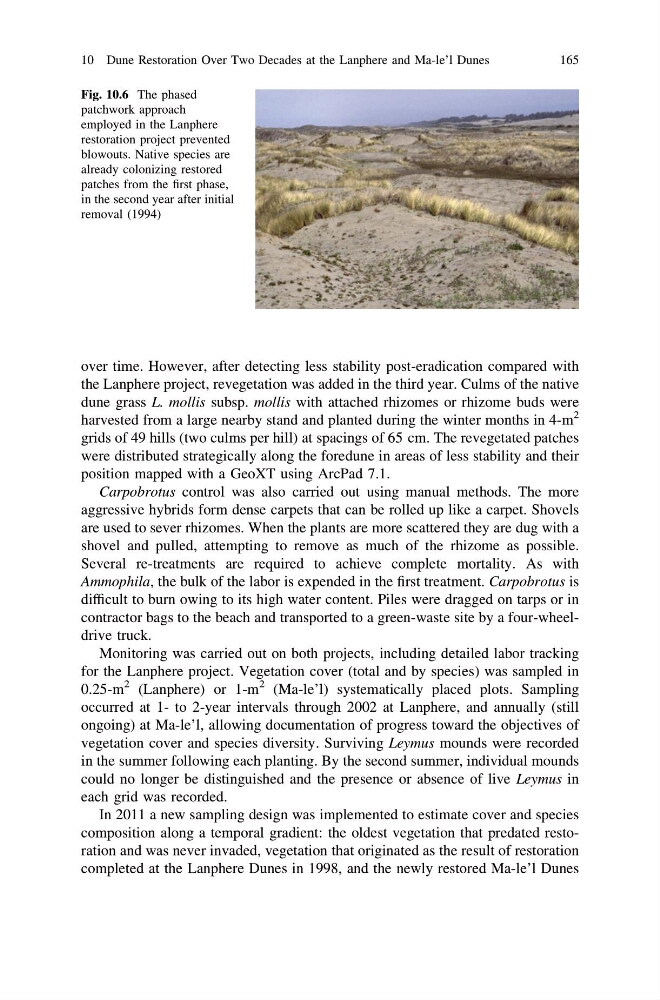
Fig. 10.6 The phased
patchwork approach
employed in the Lanphere
restoration project prevented
blowouts. Native species are
already colonizing restored
patches from the first phase,
in the second year after initial
removal (1994)
10 Dune Restoration Over Two Decades at the Lanphere and Ma-le’l Dunes
165
the Lanphere project, revegetation was added in the third year. Culms of the native
dune grass L. mollis subsp. mollis with attached rhizomes or rhizome buds were
harvested from a large nearby stand and planted during the winter months in 4-m
2
grids of 49 hills (two culms per hill) at spacings of 65 cm. The revegetated patches
were distributed strategically along the foredune in areas of less stability and their
position mapped with a GeoXT using ArcPad 7.1.
Carpobrotus control was also carried out using manual methods. The more
aggressive hybrids form dense carpets that can be rolled up like a carpet. Shovels
are used to sever rhizomes. When the plants are more scattered they are dug with a
shovel and pulled, attempting to remove as much of the rhizome as possible.
Several re-treatments are required to achieve complete mortality. As with
Ammophila, the bulk of the labor is expended in the first treatment. Carpobrotus is
difficult to burn owing to its high water content. Piles were dragged on tarps or in
contractor bags to the beach and transported to a green-waste site by a four-wheeldrive truck.
Monitoring was carried out on both projects, including detailed labor tracking
for the Lanphere project. Vegetation cover (total and by species) was sampled in
0.25-m
2 (Lanphere) or 1-m
2 (Ma-le’l) systematically placed plots. Sampling
occurred at 1- to 2-year intervals through 2002 at Lanphere, and annually (still
ongoing) at Ma-le’l, allowing documentation of progress toward the objectives of
vegetation cover and species diversity. Surviving Leymus mounds were recorded
in the summer following each planting. By the second summer, individual mounds
could no longer be distinguished and the presence or absence of live Leymus in
each grid was recorded.
In 2011 a new sampling design was implemented to estimate cover and species
composition along a temporal gradient: the oldest vegetation that predated restoration and was never invaded, vegetation that originated as the result of restoration
completed at the Lanphere Dunes in 1998, and the newly restored Ma-le’l Dunes
Fig. 10.6 The phased
patchwork approach
employed in the Lanphere
restoration project prevented
blowouts. Native species are
already colonizing restored
patches from the first phase,
in the second year after initial
removal (1994)
10 Dune Restoration Over Two Decades at the Lanphere and Ma-le’l Dunes
165