

year and seven in the second year. The Ma-le’l project employed fewer treatments
per year over a 3-year period. Plants were piled up on site and burned after they
had dried for a month or more.
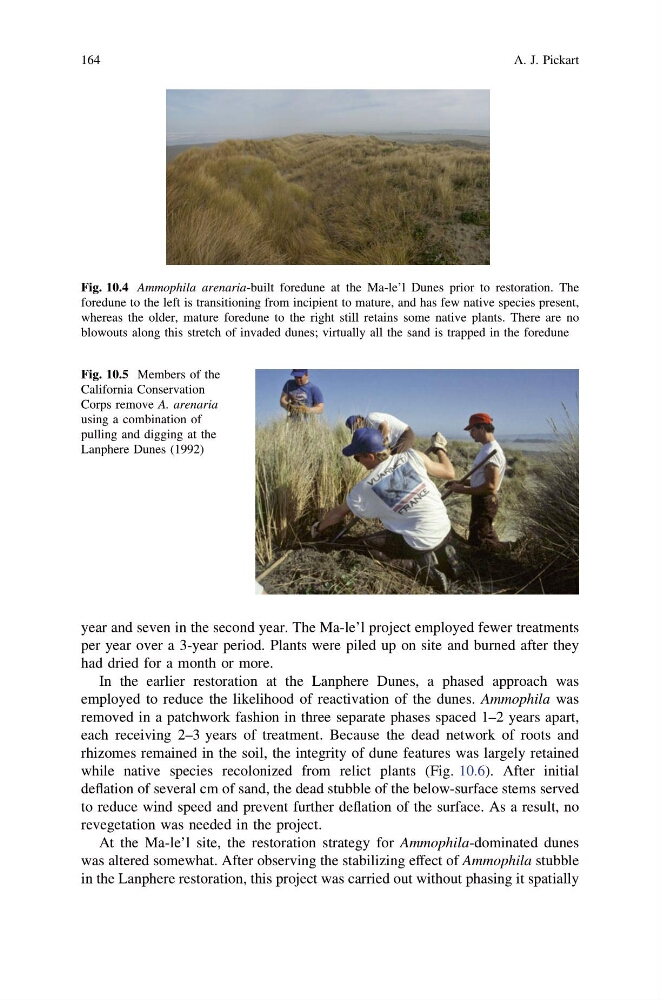
In the earlier restoration at the Lanphere Dunes, a phased approach was
employed to reduce the likelihood of reactivation of the dunes. Ammophila was
removed in a patchwork fashion in three separate phases spaced 1–2 years apart,
each receiving 2–3 years of treatment. Because the dead network of roots and
rhizomes remained in the soil, the integrity of dune features was largely retained
while native species recolonized from relict plants (Fig. 10.6). After initial
deflation of several cm of sand, the dead stubble of the below-surface stems served
to reduce wind speed and prevent further deflation of the surface. As a result, no
revegetation was needed in the project.
At the Ma-le’l site, the restoration strategy for Ammophila-dominated dunes
was altered somewhat. After observing the stabilizing effect of Ammophila stubble
in the Lanphere restoration, this project was carried out without phasing it spatially
Fig. 10.4 Ammophila arenaria-built foredune at the Ma-le’l Dunes prior to restoration. The
foredune to the left is transitioning from incipient to mature, and has few native species present,
whereas the older, mature foredune to the right still retains some native plants. There are no
blowouts along this stretch of invaded dunes; virtually all the sand is trapped in the foredune
Fig. 10.5 Members of the
California Conservation
Corps remove A. arenaria
using a combination of
pulling and digging at the
Lanphere Dunes (1992)
164
A. J. Pickart
per year over a 3-year period. Plants were piled up on site and burned after they
had dried for a month or more.
In the earlier restoration at the Lanphere Dunes, a phased approach was
employed to reduce the likelihood of reactivation of the dunes. Ammophila was
removed in a patchwork fashion in three separate phases spaced 1–2 years apart,
each receiving 2–3 years of treatment. Because the dead network of roots and
rhizomes remained in the soil, the integrity of dune features was largely retained
while native species recolonized from relict plants (Fig. 10.6). After initial
deflation of several cm of sand, the dead stubble of the below-surface stems served
to reduce wind speed and prevent further deflation of the surface. As a result, no
revegetation was needed in the project.
At the Ma-le’l site, the restoration strategy for Ammophila-dominated dunes
was altered somewhat. After observing the stabilizing effect of Ammophila stubble
in the Lanphere restoration, this project was carried out without phasing it spatially
Fig. 10.4 Ammophila arenaria-built foredune at the Ma-le’l Dunes prior to restoration. The
foredune to the left is transitioning from incipient to mature, and has few native species present,
whereas the older, mature foredune to the right still retains some native plants. There are no
blowouts along this stretch of invaded dunes; virtually all the sand is trapped in the foredune
Fig. 10.5 Members of the
California Conservation
Corps remove A. arenaria
using a combination of
pulling and digging at the
Lanphere Dunes (1992)
164
A. J. Pickart