

changed from about 3.5 m
3 /m/year in the 1980s (de Ruig and Louisse 1991) to
about 10 m
3 /m/year in the last few decades (Arens et al. 2010). On the Wadden
Islands, the input is even larger (Arens et al. 2010). When studying volume
changes along coastal transects, it appears that for many sections trend breaks in
the volume development coincide with the start of nourishments (Fig. 7.5).
Compared with the total volume of nourishments (about 12 10
6 m
3 /year), the
amount of sand stored in the dunes is approximately 25 %.
The increased input of sand into the dunes has resulted in important changes in
the system. In many places, incipient foredunes have been developing in front of
the previous foredunes. There are signs that this inhibits the interaction among the
beach, foredunes, and inner dunes, limits the input of fresh sand into the inner
dunes, and causes a further fixation of the coastal dune landscape. Also stimulated
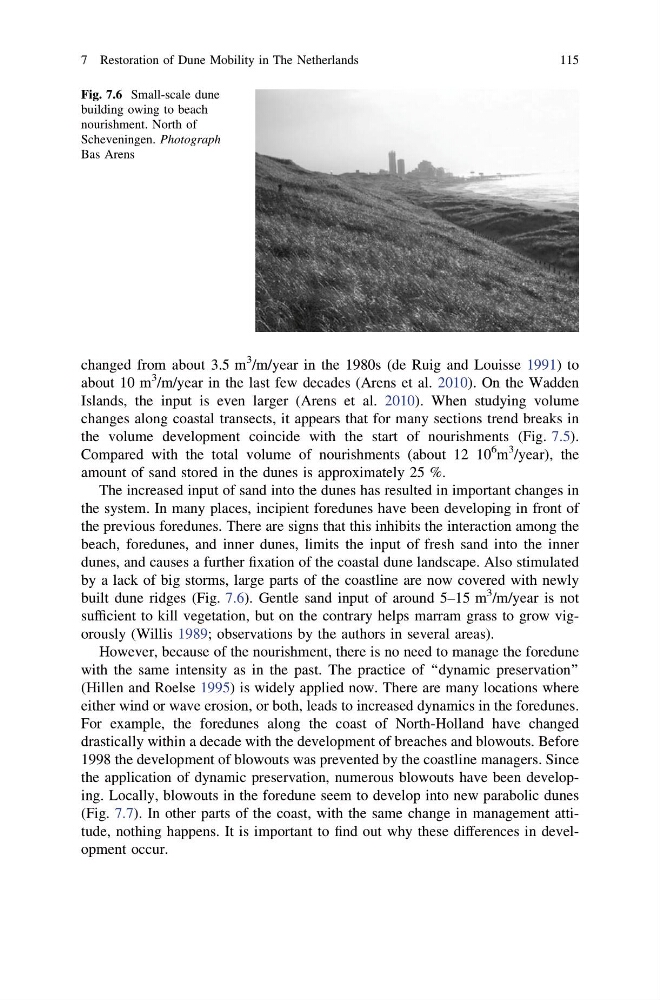
by a lack of big storms, large parts of the coastline are now covered with newly
built dune ridges (Fig. 7.6). Gentle sand input of around 5–15 m
3 /m/year is not
sufficient to kill vegetation, but on the contrary helps marram grass to grow vigorously (Willis 1989; observations by the authors in several areas).
However, because of the nourishment, there is no need to manage the foredune
with the same intensity as in the past. The practice of ‘‘dynamic preservation’’
(Hillen and Roelse 1995) is widely applied now. There are many locations where
either wind or wave erosion, or both, leads to increased dynamics in the foredunes.
For example, the foredunes along the coast of North-Holland have changed
drastically within a decade with the development of breaches and blowouts. Before
1998 the development of blowouts was prevented by the coastline managers. Since
the application of dynamic preservation, numerous blowouts have been developing. Locally, blowouts in the foredune seem to develop into new parabolic dunes
(Fig. 7.7). In other parts of the coast, with the same change in management attitude, nothing happens. It is important to find out why these differences in development occur.
Fig. 7.6 Small-scale dune
building owing to beach
nourishment. North of
Scheveningen. Photograph
Bas Arens
7 Restoration of Dune Mobility in The Netherlands
115
3 /m/year in the 1980s (de Ruig and Louisse 1991) to
about 10 m
3 /m/year in the last few decades (Arens et al. 2010). On the Wadden
Islands, the input is even larger (Arens et al. 2010). When studying volume
changes along coastal transects, it appears that for many sections trend breaks in
the volume development coincide with the start of nourishments (Fig. 7.5).
Compared with the total volume of nourishments (about 12 10
6 m
3 /year), the
amount of sand stored in the dunes is approximately 25 %.
The increased input of sand into the dunes has resulted in important changes in
the system. In many places, incipient foredunes have been developing in front of
the previous foredunes. There are signs that this inhibits the interaction among the
beach, foredunes, and inner dunes, limits the input of fresh sand into the inner
dunes, and causes a further fixation of the coastal dune landscape. Also stimulated
by a lack of big storms, large parts of the coastline are now covered with newly
built dune ridges (Fig. 7.6). Gentle sand input of around 5–15 m
3 /m/year is not
sufficient to kill vegetation, but on the contrary helps marram grass to grow vigorously (Willis 1989; observations by the authors in several areas).
However, because of the nourishment, there is no need to manage the foredune
with the same intensity as in the past. The practice of ‘‘dynamic preservation’’
(Hillen and Roelse 1995) is widely applied now. There are many locations where
either wind or wave erosion, or both, leads to increased dynamics in the foredunes.
For example, the foredunes along the coast of North-Holland have changed
drastically within a decade with the development of breaches and blowouts. Before
1998 the development of blowouts was prevented by the coastline managers. Since
the application of dynamic preservation, numerous blowouts have been developing. Locally, blowouts in the foredune seem to develop into new parabolic dunes
(Fig. 7.7). In other parts of the coast, with the same change in management attitude, nothing happens. It is important to find out why these differences in development occur.
Fig. 7.6 Small-scale dune
building owing to beach
nourishment. North of
Scheveningen. Photograph
Bas Arens
7 Restoration of Dune Mobility in The Netherlands
115