

now responsible for the rapid colonization of bare surfaces (e.g., Provoost et al.
2011). Spreading of marram by seeds is certainly more significant now than vegetative expansion. It is not clear if this is a result of the warmer climate, increased
rainfall, nitrogen in the system, a positive feedback or a combination of factors.
Although most of the landscape is stabilized, some bare sand is left through the
activity of blowouts. These smaller scaled features are superimposed on the
underlying landscape of parabolic dunes. In some places the former parabolics are
mostly covered by blowouts, in other parts they are untouched, depending among
others on the rabbit population, the interference of human use or management and
vulnerability to water erosion (Jungerius and van der Meulen 1988). Since rabbit
populations declined owing to myxomatosis and VHS, blowout activity has also
decreased considerably in the last few decades. The percentage of dune surface
covered with active blowouts is nowadays less than 1 %.
7.3.2 Changing Perspectives
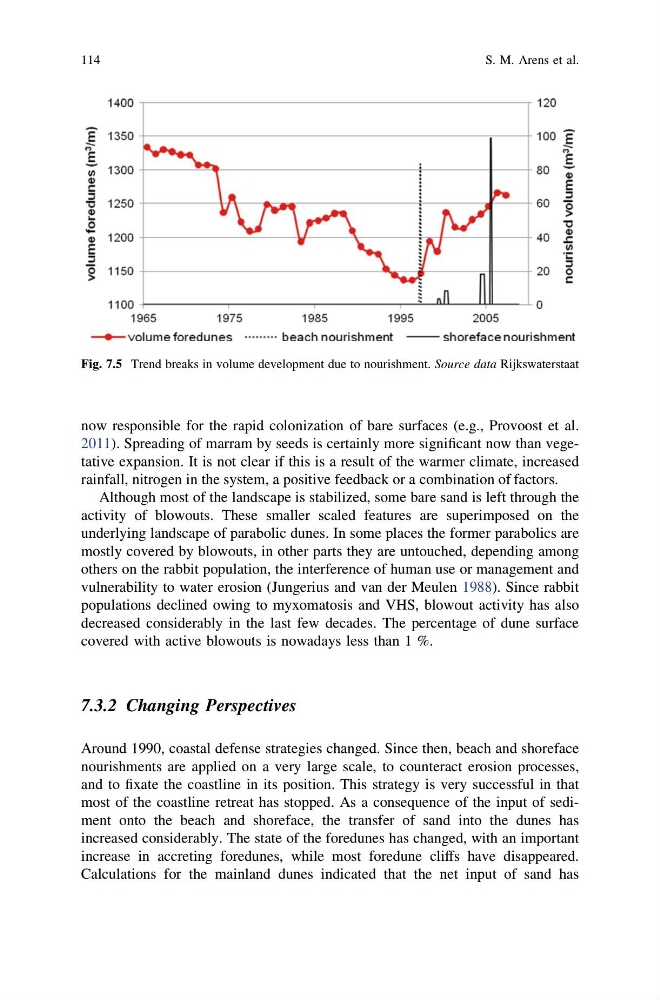
Around 1990, coastal defense strategies changed. Since then, beach and shoreface
nourishments are applied on a very large scale, to counteract erosion processes,
and to fixate the coastline in its position. This strategy is very successful in that
most of the coastline retreat has stopped. As a consequence of the input of sediment onto the beach and shoreface, the transfer of sand into the dunes has
increased considerably. The state of the foredunes has changed, with an important
increase in accreting foredunes, while most foredune cliffs have disappeared.
Calculations for the mainland dunes indicated that the net input of sand has
Fig. 7.5 Trend breaks in volume development due to nourishment. Source data Rijkswaterstaat
114
S. M. Arens et al.
2011). Spreading of marram by seeds is certainly more significant now than vegetative expansion. It is not clear if this is a result of the warmer climate, increased
rainfall, nitrogen in the system, a positive feedback or a combination of factors.
Although most of the landscape is stabilized, some bare sand is left through the
activity of blowouts. These smaller scaled features are superimposed on the
underlying landscape of parabolic dunes. In some places the former parabolics are
mostly covered by blowouts, in other parts they are untouched, depending among
others on the rabbit population, the interference of human use or management and
vulnerability to water erosion (Jungerius and van der Meulen 1988). Since rabbit
populations declined owing to myxomatosis and VHS, blowout activity has also
decreased considerably in the last few decades. The percentage of dune surface
covered with active blowouts is nowadays less than 1 %.
7.3.2 Changing Perspectives
Around 1990, coastal defense strategies changed. Since then, beach and shoreface
nourishments are applied on a very large scale, to counteract erosion processes,
and to fixate the coastline in its position. This strategy is very successful in that
most of the coastline retreat has stopped. As a consequence of the input of sediment onto the beach and shoreface, the transfer of sand into the dunes has
increased considerably. The state of the foredunes has changed, with an important
increase in accreting foredunes, while most foredune cliffs have disappeared.
Calculations for the mainland dunes indicated that the net input of sand has
Fig. 7.5 Trend breaks in volume development due to nourishment. Source data Rijkswaterstaat
114
S. M. Arens et al.