

Since beach and shoreface nourishments are applied worldwide on a large scale,
the impact of nourishment on dunes is a big issue, and currently intensively studied
in The Netherlands. The above examples illustrate that, depending on the coastal
setting, the effects might be negative (a blocking of the interaction between
shoreface and dunes) or positive (a new release of sand and reactivation of
dynamic processes). Furthermore, if the nourished sand differs from the original
sand, e.g., in grain size, carbonate content or mineralogical compounds, there may
be ecological consequences. Recent research (Stuyfzand et al. 2010) indicates that
the nourished sand mainly differs in carbonate content. We need to identify the
mechanisms behind the effects of nourishment to be able to optimize nourishment
strategies (i.e., minimize the negative, maximize the positive effects).
Some current developments may further favor aeolian processes and give rise to
new phases of dune mobility. Grazing as a management tool replaces the former
activity of rabbits. Increased summer droughts are expected, and occasionally
observed, as in the summer of 2006. There are observations that the combination
of higher temperatures and increased rainfall intensities results in higher levels of
water erosion: intense drought enhances the water repellency of the soil (Dekker
and Jungerius 1990), resulting in surface run-off and considerable water erosion
during heavy showers, enabling the development of new blowouts (Jungerius and
van der Meulen 1988).
7.4 Restoration Projects
Currently, because of stabilization, many of the dunes tend to end up with the same
climax vegetation, dominated by shrubs. On average, biodiversity is decreasing
(Arens and Geelen 2006; Kutiel 2013). New ways of management are being
developed to maintain biodiversity, or increase it where possible. Which factors
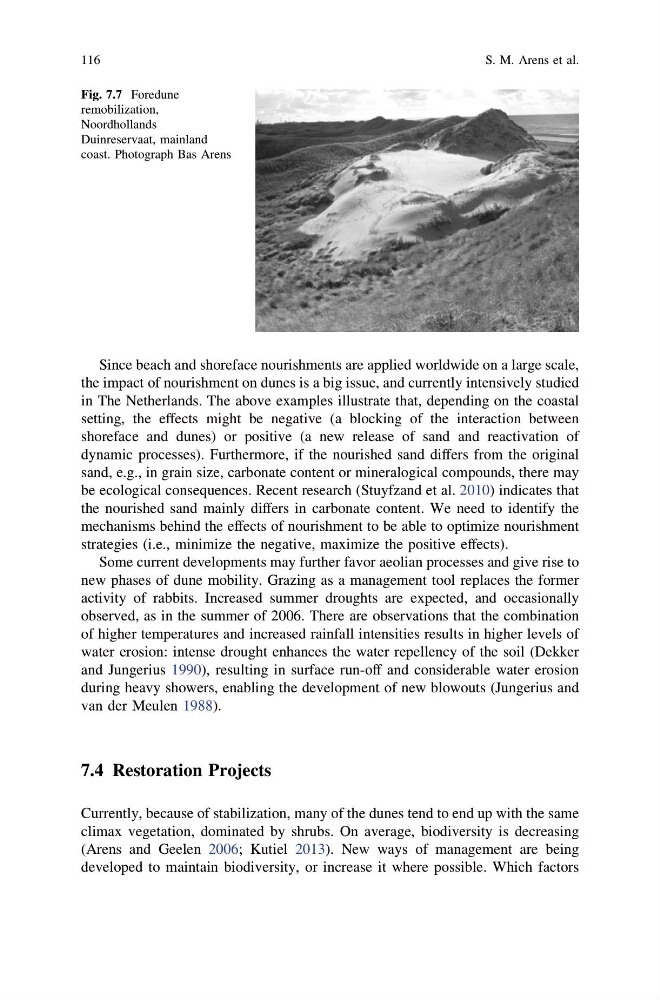
Fig. 7.7 Foredune
remobilization,
Noordhollands
Duinreservaat, mainland
coast. Photograph Bas Arens
116
S. M. Arens et al.
the impact of nourishment on dunes is a big issue, and currently intensively studied
in The Netherlands. The above examples illustrate that, depending on the coastal
setting, the effects might be negative (a blocking of the interaction between
shoreface and dunes) or positive (a new release of sand and reactivation of
dynamic processes). Furthermore, if the nourished sand differs from the original
sand, e.g., in grain size, carbonate content or mineralogical compounds, there may
be ecological consequences. Recent research (Stuyfzand et al. 2010) indicates that
the nourished sand mainly differs in carbonate content. We need to identify the
mechanisms behind the effects of nourishment to be able to optimize nourishment
strategies (i.e., minimize the negative, maximize the positive effects).
Some current developments may further favor aeolian processes and give rise to
new phases of dune mobility. Grazing as a management tool replaces the former
activity of rabbits. Increased summer droughts are expected, and occasionally
observed, as in the summer of 2006. There are observations that the combination
of higher temperatures and increased rainfall intensities results in higher levels of
water erosion: intense drought enhances the water repellency of the soil (Dekker
and Jungerius 1990), resulting in surface run-off and considerable water erosion
during heavy showers, enabling the development of new blowouts (Jungerius and
van der Meulen 1988).
7.4 Restoration Projects
Currently, because of stabilization, many of the dunes tend to end up with the same
climax vegetation, dominated by shrubs. On average, biodiversity is decreasing
(Arens and Geelen 2006; Kutiel 2013). New ways of management are being
developed to maintain biodiversity, or increase it where possible. Which factors
Fig. 7.7 Foredune
remobilization,
Noordhollands
Duinreservaat, mainland
coast. Photograph Bas Arens
116
S. M. Arens et al.