

the total entrance of this radionuclide in the sea during this period, and
137 Cs –
40 TBq, or 1.6–2.3%, respectively (Gudiksen et al. 1989; Gulin et al. 2011). These
estimates imply that the deposition of
90 Sr and
137 Cs in the thickness of the bottom
sediments was insignificant compared with the content of these radionuclides in the
oxygen and hydrogen-sulphidous zone of the Black Sea. Therefore, we can consider
the water mass of these areas, especially hydrogen-sulphidous as the main depot for
the post-Chernobyl
90 Sr and
137 Cs.
It was obtained (Stokozov 2004; Mirzoyeva 2008; Polikarpov et al. 2008), that in
the period after the ChNPP accident the reduction of the
90 Sr and
137 Cs concentrations in the surface water of the Black Sea was determined by stirring in a layer of
0–50 m and a vertical migration of
90 Sr and
137 Cs in deep waters mostly in the
0–200 m layer, since 1986 (Fig. 17.6).
The results of studies of the vertical distribution of
90 Sr and
137 Cs in the area of
western cyclonic gyre of the Black Sea, obtained in 2013 and 2015 are shown in
Figs. 17.7 and 17.8, Table 17.3.
They allowed to traced the dynamics of the content of radionuclides in the water
column of the Black Sea for the entire post-Chernobyl period, and to assess their
distribution in the oxygen and hydrogen-sulphidous zones. It is shown (Figs. 17.7
and 17.8, Table 17.3), that by 2015 the system of biogeochemical conditioning
90 Sr
and
137
Cs content in the upper 100-m water column of the Black Sea is almost
reached the stationary level, i.e. entrance streams of these radionuclides in the
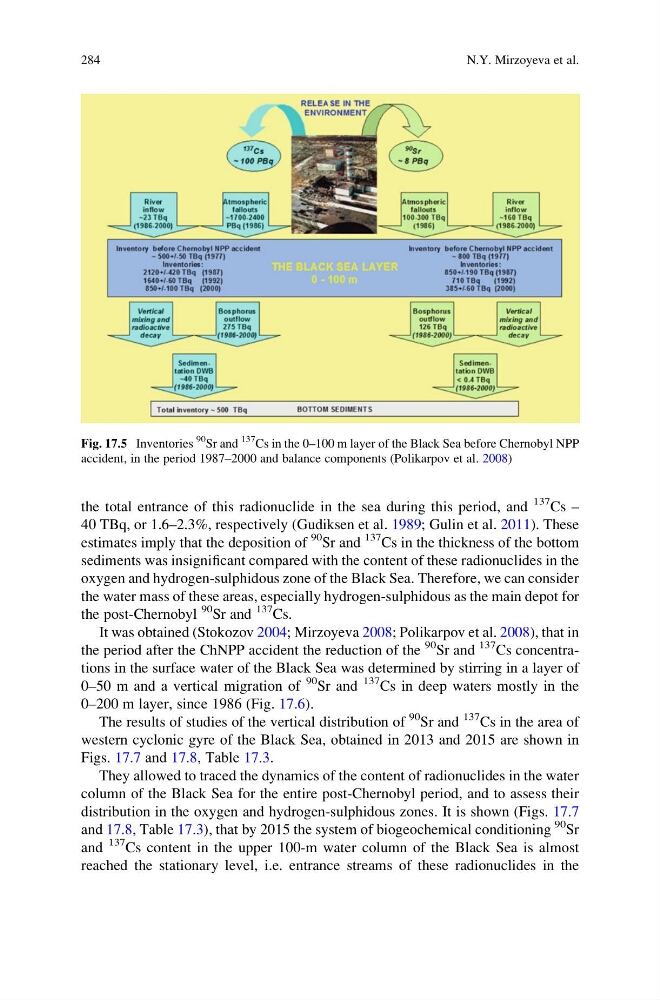
Fig. 17.5 Inventories
90
Sr and
137
Cs in the 0–100 m layer of the Black Sea before Chernobyl NPP
accident, in the period 1987–2000 and balance components (Polikarpov et al. 2008)
284
N.Y. Mirzoyeva et al.
137 Cs –
40 TBq, or 1.6–2.3%, respectively (Gudiksen et al. 1989; Gulin et al. 2011). These
estimates imply that the deposition of
90 Sr and
137 Cs in the thickness of the bottom
sediments was insignificant compared with the content of these radionuclides in the
oxygen and hydrogen-sulphidous zone of the Black Sea. Therefore, we can consider
the water mass of these areas, especially hydrogen-sulphidous as the main depot for
the post-Chernobyl
90 Sr and
137 Cs.
It was obtained (Stokozov 2004; Mirzoyeva 2008; Polikarpov et al. 2008), that in
the period after the ChNPP accident the reduction of the
90 Sr and
137 Cs concentrations in the surface water of the Black Sea was determined by stirring in a layer of
0–50 m and a vertical migration of
90 Sr and
137 Cs in deep waters mostly in the
0–200 m layer, since 1986 (Fig. 17.6).
The results of studies of the vertical distribution of
90 Sr and
137 Cs in the area of
western cyclonic gyre of the Black Sea, obtained in 2013 and 2015 are shown in
Figs. 17.7 and 17.8, Table 17.3.
They allowed to traced the dynamics of the content of radionuclides in the water
column of the Black Sea for the entire post-Chernobyl period, and to assess their
distribution in the oxygen and hydrogen-sulphidous zones. It is shown (Figs. 17.7
and 17.8, Table 17.3), that by 2015 the system of biogeochemical conditioning
90 Sr
and
137
Cs content in the upper 100-m water column of the Black Sea is almost
reached the stationary level, i.e. entrance streams of these radionuclides in the
Fig. 17.5 Inventories
90
Sr and
137
Cs in the 0–100 m layer of the Black Sea before Chernobyl NPP
accident, in the period 1987–2000 and balance components (Polikarpov et al. 2008)
284
N.Y. Mirzoyeva et al.