

surface layers of the sea are now balanced by their radioactive decay and migration
in depth layers.
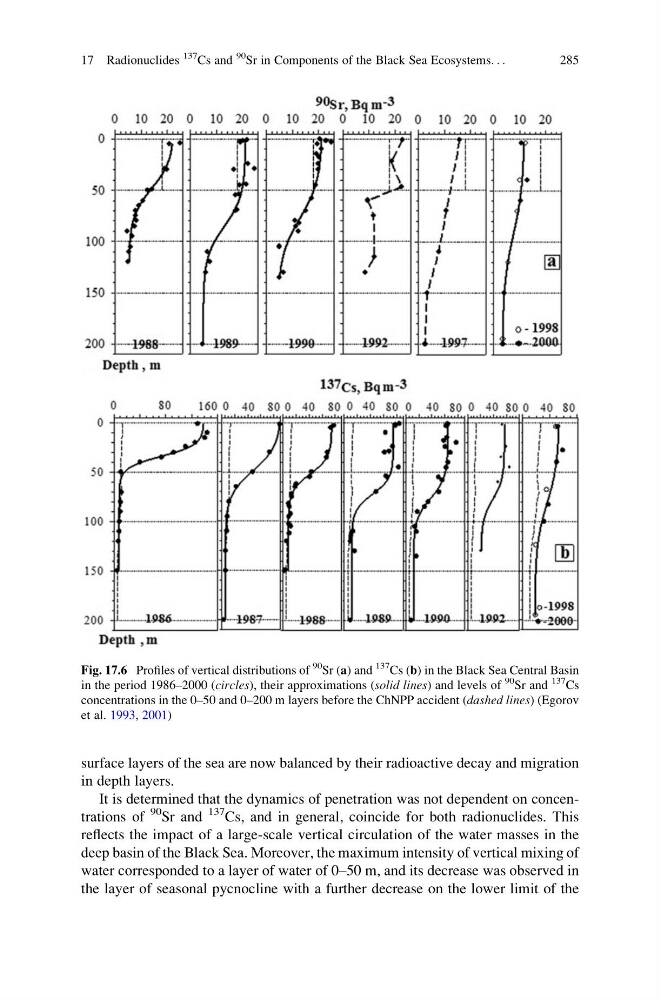
It is determined that the dynamics of penetration was not dependent on concentrations of
90 Sr and
137 Cs, and in general, coincide for both radionuclides. This
reflects the impact of a large-scale vertical circulation of the water masses in the
deep basin of the Black Sea. Moreover, the maximum intensity of vertical mixing of
water corresponded to a layer of water of 0–50 m, and its decrease was observed in
the layer of seasonal pycnocline with a further decrease on the lower limit of the
Fig. 17.6 Profiles of vertical distributions of
90
Sr (a) and
137
Cs (b) in the Black Sea Central Basin
in the period 1986–2000 (circles), their approximations (solid lines) and levels of
90 Sr and
137
Cs
concentrations in the 0–50 and 0–200 m layers before the ChNPP accident (dashed lines) (Egorov
et al. 1993, 2001)
17 Radionuclides
137
Cs and
90
Sr in Components of the Black Sea Ecosystems. . .
285
in depth layers.
It is determined that the dynamics of penetration was not dependent on concentrations of
90 Sr and
137 Cs, and in general, coincide for both radionuclides. This
reflects the impact of a large-scale vertical circulation of the water masses in the
deep basin of the Black Sea. Moreover, the maximum intensity of vertical mixing of
water corresponded to a layer of water of 0–50 m, and its decrease was observed in
the layer of seasonal pycnocline with a further decrease on the lower limit of the
Fig. 17.6 Profiles of vertical distributions of
90
Sr (a) and
137
Cs (b) in the Black Sea Central Basin
in the period 1986–2000 (circles), their approximations (solid lines) and levels of
90 Sr and
137
Cs
concentrations in the 0–50 and 0–200 m layers before the ChNPP accident (dashed lines) (Egorov
et al. 1993, 2001)
17 Radionuclides
137
Cs and
90
Sr in Components of the Black Sea Ecosystems. . .
285