

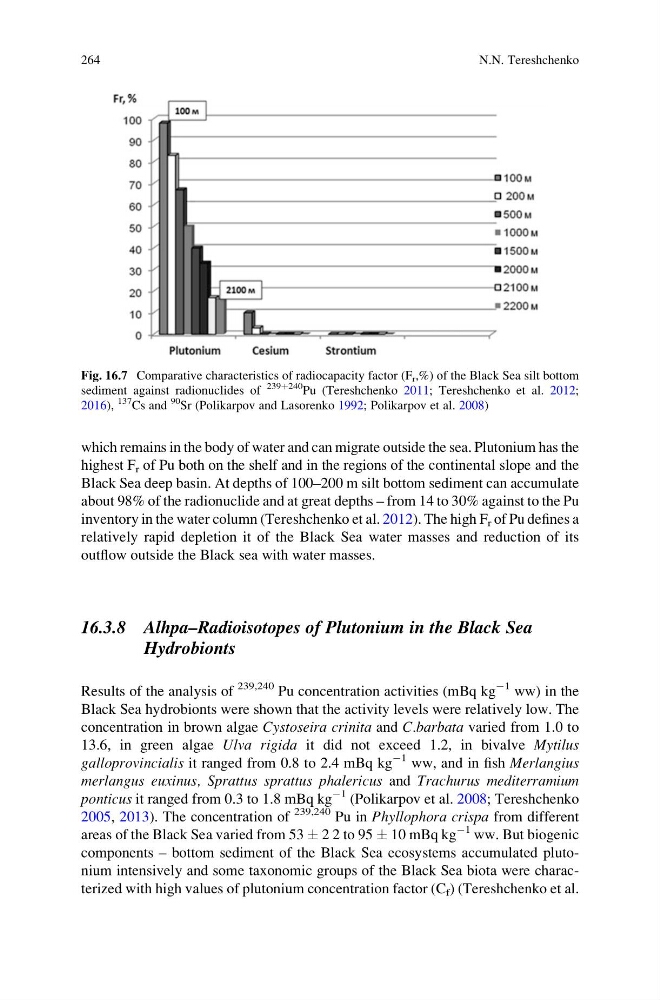
which remains in the body of water and can migrate outside the sea. Plutonium has the
highest F r of Pu both on the shelf and in the regions of the continental slope and the
Black Sea deep basin. At depths of 100–200 m silt bottom sediment can accumulate
about 98% of the radionuclide and at great depths – from 14 to 30% against to the Pu
inventory in the water column (Tereshchenko et al. 2012). The high F r of Pu defines a
relatively rapid depletion it of the Black Sea water masses and reduction of its
outflow outside the Black sea with water masses.
16.3.8 Alhpa–Radioisotopes of Plutonium in the Black Sea
Hydrobionts
Results of the analysis of
239,240 Pu concentration activities (mBq kg
À1 ww) in the
Black Sea hydrobionts were shown that the activity levels were relatively low. The
concentration in brown algae Cystoseira crinita and C.barbata varied from 1.0 to
13.6, in green algae Ulva rigida it did not exceed 1.2, in bivalve Mytilus
galloprovincialis it ranged from 0.8 to 2.4 mBq kg
À1 ww, and in fish Merlangius
merlangus euxinus, Sprattus sprattus phalericus and Trachurus mediterramium
ponticus it ranged from 0.3 to 1.8 mBq kg
À1 (Polikarpov et al. 2008; Tereshchenko
2005, 2013). The concentration of
239,240 Pu in Phyllophora crispa from different
areas of the Black Sea varied from 53 Æ 2 2 to 95 Æ 10 mBq kg
À1 ww. But biogenic
components – bottom sediment of the Black Sea ecosystems accumulated plutonium intensively and some taxonomic groups of the Black Sea biota were characterized with high values of plutonium concentration factor (C f ) (Tereshchenko et al.
Fig. 16.7 Comparative characteristics of radiocapacity factor (F r ,%) of the Black Sea silt bottom
sediment against radionuclides of
239þ240
Pu (Tereshchenko 2011; Tereshchenko et al. 2012;
2016),
137
Cs and
90
Sr (Polikarpov and Lasorenko 1992; Polikarpov et al. 2008)
264
N.N. Tereshchenko
highest F r of Pu both on the shelf and in the regions of the continental slope and the
Black Sea deep basin. At depths of 100–200 m silt bottom sediment can accumulate
about 98% of the radionuclide and at great depths – from 14 to 30% against to the Pu
inventory in the water column (Tereshchenko et al. 2012). The high F r of Pu defines a
relatively rapid depletion it of the Black Sea water masses and reduction of its
outflow outside the Black sea with water masses.
16.3.8 Alhpa–Radioisotopes of Plutonium in the Black Sea
Hydrobionts
Results of the analysis of
239,240 Pu concentration activities (mBq kg
À1 ww) in the
Black Sea hydrobionts were shown that the activity levels were relatively low. The
concentration in brown algae Cystoseira crinita and C.barbata varied from 1.0 to
13.6, in green algae Ulva rigida it did not exceed 1.2, in bivalve Mytilus
galloprovincialis it ranged from 0.8 to 2.4 mBq kg
À1 ww, and in fish Merlangius
merlangus euxinus, Sprattus sprattus phalericus and Trachurus mediterramium
ponticus it ranged from 0.3 to 1.8 mBq kg
À1 (Polikarpov et al. 2008; Tereshchenko
2005, 2013). The concentration of
239,240 Pu in Phyllophora crispa from different
areas of the Black Sea varied from 53 Æ 2 2 to 95 Æ 10 mBq kg
À1 ww. But biogenic
components – bottom sediment of the Black Sea ecosystems accumulated plutonium intensively and some taxonomic groups of the Black Sea biota were characterized with high values of plutonium concentration factor (C f ) (Tereshchenko et al.
Fig. 16.7 Comparative characteristics of radiocapacity factor (F r ,%) of the Black Sea silt bottom
sediment against radionuclides of
239þ240
Pu (Tereshchenko 2011; Tereshchenko et al. 2012;
2016),
137
Cs and
90
Sr (Polikarpov and Lasorenko 1992; Polikarpov et al. 2008)
264
N.N. Tereshchenko