

input into the water environment. As a quantitative measure of radiocapacity used
the radiocapacity factor (F r , %) (Polikarpov and Lasorenko 1992; Tereshchenko
et al. 2012; 2016). As a relative value, it refers to the proportion of the radionuclide,
which accumulates by sediment from the water column, and depends on the
accumulative ability of sediment, as well as the depth of the water and the thickness
of the accumulating layer of sediment. The values of the radiocapacity factor for
Black Sea bottom sediment against Pu were calculated on the basis of field
observations and expressed as a percentage, are shown in Fig. 16.7 (Tereshchenko
2011; Tereshchenko et al. 2014).
If we compare F r of Pu with those of cesium and strontium, it is becoming
obviously the differences between the biogeochemical Pu behavior and Cs, Sr
behavior (Fig. 16.7). As it is well known, strontium refers to hydrotropic radionuclides (Polikarpov and Lasorenko 1992). It remains in the water and moves with the
water masses (including outside of the Black Sea), and the sediment accumulates it
very little (Polikarpov et al. 2008), so the F r of Sr equals to the thousandths of a
percent. Although cesium in freshwater ecosystems refers to pedotropic radionuclides (Polikarpov and Lasorenko 1992), but its accumulation in sediment greatly
affect the redistribution of the system “water – bottom sediments” only on the shelf
of the Black Sea (Fig. 16.7), Cs soon shows properties of equitropic element, it
more evenly distributed between the main components of the aquatic ecosystem:
water – bottom sediment – biota. The bottom sediments of the continental slope and
the Black Sea deep basin accumulate Cs in a less degree, the principal amount of
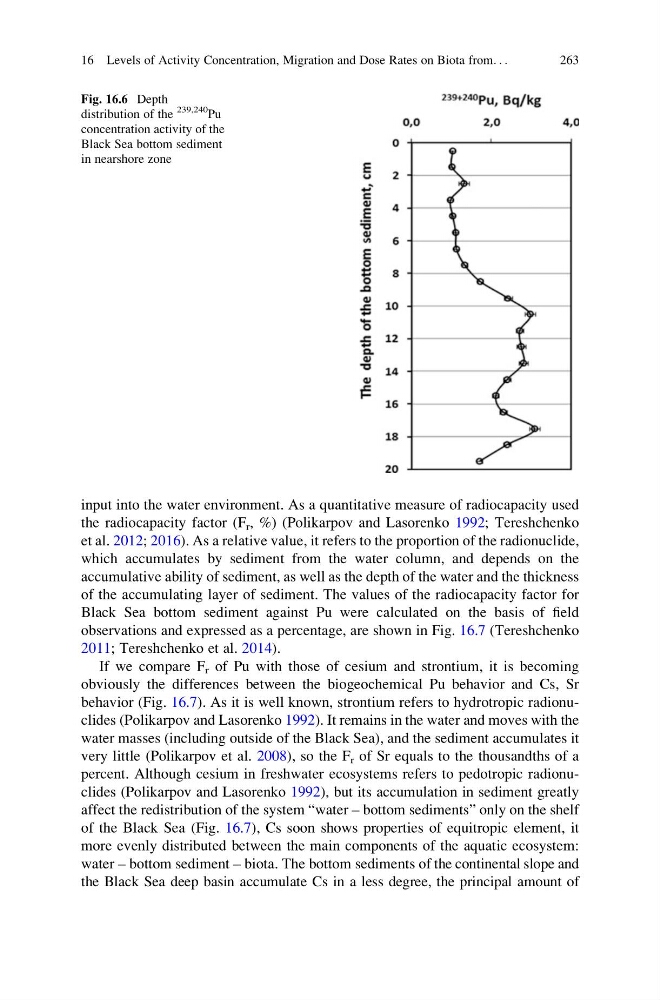
Fig. 16.6 Depth
distribution of the
239,240
Pu
concentration activity of the
Black Sea bottom sediment
in nearshore zone
16 Levels of Activity Concentration, Migration and Dose Rates on Biota from. . .
263
the radiocapacity factor (F r , %) (Polikarpov and Lasorenko 1992; Tereshchenko
et al. 2012; 2016). As a relative value, it refers to the proportion of the radionuclide,
which accumulates by sediment from the water column, and depends on the
accumulative ability of sediment, as well as the depth of the water and the thickness
of the accumulating layer of sediment. The values of the radiocapacity factor for
Black Sea bottom sediment against Pu were calculated on the basis of field
observations and expressed as a percentage, are shown in Fig. 16.7 (Tereshchenko
2011; Tereshchenko et al. 2014).
If we compare F r of Pu with those of cesium and strontium, it is becoming
obviously the differences between the biogeochemical Pu behavior and Cs, Sr
behavior (Fig. 16.7). As it is well known, strontium refers to hydrotropic radionuclides (Polikarpov and Lasorenko 1992). It remains in the water and moves with the
water masses (including outside of the Black Sea), and the sediment accumulates it
very little (Polikarpov et al. 2008), so the F r of Sr equals to the thousandths of a
percent. Although cesium in freshwater ecosystems refers to pedotropic radionuclides (Polikarpov and Lasorenko 1992), but its accumulation in sediment greatly
affect the redistribution of the system “water – bottom sediments” only on the shelf
of the Black Sea (Fig. 16.7), Cs soon shows properties of equitropic element, it
more evenly distributed between the main components of the aquatic ecosystem:
water – bottom sediment – biota. The bottom sediments of the continental slope and
the Black Sea deep basin accumulate Cs in a less degree, the principal amount of
Fig. 16.6 Depth
distribution of the
239,240
Pu
concentration activity of the
Black Sea bottom sediment
in nearshore zone
16 Levels of Activity Concentration, Migration and Dose Rates on Biota from. . .
263