

remobilization in the reduction hydrogen sulphide zone of the Black Sea. A more
rapid Pu settling to the bottom sediment with suspended matter promote redox
conditions in the transition redox zone of the sea, where the change of the oxidizing
conditions on the reducing in the water causes the Pu co–precipitation with iron and
manganese, which are transformed under these conditions from dissolved to the
suspended form (Morss et al. 2008). Mesotrophic status of waters in the open sea
and a large runoff of extensive Black Sea catchment basin lead to increase in the
number of suspended matter of biogenic and terrigenous origin. There are two
factors: increased adsorption on the particles and increasing the number of
suspended matter provide more strong plutonium flux with the biogeochemical
sedimentation in the bottom sediment and short time of plutonium stay in the
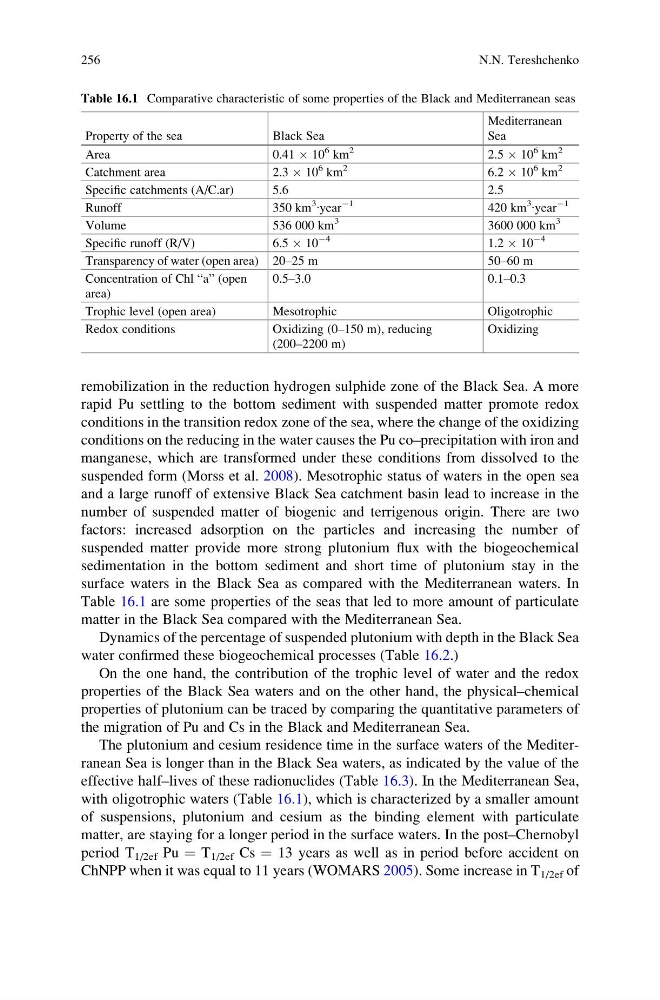
surface waters in the Black Sea as compared with the Mediterranean waters. In
Table 16.1 are some properties of the seas that led to more amount of particulate
matter in the Black Sea compared with the Mediterranean Sea.
Dynamics of the percentage of suspended plutonium with depth in the Black Sea
water confirmed these biogeochemical processes (Table 16.2.)
On the one hand, the contribution of the trophic level of water and the redox
properties of the Black Sea waters and on the other hand, the physical–chemical
properties of plutonium can be traced by comparing the quantitative parameters of
the migration of Pu and Cs in the Black and Mediterranean Sea.
The plutonium and cesium residence time in the surface waters of the Mediterranean Sea is longer than in the Black Sea waters, as indicated by the value of the
effective half–lives of these radionuclides (Table 16.3). In the Mediterranean Sea,
with oligotrophic waters (Table 16.1), which is characterized by a smaller amount
of suspensions, plutonium and cesium as the binding element with particulate
matter, are staying for a longer period in the surface waters. In the post–Chernobyl
period T 1/2ef Pu ¼ T 1/2ef Cs ¼ 13 years as well as in period before accident on
ChNPP when it was equal to 11 years (WOMARS 2005). Some increase in T 1/2ef of
Table 16.1 Comparative characteristic of some properties of the Black and Mediterranean seas
Property of the sea
Black Sea
Mediterranean
Sea
Area
0.41 Â 10
6 km
2
2.5 Â 10
6 km
2
Catchment area
2.3 Â 10
6 km
2
6.2 Â 10
6 km
2
Specific catchments (A/C.ar)
5.6
2.5
Runoff
350 km
3
∙year
À1
420 km
3
∙year
À1
Volume
536 000 km
3
3600 000 km
3
Specific runoff (R/V)
6.5 Â 10
À4
1.2 Â 10
À4
Transparency of water (open area) 20–25 m
50–60 m
Concentration of Chl “a” (open
area)
0.5–3.0
0.1–0.3
Trophic level (open area)
Mesotrophic
Oligotrophic
Redox conditions
Oxidizing (0–150 m), reducing
(200–2200 m)
Oxidizing
256
N.N. Tereshchenko
rapid Pu settling to the bottom sediment with suspended matter promote redox
conditions in the transition redox zone of the sea, where the change of the oxidizing
conditions on the reducing in the water causes the Pu co–precipitation with iron and
manganese, which are transformed under these conditions from dissolved to the
suspended form (Morss et al. 2008). Mesotrophic status of waters in the open sea
and a large runoff of extensive Black Sea catchment basin lead to increase in the
number of suspended matter of biogenic and terrigenous origin. There are two
factors: increased adsorption on the particles and increasing the number of
suspended matter provide more strong plutonium flux with the biogeochemical
sedimentation in the bottom sediment and short time of plutonium stay in the
surface waters in the Black Sea as compared with the Mediterranean waters. In
Table 16.1 are some properties of the seas that led to more amount of particulate
matter in the Black Sea compared with the Mediterranean Sea.
Dynamics of the percentage of suspended plutonium with depth in the Black Sea
water confirmed these biogeochemical processes (Table 16.2.)
On the one hand, the contribution of the trophic level of water and the redox
properties of the Black Sea waters and on the other hand, the physical–chemical
properties of plutonium can be traced by comparing the quantitative parameters of
the migration of Pu and Cs in the Black and Mediterranean Sea.
The plutonium and cesium residence time in the surface waters of the Mediterranean Sea is longer than in the Black Sea waters, as indicated by the value of the
effective half–lives of these radionuclides (Table 16.3). In the Mediterranean Sea,
with oligotrophic waters (Table 16.1), which is characterized by a smaller amount
of suspensions, plutonium and cesium as the binding element with particulate
matter, are staying for a longer period in the surface waters. In the post–Chernobyl
period T 1/2ef Pu ¼ T 1/2ef Cs ¼ 13 years as well as in period before accident on
ChNPP when it was equal to 11 years (WOMARS 2005). Some increase in T 1/2ef of
Table 16.1 Comparative characteristic of some properties of the Black and Mediterranean seas
Property of the sea
Black Sea
Mediterranean
Sea
Area
0.41 Â 10
6 km
2
2.5 Â 10
6 km
2
Catchment area
2.3 Â 10
6 km
2
6.2 Â 10
6 km
2
Specific catchments (A/C.ar)
5.6
2.5
Runoff
350 km
3
∙year
À1
420 km
3
∙year
À1
Volume
536 000 km
3
3600 000 km
3
Specific runoff (R/V)
6.5 Â 10
À4
1.2 Â 10
À4
Transparency of water (open area) 20–25 m
50–60 m
Concentration of Chl “a” (open
area)
0.5–3.0
0.1–0.3
Trophic level (open area)
Mesotrophic
Oligotrophic
Redox conditions
Oxidizing (0–150 m), reducing
(200–2200 m)
Oxidizing
256
N.N. Tereshchenko