

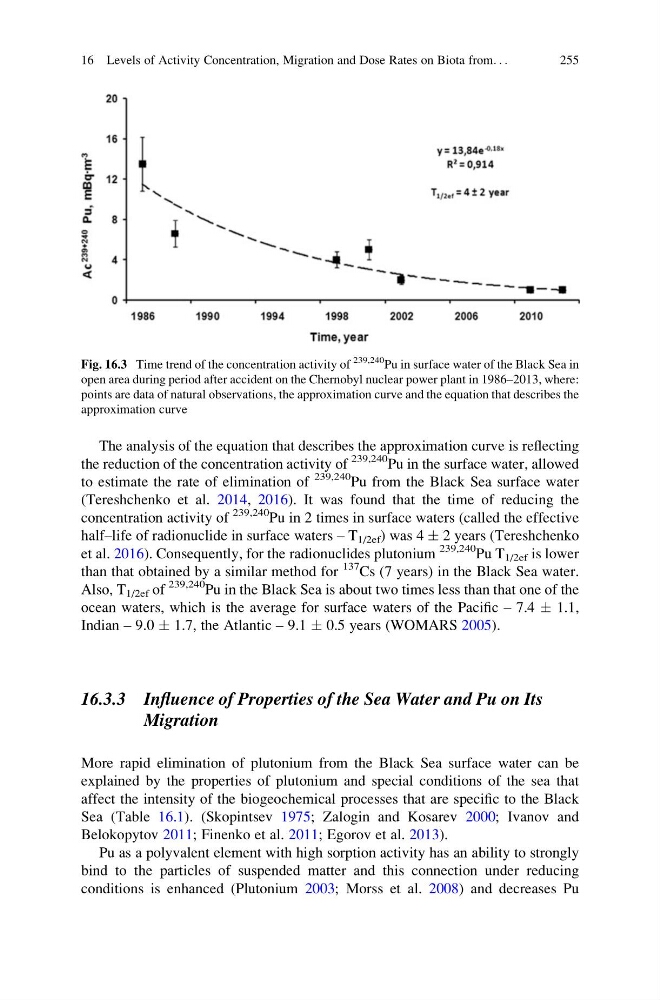
The analysis of the equation that describes the approximation curve is reflecting
the reduction of the concentration activity of
239,240 Pu in the surface water, allowed
to estimate the rate of elimination of
239,240 Pu from the Black Sea surface water
(Tereshchenko et al. 2014, 2016). It was found that the time of reducing the
concentration activity of
239,240 Pu in 2 times in surface waters (called the effective
half–life of radionuclide in surface waters – T 1/2ef ) was 4 Æ 2 years (Tereshchenko
et al. 2016). Consequently, for the radionuclides plutonium
239,240 Pu T 1/2ef is lower
than that obtained by a similar method for
137 Cs (7 years) in the Black Sea water.
Also, T 1/2ef of
239,240 Pu in the Black Sea is about two times less than that one of the
ocean waters, which is the average for surface waters of the Pacific – 7.4 Æ 1.1,
Indian – 9.0 Æ 1.7, the Atlantic – 9.1 Æ 0.5 years (WOMARS 2005).
16.3.3 Influence of Properties of the Sea Water and Pu on Its
Migration
More rapid elimination of plutonium from the Black Sea surface water can be
explained by the properties of plutonium and special conditions of the sea that
affect the intensity of the biogeochemical processes that are specific to the Black
Sea (Table 16.1). (Skopintsev 1975; Zalogin and Kosarev 2000; Ivanov and
Belokopytov 2011; Finenko et al. 2011; Egorov et al. 2013).
Pu as a polyvalent element with high sorption activity has an ability to strongly
bind to the particles of suspended matter and this connection under reducing
conditions is enhanced (Plutonium 2003; Morss et al. 2008) and decreases Pu
Fig. 16.3 Time trend of the concentration activity of
239,240
Pu in surface water of the Black Sea in
open area during period after accident on the Chernobyl nuclear power plant in 1986–2013, where:
points are data of natural observations, the approximation curve and the equation that describes the
approximation curve
16 Levels of Activity Concentration, Migration and Dose Rates on Biota from. . .
255
the reduction of the concentration activity of
239,240 Pu in the surface water, allowed
to estimate the rate of elimination of
239,240 Pu from the Black Sea surface water
(Tereshchenko et al. 2014, 2016). It was found that the time of reducing the
concentration activity of
239,240 Pu in 2 times in surface waters (called the effective
half–life of radionuclide in surface waters – T 1/2ef ) was 4 Æ 2 years (Tereshchenko
et al. 2016). Consequently, for the radionuclides plutonium
239,240 Pu T 1/2ef is lower
than that obtained by a similar method for
137 Cs (7 years) in the Black Sea water.
Also, T 1/2ef of
239,240 Pu in the Black Sea is about two times less than that one of the
ocean waters, which is the average for surface waters of the Pacific – 7.4 Æ 1.1,
Indian – 9.0 Æ 1.7, the Atlantic – 9.1 Æ 0.5 years (WOMARS 2005).
16.3.3 Influence of Properties of the Sea Water and Pu on Its
Migration
More rapid elimination of plutonium from the Black Sea surface water can be
explained by the properties of plutonium and special conditions of the sea that
affect the intensity of the biogeochemical processes that are specific to the Black
Sea (Table 16.1). (Skopintsev 1975; Zalogin and Kosarev 2000; Ivanov and
Belokopytov 2011; Finenko et al. 2011; Egorov et al. 2013).
Pu as a polyvalent element with high sorption activity has an ability to strongly
bind to the particles of suspended matter and this connection under reducing
conditions is enhanced (Plutonium 2003; Morss et al. 2008) and decreases Pu
Fig. 16.3 Time trend of the concentration activity of
239,240
Pu in surface water of the Black Sea in
open area during period after accident on the Chernobyl nuclear power plant in 1986–2013, where:
points are data of natural observations, the approximation curve and the equation that describes the
approximation curve
16 Levels of Activity Concentration, Migration and Dose Rates on Biota from. . .
255