

water at near estuaries and the open sea areas have declined markedly (IAEA 2004;
Polirarpov et al. 2008).
By the beginning of the 1990s, it was 4.1–6.4 mBq m
À3 in the deep water area of
the central and southern parts of the sea, 7.0–11.0 mBq m
À3 near the north–eastern
coast and by the end of the 1990s it has decreased to 3.0–4.0 mBq m
À3 in the
western parts of the Black Sea, as well as near the Crimean coast (Polikarpov et al.
1991; Sanchez et al. 1991; Buesseler and Livingston, 1996; IAEA 2004; Polikarpov
et al. 2008; Tereshchenko et al. 2014, 2016). In subsequent years, the
239,240 Pu
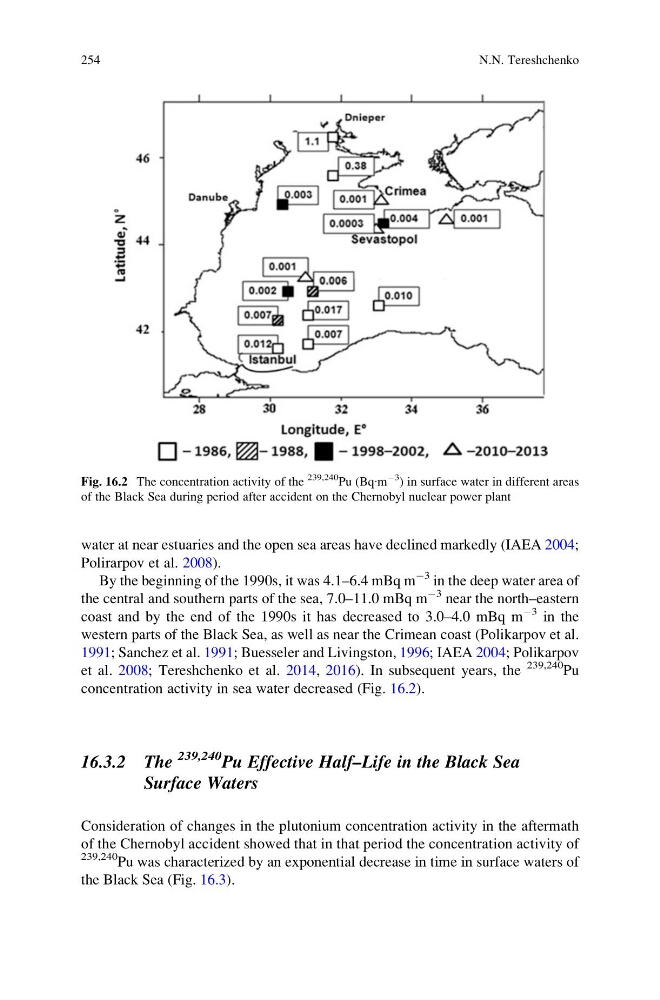
concentration activity in sea water decreased (Fig. 16.2).
16.3.2 The
239,240
Pu Effective Half–Life in the Black Sea
Surface Waters
Consideration of changes in the plutonium concentration activity in the aftermath
of the Chernobyl accident showed that in that period the concentration activity of
239,240 Pu was characterized by an exponential decrease in time in surface waters of
the Black Sea (Fig. 16.3).
Fig. 16.2 The concentration activity of the
239,240
Pu (Bq∙m
À3
) in surface water in different areas
of the Black Sea during period after accident on the Chernobyl nuclear power plant
254
N.N. Tereshchenko
Polirarpov et al. 2008).
By the beginning of the 1990s, it was 4.1–6.4 mBq m
À3 in the deep water area of
the central and southern parts of the sea, 7.0–11.0 mBq m
À3 near the north–eastern
coast and by the end of the 1990s it has decreased to 3.0–4.0 mBq m
À3 in the
western parts of the Black Sea, as well as near the Crimean coast (Polikarpov et al.
1991; Sanchez et al. 1991; Buesseler and Livingston, 1996; IAEA 2004; Polikarpov
et al. 2008; Tereshchenko et al. 2014, 2016). In subsequent years, the
239,240 Pu
concentration activity in sea water decreased (Fig. 16.2).
16.3.2 The
239,240
Pu Effective Half–Life in the Black Sea
Surface Waters
Consideration of changes in the plutonium concentration activity in the aftermath
of the Chernobyl accident showed that in that period the concentration activity of
239,240 Pu was characterized by an exponential decrease in time in surface waters of
the Black Sea (Fig. 16.3).
Fig. 16.2 The concentration activity of the
239,240
Pu (Bq∙m
À3
) in surface water in different areas
of the Black Sea during period after accident on the Chernobyl nuclear power plant
254
N.N. Tereshchenko