

16.3.1 Alhpa-Radioisotopes of Plutonium in the Black
Sea Water
In the 1986–1989 study of
238 Pu and
239,240
Pu concentration activity in the Black
Sea water showed that the activity ratio of
238 Pu/
239,240 Pu was approximately
0.1–0.3 in the central and southern parts of the sea (Polikarpov et al. 1990, 2008;
Tereshchenko et al. 2014, 2016). This date indicated that the total concentration
activity of plutonium caused by radioisotopes from the Chernobyl fallout as well as
from the global fallout, because the activity ratio of
238 Pu/
239,240 Pu were about
0.036 for plutonium isotopes from the global fallout and 0.4–0.5 for plutonium
isotopes from the Chernobyl fallout. The activity ratio of these components
depended on the history and routes of the Chernobyl radioactive contamination.
In general, the plutonium isotopes of the Chernobyl origin accounted for a smaller
part of the total contamination.
A different situation was observed in the North–western Black Sea, where the
input of radionuclides with river runoff (Dnieper, the Danube, Dniester, Southern Bug
rivers and the North Crimean Canal) was significant, along with atmospheric fallout
(Polikarpov et al. 1990). In the north–western part of the sea and the estuarine areas
239,240
Pu concentration activity was of approximately 0.3–1.1 Bq m
À3 in
1986–1988 (Fig. 16.2), wherein the ratio of
238
Pu/
239,240
Pu varied in the range
0.4–0.5, indicating that a prevailing share of the Chernobyl plutonium isotopes in
their total amount in these areas But even such a relatively high concentration activity
of plutonium in the seawater were several orders of magnitude below the permissible
concentrations of these radionuclides, and it did not threaten either human health or
hydrobionts (NRB-99/2009 2009).
The plutonium input to the Black Sea and its migration from the catchment area
led to formation of maximum concentration activity of
239,240 Pu in estuarine waters
at the north–western part of the sea for the next few years after the accident on
ChNPP. But over time the difference of the
239,240 Pu concentration activity levels in
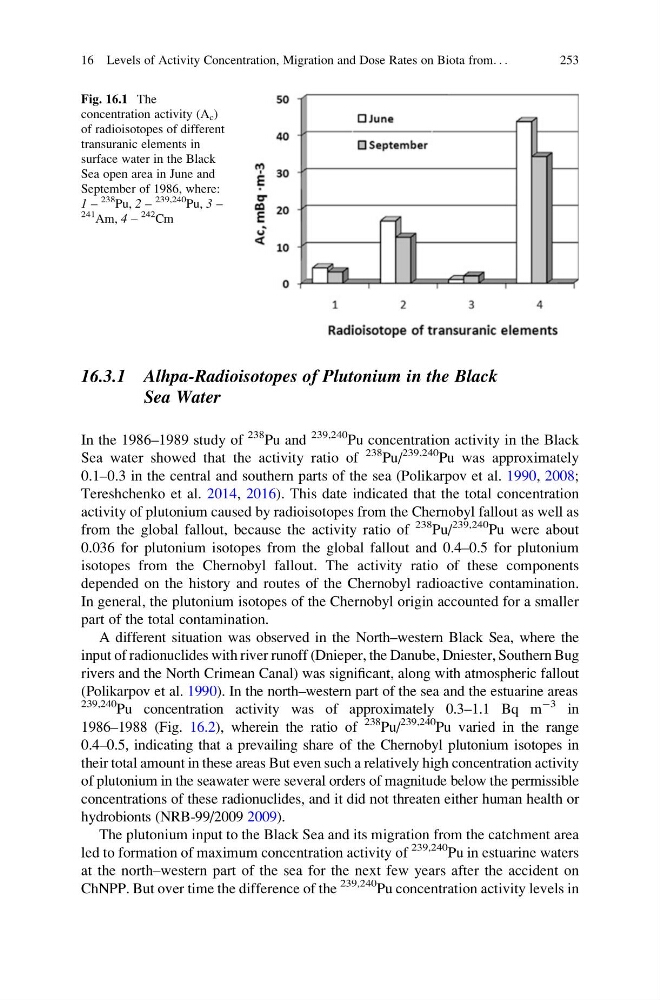
Fig. 16.1 The
concentration activity (A c )
of radioisotopes of different
transuranic elements in
surface water in the Black
Sea open area in June and
September of 1986, where:
1 –
238
Pu, 2 –
239,240
Pu, 3 –
241
Am, 4 –
242
Cm
16 Levels of Activity Concentration, Migration and Dose Rates on Biota from. . .
253
Sea Water
In the 1986–1989 study of
238 Pu and
239,240
Pu concentration activity in the Black
Sea water showed that the activity ratio of
238 Pu/
239,240 Pu was approximately
0.1–0.3 in the central and southern parts of the sea (Polikarpov et al. 1990, 2008;
Tereshchenko et al. 2014, 2016). This date indicated that the total concentration
activity of plutonium caused by radioisotopes from the Chernobyl fallout as well as
from the global fallout, because the activity ratio of
238 Pu/
239,240 Pu were about
0.036 for plutonium isotopes from the global fallout and 0.4–0.5 for plutonium
isotopes from the Chernobyl fallout. The activity ratio of these components
depended on the history and routes of the Chernobyl radioactive contamination.
In general, the plutonium isotopes of the Chernobyl origin accounted for a smaller
part of the total contamination.
A different situation was observed in the North–western Black Sea, where the
input of radionuclides with river runoff (Dnieper, the Danube, Dniester, Southern Bug
rivers and the North Crimean Canal) was significant, along with atmospheric fallout
(Polikarpov et al. 1990). In the north–western part of the sea and the estuarine areas
239,240
Pu concentration activity was of approximately 0.3–1.1 Bq m
À3 in
1986–1988 (Fig. 16.2), wherein the ratio of
238
Pu/
239,240
Pu varied in the range
0.4–0.5, indicating that a prevailing share of the Chernobyl plutonium isotopes in
their total amount in these areas But even such a relatively high concentration activity
of plutonium in the seawater were several orders of magnitude below the permissible
concentrations of these radionuclides, and it did not threaten either human health or
hydrobionts (NRB-99/2009 2009).
The plutonium input to the Black Sea and its migration from the catchment area
led to formation of maximum concentration activity of
239,240 Pu in estuarine waters
at the north–western part of the sea for the next few years after the accident on
ChNPP. But over time the difference of the
239,240 Pu concentration activity levels in
Fig. 16.1 The
concentration activity (A c )
of radioisotopes of different
transuranic elements in
surface water in the Black
Sea open area in June and
September of 1986, where:
1 –
238
Pu, 2 –
239,240
Pu, 3 –
241
Am, 4 –
242
Cm
16 Levels of Activity Concentration, Migration and Dose Rates on Biota from. . .
253