

7.2 Participatory Action
165
7.2 Participatory Action
7.2.1 Introduction
Why do people still worry about the status of nature or the natural environment, for example, the coastal environment, but usually act such as their behavior don’t cause impacts?
The evolvement of ICZM over the last decades shows a similar picture as drawn for the
environmentalism. Most of the people are worrying about the bad status and deterioration
of natural assets, but show a contradictory behavior. The reasons for that behavior are
diverse and won’t be in the focus of this section. Nevertheless, it seems to be important
to find new ways on how to deal with existing apprehension and dissatisfaction of both
the current status and anticipated future development of the natural environment and the
process and the enforcement of environmental legislation (e.g., Renn and Webler, 1994;
Renn, 1999).
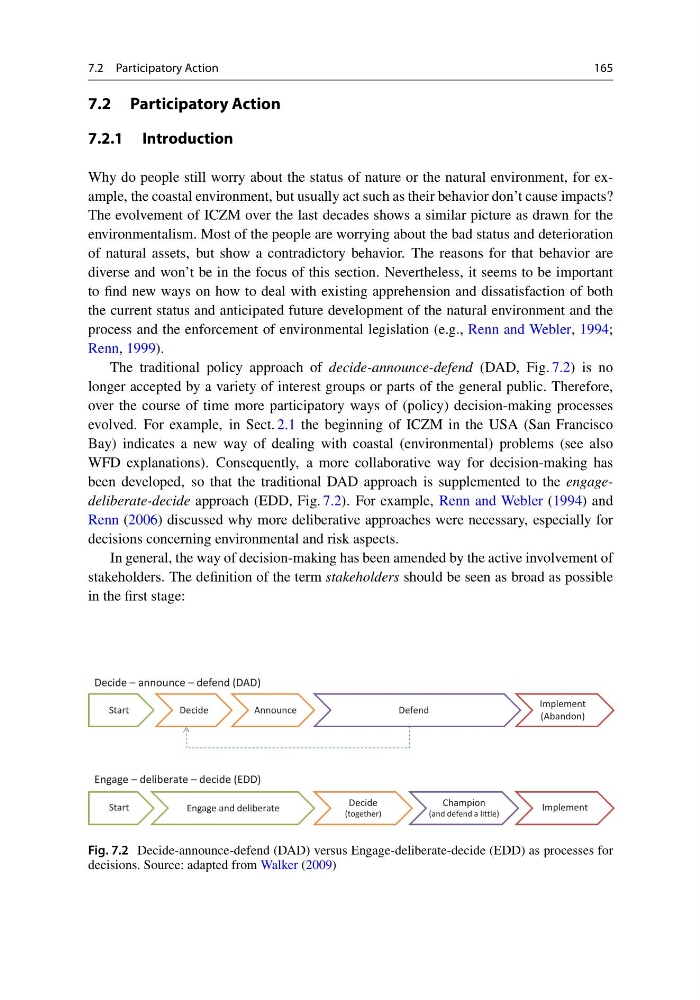
The traditional policy approach of decide-announce-defend (DAD, Fig. 7.2) is no
longer accepted by a variety of interest groups or parts of the general public. Therefore,
over the course of time more participatory ways of (policy) decision-making processes
evolved. For example, in Sect. 2.1 the beginning of ICZM in the USA (San Francisco
Bay) indicates a new way of dealing with coastal (environmental) problems (see also
WFD explanations). Consequently, a more collaborative way for decision-making has
been developed, so that the traditional DAD approach is supplemented to the engagedeliberate-decide approach (EDD, Fig. 7.2). For example, Renn and Webler (1994) and
Renn (2006) discussed why more deliberative approaches were necessary, especially for
decisions concerning environmental and risk aspects.
In general, the way of decision-making has been amended by the active involvement of
stakeholders. The definition of the term stakeholders should be seen as broad as possible
in the first stage:
Start
Decide
Announce
Defend
Implement
(Abandon)
Start
Engage and deliberate
Decide
(together)
Champion
(and defend a little)
Implement
Decide – announce – defend (DAD)
Engage – deliberate – decide (EDD)
Fig. 7.2 Decide-announce-defend (DAD) versus Engage-deliberate-decide (EDD) as processes for
decisions. Source: adapted from Walker (2009)
165
7.2 Participatory Action
7.2.1 Introduction
Why do people still worry about the status of nature or the natural environment, for example, the coastal environment, but usually act such as their behavior don’t cause impacts?
The evolvement of ICZM over the last decades shows a similar picture as drawn for the
environmentalism. Most of the people are worrying about the bad status and deterioration
of natural assets, but show a contradictory behavior. The reasons for that behavior are
diverse and won’t be in the focus of this section. Nevertheless, it seems to be important
to find new ways on how to deal with existing apprehension and dissatisfaction of both
the current status and anticipated future development of the natural environment and the
process and the enforcement of environmental legislation (e.g., Renn and Webler, 1994;
Renn, 1999).
The traditional policy approach of decide-announce-defend (DAD, Fig. 7.2) is no
longer accepted by a variety of interest groups or parts of the general public. Therefore,
over the course of time more participatory ways of (policy) decision-making processes
evolved. For example, in Sect. 2.1 the beginning of ICZM in the USA (San Francisco
Bay) indicates a new way of dealing with coastal (environmental) problems (see also
WFD explanations). Consequently, a more collaborative way for decision-making has
been developed, so that the traditional DAD approach is supplemented to the engagedeliberate-decide approach (EDD, Fig. 7.2). For example, Renn and Webler (1994) and
Renn (2006) discussed why more deliberative approaches were necessary, especially for
decisions concerning environmental and risk aspects.
In general, the way of decision-making has been amended by the active involvement of
stakeholders. The definition of the term stakeholders should be seen as broad as possible
in the first stage:
Start
Decide
Announce
Defend
Implement
(Abandon)
Start
Engage and deliberate
Decide
(together)
Champion
(and defend a little)
Implement
Decide – announce – defend (DAD)
Engage – deliberate – decide (EDD)
Fig. 7.2 Decide-announce-defend (DAD) versus Engage-deliberate-decide (EDD) as processes for
decisions. Source: adapted from Walker (2009)