

5.4 Estuaries in the Southern North Sea Region
95
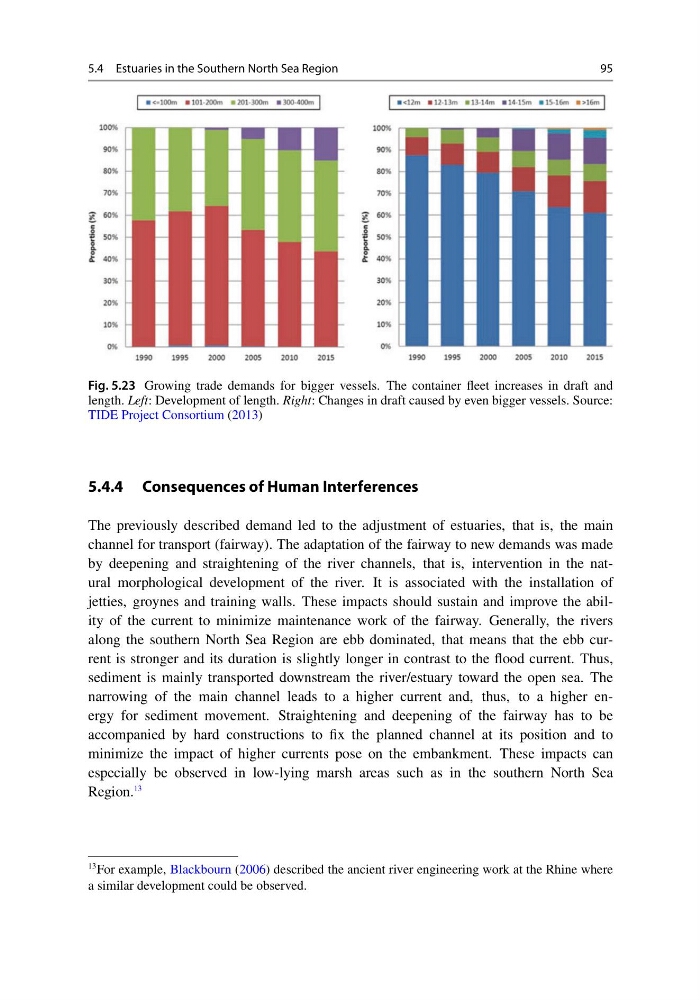
Fig. 5.23 Growing trade demands for bigger vessels. The container fleet increases in draft and
length. Left: Development of length. Right: Changes in draft caused by even bigger vessels. Source:
TIDE Project Consortium (2013)
5.4.4 Consequences of Human Interferences
The previously described demand led to the adjustment of estuaries, that is, the main
channel for transport (fairway). The adaptation of the fairway to new demands was made
by deepening and straightening of the river channels, that is, intervention in the natural morphological development of the river. It is associated with the installation of
jetties, groynes and training walls. These impacts should sustain and improve the ability of the current to minimize maintenance work of the fairway. Generally, the rivers
along the southern North Sea Region are ebb dominated, that means that the ebb current is stronger and its duration is slightly longer in contrast to the flood current. Thus,
sediment is mainly transported downstream the river/estuary toward the open sea. The
narrowing of the main channel leads to a higher current and, thus, to a higher energy for sediment movement. Straightening and deepening of the fairway has to be
accompanied by hard constructions to fix the planned channel at its position and to
minimize the impact of higher currents pose on the embankment. These impacts can
especially be observed in low-lying marsh areas such as in the southern North Sea
Region.
13
13 For example, Blackbourn (2006) described the ancient river engineering work at the Rhine where
a similar development could be observed.
95
Fig. 5.23 Growing trade demands for bigger vessels. The container fleet increases in draft and
length. Left: Development of length. Right: Changes in draft caused by even bigger vessels. Source:
TIDE Project Consortium (2013)
5.4.4 Consequences of Human Interferences
The previously described demand led to the adjustment of estuaries, that is, the main
channel for transport (fairway). The adaptation of the fairway to new demands was made
by deepening and straightening of the river channels, that is, intervention in the natural morphological development of the river. It is associated with the installation of
jetties, groynes and training walls. These impacts should sustain and improve the ability of the current to minimize maintenance work of the fairway. Generally, the rivers
along the southern North Sea Region are ebb dominated, that means that the ebb current is stronger and its duration is slightly longer in contrast to the flood current. Thus,
sediment is mainly transported downstream the river/estuary toward the open sea. The
narrowing of the main channel leads to a higher current and, thus, to a higher energy for sediment movement. Straightening and deepening of the fairway has to be
accompanied by hard constructions to fix the planned channel at its position and to
minimize the impact of higher currents pose on the embankment. These impacts can
especially be observed in low-lying marsh areas such as in the southern North Sea
Region.
13
13 For example, Blackbourn (2006) described the ancient river engineering work at the Rhine where
a similar development could be observed.