

64
00
1-0
Q 9 3
~u.
cr~
~:3 2
-z
Wz
~
(f)~
is
Exercise 5
9. Designate the appropriate berm for Bfs by comparing the theoretical Qllf, with your values
for QBfs' Compute the appropriate recurrence intervals for each of the estimated discharge
values measured in 7 above. Calculate the ratio:
estimated discharge (Q)
mean annual flood (MAF) discharge
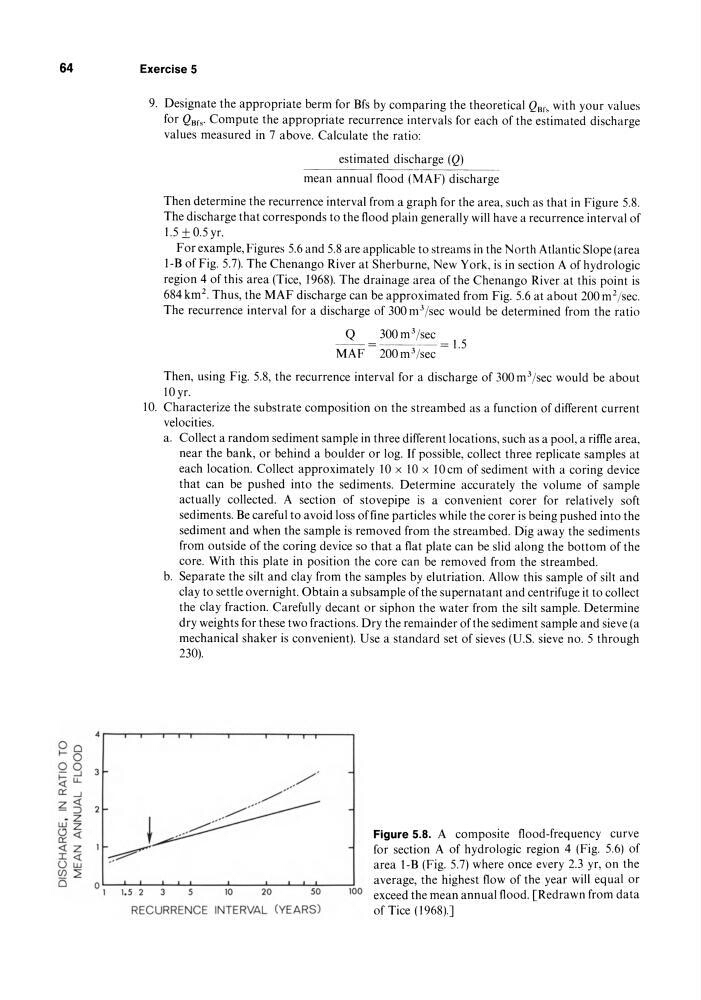
Then determine the recurrence interval from a graph for the area, such as that in Figure 5.8.
The discharge that corresponds to the flood plain generally will have a recurrence interval of
1.5 ± 0.5 yr.
For example, Figures 5.6 and 5.8 are applicable to streams in the North Atlantic Slope (area
1-B of Fig. 5.7). The Chenango River at Sherburne, New York, is in section A of hydrologic
region 4 of this area (Tice, 1968). The drainage area of the Chenango River at this point is
684 km 2 . Thus, the MAF discharge can be approximated from Fig. 5.6 at about 200 m 2 jsec.
The recurrence interval for a discharge of 300 m 3 jsec would be determined from the ratio
Q
300m J /sec
- -
= -
-
-= 1.5
MAF 200m J /sec
Then, using Fig. 5.8, the recurrence interval for a discharge of 300 m 3/sec would be about
10 yr.
10. Characterize the substrate composition on the streambed as a function of different current
velocities.
a. Collect a random sediment sample in three different locations, such as a pool, a rime area,
near the bank, or behind a boulder or log. If possible, collect three replicate samples at
each location. Collect approximately 10 x lOx 10 em of sediment with a coring device
that can be pushed into the sediments. Determine accurately the volume of sample
actually collected. A section of stovepipe is a convenient corer for relatively soft
sediments. Be careful to avoid loss of fine particles while the corer is being pushed into the
sediment and when the sample is removed from the streambed. Dig away the sediments
from outside of the coring device so that a flat plate can be slid along the bottom of the
core. With this plate in position the core can be removed from the streambed.
b. Separate the silt and clay from the samples by elutriation. Allow this sample of silt and
clay to settle overnight. Obtain a subsample of the supernatant and centrifuge it to collect
the clay fraction. Carefully decant or siphon the water from the silt sample. Determine
dry weights for these two fractions. Dry the remainder of the sediment sample and sieve (a
mechanical shaker is convenient). Use a standard set of sieves (U.S. sieve no. 5 through
230).
1.5 2
3
5
10
20
50
RECURRENCE INTERVAL (YEARS)
Figure 5.B. A composite flood-frequency curve
for section A of hydrologic region 4 (Fig. 5.6) of
area I-B (Fig. 5.7) where once every 2.3 yr, on the
average, the highest flow of the year will equal or
100 exceed the mean annual flood. [Redrawn from data
of Tice (\968).]
00
1-0
Q 9 3
~u.
cr~
~:3 2
-z
Wz
~
(f)~
is
Exercise 5
9. Designate the appropriate berm for Bfs by comparing the theoretical Qllf, with your values
for QBfs' Compute the appropriate recurrence intervals for each of the estimated discharge
values measured in 7 above. Calculate the ratio:
estimated discharge (Q)
mean annual flood (MAF) discharge
Then determine the recurrence interval from a graph for the area, such as that in Figure 5.8.
The discharge that corresponds to the flood plain generally will have a recurrence interval of
1.5 ± 0.5 yr.
For example, Figures 5.6 and 5.8 are applicable to streams in the North Atlantic Slope (area
1-B of Fig. 5.7). The Chenango River at Sherburne, New York, is in section A of hydrologic
region 4 of this area (Tice, 1968). The drainage area of the Chenango River at this point is
684 km 2 . Thus, the MAF discharge can be approximated from Fig. 5.6 at about 200 m 2 jsec.
The recurrence interval for a discharge of 300 m 3 jsec would be determined from the ratio
Q
300m J /sec
- -
= -
-
-= 1.5
MAF 200m J /sec
Then, using Fig. 5.8, the recurrence interval for a discharge of 300 m 3/sec would be about
10 yr.
10. Characterize the substrate composition on the streambed as a function of different current
velocities.
a. Collect a random sediment sample in three different locations, such as a pool, a rime area,
near the bank, or behind a boulder or log. If possible, collect three replicate samples at
each location. Collect approximately 10 x lOx 10 em of sediment with a coring device
that can be pushed into the sediments. Determine accurately the volume of sample
actually collected. A section of stovepipe is a convenient corer for relatively soft
sediments. Be careful to avoid loss of fine particles while the corer is being pushed into the
sediment and when the sample is removed from the streambed. Dig away the sediments
from outside of the coring device so that a flat plate can be slid along the bottom of the
core. With this plate in position the core can be removed from the streambed.
b. Separate the silt and clay from the samples by elutriation. Allow this sample of silt and
clay to settle overnight. Obtain a subsample of the supernatant and centrifuge it to collect
the clay fraction. Carefully decant or siphon the water from the silt sample. Determine
dry weights for these two fractions. Dry the remainder of the sediment sample and sieve (a
mechanical shaker is convenient). Use a standard set of sieves (U.S. sieve no. 5 through
230).
1.5 2
3
5
10
20
50
RECURRENCE INTERVAL (YEARS)
Figure 5.B. A composite flood-frequency curve
for section A of hydrologic region 4 (Fig. 5.6) of
area I-B (Fig. 5.7) where once every 2.3 yr, on the
average, the highest flow of the year will equal or
100 exceed the mean annual flood. [Redrawn from data
of Tice (\968).]