

170
Exercise 11
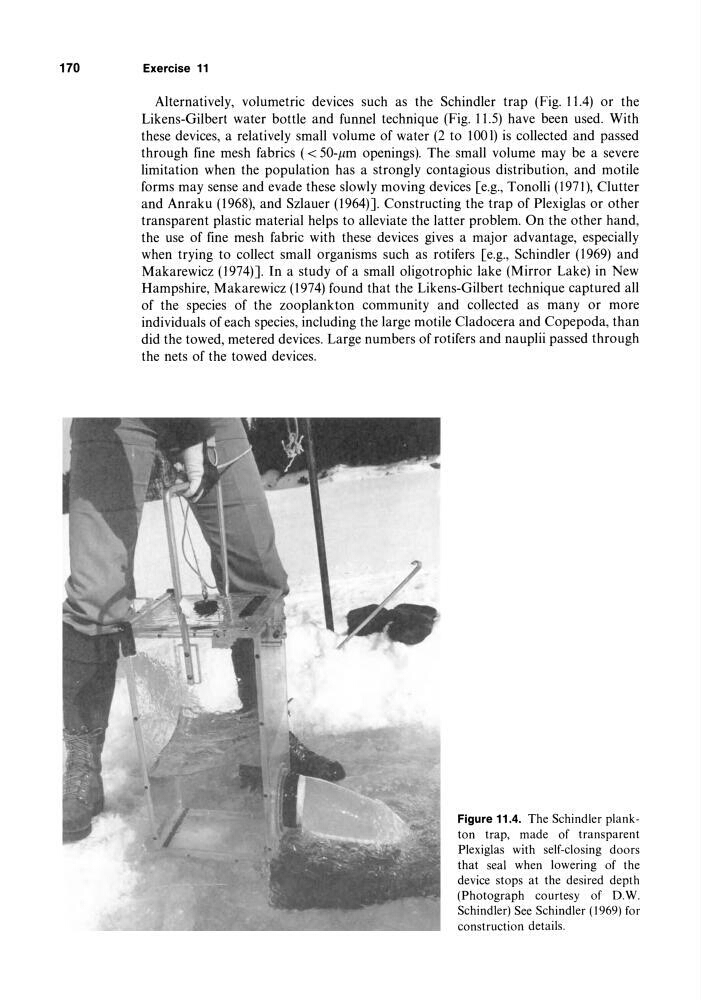
Alternatively, volumetric devices such as the Schindler trap (Fig. 11.4) or the
Likens-Gilbert water bottle and funnel technique (Fig. 11.5) have been used. With
these devices, a relatively small volume of water (2 to 1001) is collected and passed
through fine mesh fabrics ( < 50-pm openings). The small volume may be a severe
limitation when the population has a strongly contagious distribution, and motile
forms may sense and evade these slowly moving devices [e.g., Tonolli (1971), Clutter
and Amaku (1968), and Szlauer (1964)]. Constructing the trap of Plexiglas or other
transparent plastic material helps to alleviate the latter problem. On the other hand,
the use of fine mesh fabric with these devices gives a major advantage, especially
when trying to collect small organisms such as rotifers [e.g., Schindler (1969) and
Makarewicz (1974)]. In a study of a small oligotrophic lake (Mirror Lake) in New
Hampshire, Makarewicz (1974) found that the Likens-Gilbert technique captured all
of the species of the zooplankton community and collected as many or more
individuals of each species, including the large motile Cladocera and Copepoda, than
did the towed, metered devices. Large numbers of rotifers and nauplii passed through
the nets of the towed devices.
Figure 11.4. The Schindler plankton trap, made of transparent
Plexiglas with self-closing doors
that seal when lowering of the
device stops at the desired depth
(Photograph courtesy of D.W.
Schindler) See Schindler (1969) for
construction details.
Exercise 11
Alternatively, volumetric devices such as the Schindler trap (Fig. 11.4) or the
Likens-Gilbert water bottle and funnel technique (Fig. 11.5) have been used. With
these devices, a relatively small volume of water (2 to 1001) is collected and passed
through fine mesh fabrics ( < 50-pm openings). The small volume may be a severe
limitation when the population has a strongly contagious distribution, and motile
forms may sense and evade these slowly moving devices [e.g., Tonolli (1971), Clutter
and Amaku (1968), and Szlauer (1964)]. Constructing the trap of Plexiglas or other
transparent plastic material helps to alleviate the latter problem. On the other hand,
the use of fine mesh fabric with these devices gives a major advantage, especially
when trying to collect small organisms such as rotifers [e.g., Schindler (1969) and
Makarewicz (1974)]. In a study of a small oligotrophic lake (Mirror Lake) in New
Hampshire, Makarewicz (1974) found that the Likens-Gilbert technique captured all
of the species of the zooplankton community and collected as many or more
individuals of each species, including the large motile Cladocera and Copepoda, than
did the towed, metered devices. Large numbers of rotifers and nauplii passed through
the nets of the towed devices.
Figure 11.4. The Schindler plankton trap, made of transparent
Plexiglas with self-closing doors
that seal when lowering of the
device stops at the desired depth
(Photograph courtesy of D.W.
Schindler) See Schindler (1969) for
construction details.