

Collection, Enumeration, and Biomass of Zooplankton
169
(F) may be calculated as follows:
W
F = ------(A)(D)
where W = volume of water filtered; A = area of mouth of sampler; and D = distance
towed.
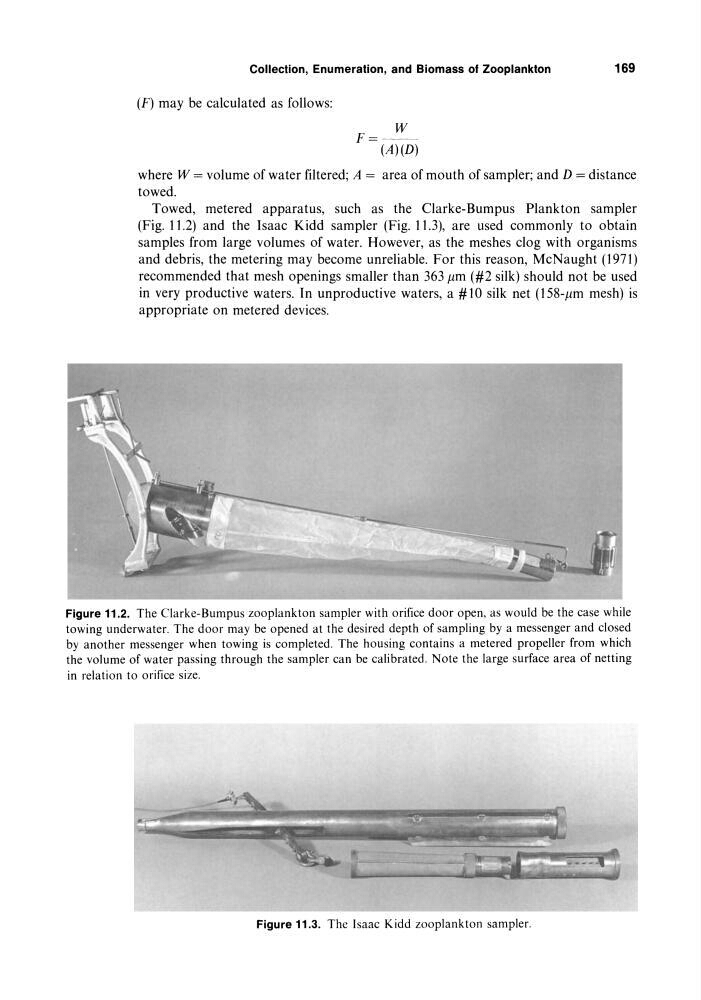
Towed, metered apparatus, such as the Clarke-Bumpus Plankton sampler
(Fig. 11.2) and the Isaac Kidd sampler (Fig. 11.3), are used commonly to obtain
samples from large volumes of water. However, as the meshes clog with organisms
and debris, the metering may become unreliable. For this reason, McNaught (1971)
recommended that mesh openings smaller than 363 pm (#2 silk) should not be used
in very productive waters. In unproductive waters, a # 10 silk net (158-pm mesh) is
appropriate on metered devices.
Figure 11.2. The Clarke-Bumpus zooplankton sampler with orifice door open, as would be the case while
towing underwater. The door may be opened at the desired depth of sampling by a messenger and closed
by another messenger when towing is completed. The housing contains a metered propeller from which
the volume of water passing through the sampler can be calibrated. Note the large surface area of netting
in relation to orifice size.
Figure 11.3. The Isaac Kidd zooplankton sampler.
169
(F) may be calculated as follows:
W
F = ------(A)(D)
where W = volume of water filtered; A = area of mouth of sampler; and D = distance
towed.
Towed, metered apparatus, such as the Clarke-Bumpus Plankton sampler
(Fig. 11.2) and the Isaac Kidd sampler (Fig. 11.3), are used commonly to obtain
samples from large volumes of water. However, as the meshes clog with organisms
and debris, the metering may become unreliable. For this reason, McNaught (1971)
recommended that mesh openings smaller than 363 pm (#2 silk) should not be used
in very productive waters. In unproductive waters, a # 10 silk net (158-pm mesh) is
appropriate on metered devices.
Figure 11.2. The Clarke-Bumpus zooplankton sampler with orifice door open, as would be the case while
towing underwater. The door may be opened at the desired depth of sampling by a messenger and closed
by another messenger when towing is completed. The housing contains a metered propeller from which
the volume of water passing through the sampler can be calibrated. Note the large surface area of netting
in relation to orifice size.
Figure 11.3. The Isaac Kidd zooplankton sampler.