

168
Exercise 11
. .
. .
RANDOM
..
. .
.
. .
.
CONTAGIOUS
UNIFORM OR REGULAR
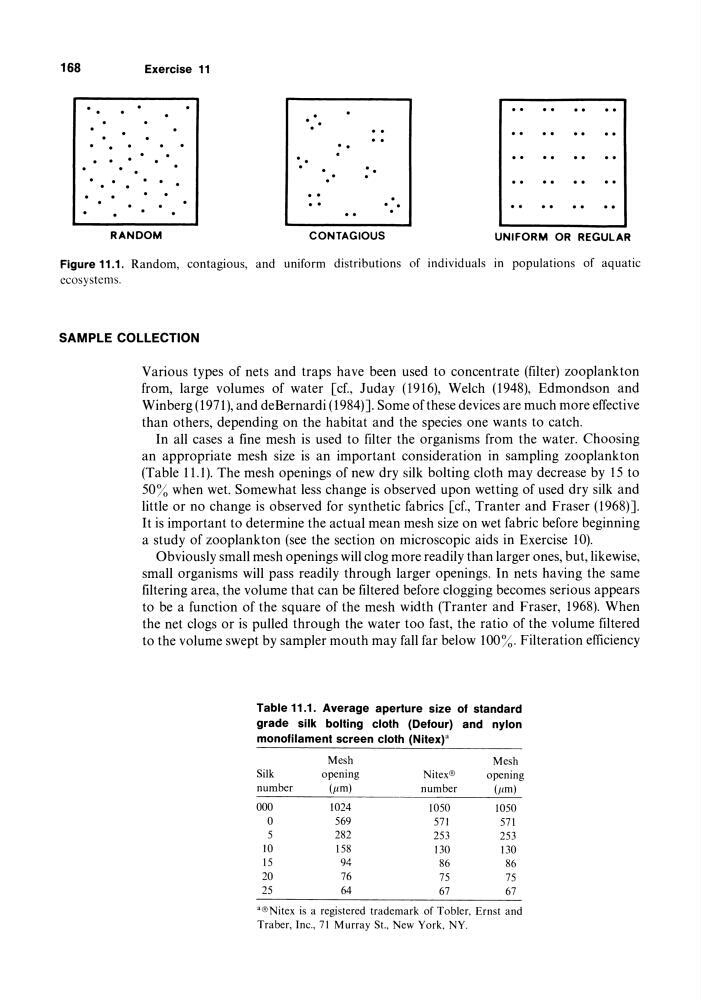
Figure 11.1. Random, contagious, and uniform distributions of individuals in populations of aquatic
ecosystems.
SAMPLE COLLECTION
Various types of nets and traps have been used to concentrate (filter) zooplankton
from, large volumes of water [cf., Juday (1916), Welch (1948), Edmondson and
Winberg (1971), and de Bernardi (1984)]. Some of these devices are much more effective
than others, depending on the habitat and the species one wants to catch.
In all cases a fine mesh is used to filter the organisms from the water. Choosing
an appropriate mesh size is an important consideration in sampling zooplankton
(Table 11.1). The mesh openings of new dry silk bolting cloth may decrease by 15 to
50% when wet. Somewhat less change is observed upon wetting of used dry silk and
little or no change is observed for synthetic fabrics [cf., Tranter and Fraser (1968)].
It is important to determine the actual mean mesh size on wet fabric before beginning
a study of zooplankton (see the section on microscopic aids in Exercise 10).
Obviously small mesh openings will clog more readily than larger ones, but, likewise,
small organisms will pass readily through larger openings. In nets having the same
filtering area, the volume that can be filtered before clogging becomes serious appears
to be a function of the square of the mesh width (Tranter and Fraser, 1968). When
the net clogs or is pulled through the water too fast, the ratio of the volume filtered
to the volume swept by sampler mouth may fall far below 100%. Filteration efficiency
Table 11.1. Average aperture size of standard
grade silk bolting cloth (Defour) and nylon
monofilament screen cloth (Nitex)"
Mesh
Mesh
Silk
opening
Nitcx®
opening
number
(Jim)
number
(jim)
000
1024
1050
1050
0
569
571
571
5
282
253
253
10
158
130
130
15
94
86
86
20
76
75
75
25
64
67
67
a®Nitex is a registered trademark of Tobler, Ernst and
Traber, Inc., 71 Murray St.. New York, NY.
Exercise 11
. .
. .
RANDOM
..
. .
.
. .
.
CONTAGIOUS
UNIFORM OR REGULAR
Figure 11.1. Random, contagious, and uniform distributions of individuals in populations of aquatic
ecosystems.
SAMPLE COLLECTION
Various types of nets and traps have been used to concentrate (filter) zooplankton
from, large volumes of water [cf., Juday (1916), Welch (1948), Edmondson and
Winberg (1971), and de Bernardi (1984)]. Some of these devices are much more effective
than others, depending on the habitat and the species one wants to catch.
In all cases a fine mesh is used to filter the organisms from the water. Choosing
an appropriate mesh size is an important consideration in sampling zooplankton
(Table 11.1). The mesh openings of new dry silk bolting cloth may decrease by 15 to
50% when wet. Somewhat less change is observed upon wetting of used dry silk and
little or no change is observed for synthetic fabrics [cf., Tranter and Fraser (1968)].
It is important to determine the actual mean mesh size on wet fabric before beginning
a study of zooplankton (see the section on microscopic aids in Exercise 10).
Obviously small mesh openings will clog more readily than larger ones, but, likewise,
small organisms will pass readily through larger openings. In nets having the same
filtering area, the volume that can be filtered before clogging becomes serious appears
to be a function of the square of the mesh width (Tranter and Fraser, 1968). When
the net clogs or is pulled through the water too fast, the ratio of the volume filtered
to the volume swept by sampler mouth may fall far below 100%. Filteration efficiency
Table 11.1. Average aperture size of standard
grade silk bolting cloth (Defour) and nylon
monofilament screen cloth (Nitex)"
Mesh
Mesh
Silk
opening
Nitcx®
opening
number
(Jim)
number
(jim)
000
1024
1050
1050
0
569
571
571
5
282
253
253
10
158
130
130
15
94
86
86
20
76
75
75
25
64
67
67
a®Nitex is a registered trademark of Tobler, Ernst and
Traber, Inc., 71 Murray St.. New York, NY.