

ALKALINITY
The Inorganic Carbon Complex
111
Historically, the term alkalinity referred to the buffering capacity of the carbonate
system in water. Today, alkalinity is used interchangeably with acid neutralizing
capacity (ANC), which refers to the capacity to neutralize strong acids such as HCI,
H 2 S0 4 , and HN0 3 . Alkalinity in water is due to any dissolved species (usually weak
acid anions) that can accept and neutralize protons. Because CO 2 is relatively
abundant in water in gaseous and dissolved form, and carbonates are common as
primary minerals over wide areas of the Earth, most fresh waters contain bicarbonate
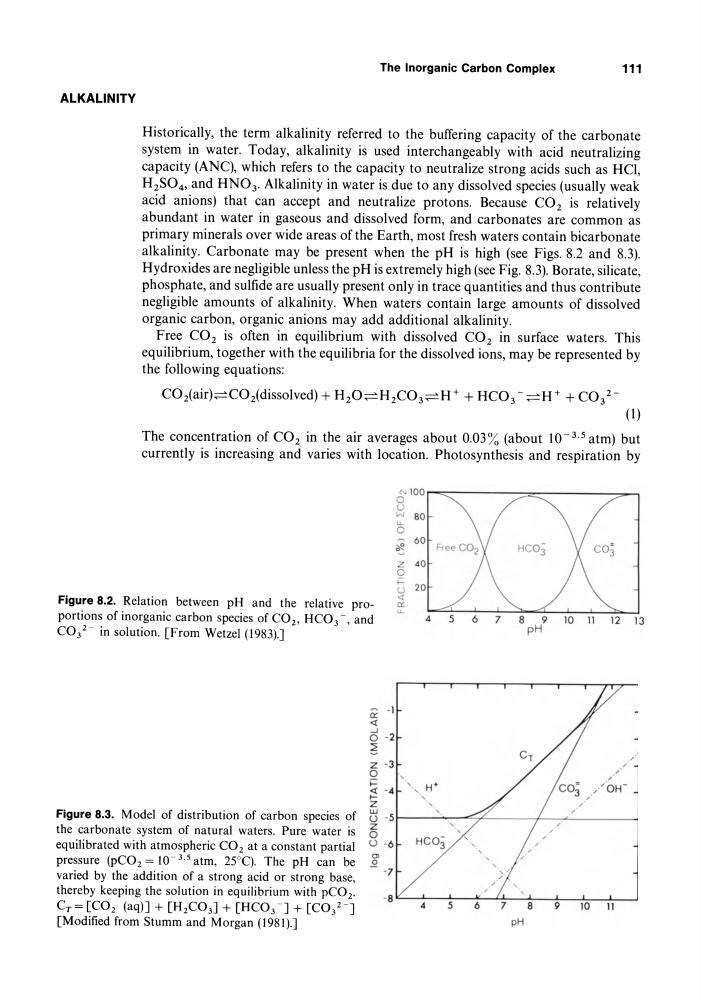
alkalinity. Carbonate may be present when the pH is high (see Figs. 8.2 and 8.3).
Hydroxides are negligible unless the pH is extremely high (see Fig. 8.3). Borate, silicate,
phosphate, and sulfide are usually present only in trace quantities and thus contribute
negligible amounts of alkalinity. When waters contain large amounts of dissolved
organic carbon, organic anions may add additional alkalinity.
Free CO 2 is often in equilibrium with dissolved CO 2 in surface waters. This
equilibrium, together with the equilibria for the dissolved ions, may be represented by
the following equations:
C02(air)~C02(dissolved) + H20~H2C03~H+ + HC0 3 - ~H+ + CO/(1)
The concentration of CO 2 in the air averages about 0.03 % (about 10- 3 . 5 atm) but
currently is increasing and varies with location. Photosynthesis and respiration by
N 100
0
U
w 80
u..
0
*60
z 40
Q
~
20
U
Figure 8.2. Relation between pH and the relative proportions of inorganic carbon species of COl' HC0 3 - , and
CO/ - in solution. [From Wetzel (1983).]
<4
Il:
u..
4
Figure 8.3. Model of distribution of carbon species of
the carbonate system of natural waters. Pure water is
equilibrated with atmospheric COl at a constant partial
pressure (pC0 2 = 10- 3 . 5 atm, 2S°C). The pH can be
varied by the addition of a strong acid or strong base,
thereby keeping the solution in equilibrium with pCO l .
CT = [COl (aq)] + [H l C0 3 ] + [HC0 3 -] + [CO/ - ]
[Modified from Stumm and Morgan (1981).]
cr <4
....J
0
~
z
Q
I<4
IZ
w
()
z
0
()
C>
.2
- I
- 2
-3 ,
-4
-5
- 6
-7
-8
, H+
, , , ,
,
HCO J
4
5
pH
The Inorganic Carbon Complex
111
Historically, the term alkalinity referred to the buffering capacity of the carbonate
system in water. Today, alkalinity is used interchangeably with acid neutralizing
capacity (ANC), which refers to the capacity to neutralize strong acids such as HCI,
H 2 S0 4 , and HN0 3 . Alkalinity in water is due to any dissolved species (usually weak
acid anions) that can accept and neutralize protons. Because CO 2 is relatively
abundant in water in gaseous and dissolved form, and carbonates are common as
primary minerals over wide areas of the Earth, most fresh waters contain bicarbonate
alkalinity. Carbonate may be present when the pH is high (see Figs. 8.2 and 8.3).
Hydroxides are negligible unless the pH is extremely high (see Fig. 8.3). Borate, silicate,
phosphate, and sulfide are usually present only in trace quantities and thus contribute
negligible amounts of alkalinity. When waters contain large amounts of dissolved
organic carbon, organic anions may add additional alkalinity.
Free CO 2 is often in equilibrium with dissolved CO 2 in surface waters. This
equilibrium, together with the equilibria for the dissolved ions, may be represented by
the following equations:
C02(air)~C02(dissolved) + H20~H2C03~H+ + HC0 3 - ~H+ + CO/(1)
The concentration of CO 2 in the air averages about 0.03 % (about 10- 3 . 5 atm) but
currently is increasing and varies with location. Photosynthesis and respiration by
N 100
0
U
w 80
u..
0
*60
z 40
Q
~
20
U
Figure 8.2. Relation between pH and the relative proportions of inorganic carbon species of COl' HC0 3 - , and
CO/ - in solution. [From Wetzel (1983).]
<4
Il:
u..
4
Figure 8.3. Model of distribution of carbon species of
the carbonate system of natural waters. Pure water is
equilibrated with atmospheric COl at a constant partial
pressure (pC0 2 = 10- 3 . 5 atm, 2S°C). The pH can be
varied by the addition of a strong acid or strong base,
thereby keeping the solution in equilibrium with pCO l .
CT = [COl (aq)] + [H l C0 3 ] + [HC0 3 -] + [CO/ - ]
[Modified from Stumm and Morgan (1981).]
cr <4
....J
0
~
z
Q
I<4
IZ
w
()
z
0
()
C>
.2
- I
- 2
-3 ,
-4
-5
- 6
-7
-8
, H+
, , , ,
,
HCO J
4
5
pH