

112
Exercise 8
aquatic organisms can influence substantially the quantity of CO 2 in water at any given
time and place.
For convenience, dissolved CO 2 and H l C0 3 can be added together and called free
CO 2 (H 2 C0 3 *) such that [H 2 C0 3 *] = [C0 2 ] + [H l C0 3 J. The equilibrium conditions in water are exemplified by the equations:
COl gas + HlO ~ Hl C03*
H2C03*';::~ H+ + HC0 3 -
HC0 3 - .;::= H+ + CO/(2)
(3)
(4)
These equilibrium equations represent a balance of ions in the reaction. For example,
adding protons will cause an imbalance to the right in these equations, which is
countered instantly by reactions which form ions on the left. Carbonate will react with
the protons and form bicarbonate (Eq. 4) which will react with more protons to form
carbonic acid (Eq. 3), which will convert back to CO 2 and water (Eq. 2). Likewise,
adding hydroxide, which removes protons, will shift the reactions to the left and will be
balanced by reactions to the right. In all cases, the concentration of protons will remain
nearly constant, and thus pH is relatively stable until the available supply of
bicarbonate and carbonate ions is exhausted.
Reaction 2 is not pH dependent, but when the partial pressure of CO 2 (pC0 2 in
atmospheres) is known, then the concentration of H 2 C0 3 * can be calculated from
H 2 C0 3 * = K H PC0 2 where KH = 10-1.5
For air, pCO l = 10- 3 . 5 ; thus H 2 C0 3 * in equilibrium with the atmosphere IS
10- 5 mol/I.
Reaction 3 is pH dependent according to the equation
K1 = [H*] [HC0 3 -]/[H 2 C0 3 *] = 10- 6 . 3
Thus, at pH = pK1 = 6.3; [HC0 3 -] = [H l C0 3 *], and buffering of this reaction is at
its maximum.
Reaction 3 is also pH dependent according to
K2 = [H+][CO/-]/[HC0 3 -] = 10- 103
Thus, at pH = pK2 = 10.3, [CO/-] = [HC0 3 -], and the buffering of this reaction is
at its maximum.
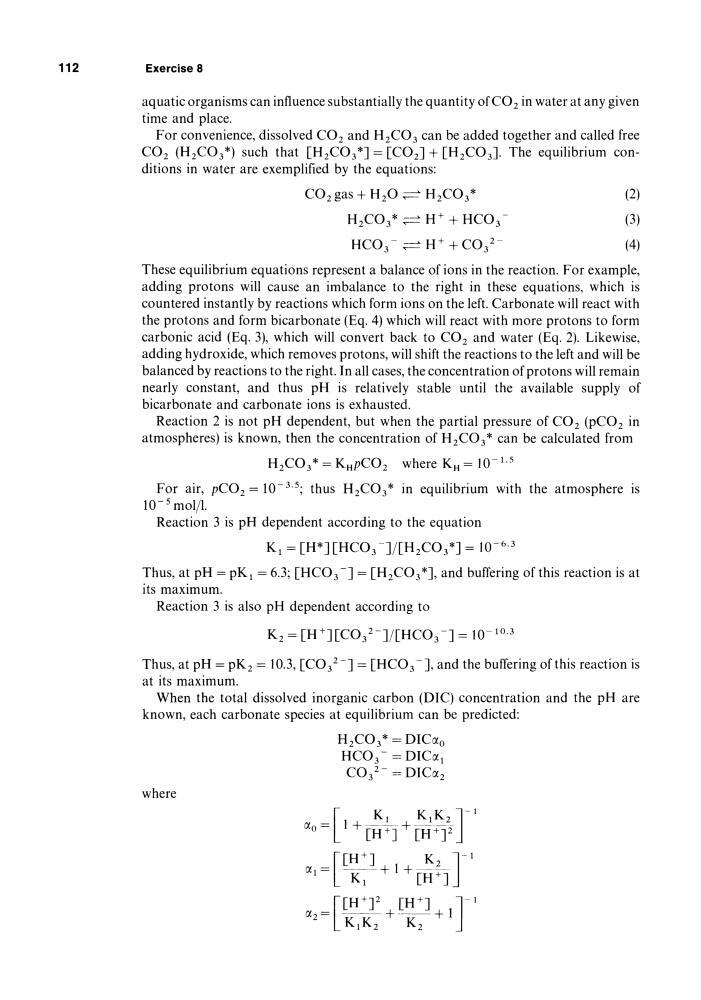
When the total dissolved inorganic carbon (DIC) concentration and the pH are
known, each carbonate species at equilibrium can be predicted:
where
H 2 C0 3 * = DICQ(o
HC0 3 - = DICQ(1
C0 3 2 - = DICIX 2
Exercise 8
aquatic organisms can influence substantially the quantity of CO 2 in water at any given
time and place.
For convenience, dissolved CO 2 and H l C0 3 can be added together and called free
CO 2 (H 2 C0 3 *) such that [H 2 C0 3 *] = [C0 2 ] + [H l C0 3 J. The equilibrium conditions in water are exemplified by the equations:
COl gas + HlO ~ Hl C03*
H2C03*';::~ H+ + HC0 3 -
HC0 3 - .;::= H+ + CO/(2)
(3)
(4)
These equilibrium equations represent a balance of ions in the reaction. For example,
adding protons will cause an imbalance to the right in these equations, which is
countered instantly by reactions which form ions on the left. Carbonate will react with
the protons and form bicarbonate (Eq. 4) which will react with more protons to form
carbonic acid (Eq. 3), which will convert back to CO 2 and water (Eq. 2). Likewise,
adding hydroxide, which removes protons, will shift the reactions to the left and will be
balanced by reactions to the right. In all cases, the concentration of protons will remain
nearly constant, and thus pH is relatively stable until the available supply of
bicarbonate and carbonate ions is exhausted.
Reaction 2 is not pH dependent, but when the partial pressure of CO 2 (pC0 2 in
atmospheres) is known, then the concentration of H 2 C0 3 * can be calculated from
H 2 C0 3 * = K H PC0 2 where KH = 10-1.5
For air, pCO l = 10- 3 . 5 ; thus H 2 C0 3 * in equilibrium with the atmosphere IS
10- 5 mol/I.
Reaction 3 is pH dependent according to the equation
K1 = [H*] [HC0 3 -]/[H 2 C0 3 *] = 10- 6 . 3
Thus, at pH = pK1 = 6.3; [HC0 3 -] = [H l C0 3 *], and buffering of this reaction is at
its maximum.
Reaction 3 is also pH dependent according to
K2 = [H+][CO/-]/[HC0 3 -] = 10- 103
Thus, at pH = pK2 = 10.3, [CO/-] = [HC0 3 -], and the buffering of this reaction is
at its maximum.
When the total dissolved inorganic carbon (DIC) concentration and the pH are
known, each carbonate species at equilibrium can be predicted:
where
H 2 C0 3 * = DICQ(o
HC0 3 - = DICQ(1
C0 3 2 - = DICIX 2