

44
The Radiocarbon Method to Estimate Primary Production
radioactivity. The use of other techniques such as centrifugation appears to be
unreasonable, particularly as a significant loss of 14C assimilates proceeds as a
natural process in organic matter exudation by algae cells even during the
incubation of bottled samples with the labeled carbonate (Fogg et al. 1965;
Nalewajko 1966). The photosynthetically 14C-Iabeled organic matter assimilated by algae not retained by filtration thus consists of the exudates excreted
in vivo by phytoplankton, of the smallest or extra thin algal cell passing though
the filter, and the protoplasm and debris of algal cells broken on mechanical
contact with the solid surface during filtration and passed through the filters
(see Sect. 2.4). The size of these losses may be very variable, depending on the
ambiental temperature and illumination, duration of exposure, volume of
bottles, and conditions of filtration. They range roughly between 5 and 40%
of total 14C assimilated by algae, thus entailing underestimations of primary
production. In eutrophic waters, dominated by dinoflagellates, the losses of
14C-assimilates during filtration are minor. In mesotrophic and eutrophic
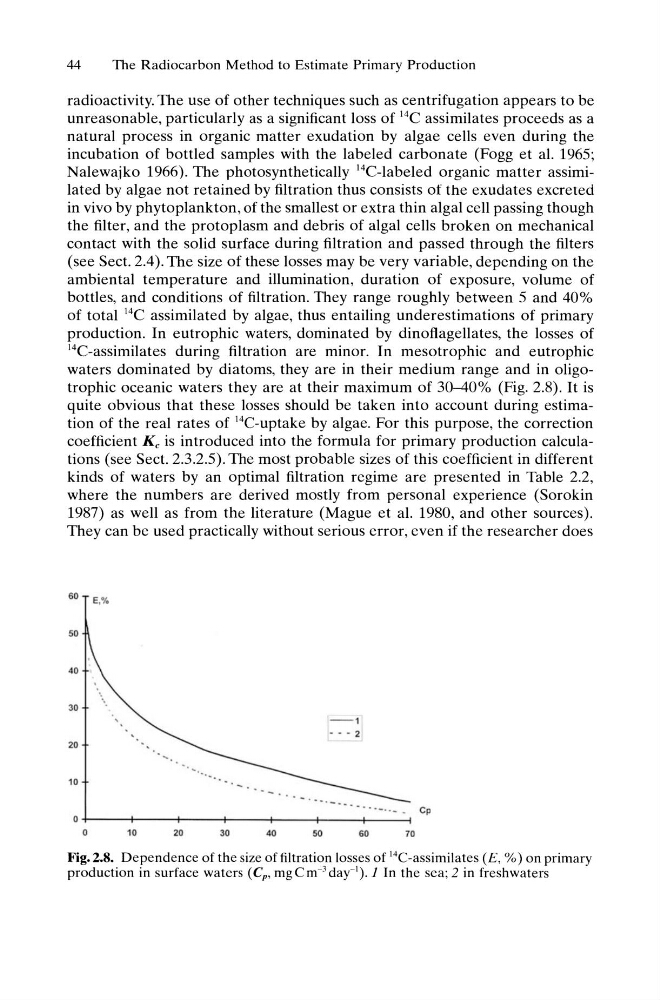
waters dominated by diatoms, they are in their medium range and in oligotrophic oceanic waters they are at their maximum of 30-40% (Fig. 2.8). It is
quite obvious that these losses should be taken into account during estimation of the real rates of 14C-uptake by algae. For this purpose, the correction
coefficient Kc is introduced into the formula for primary production calculations (see Sect. 2.3.2.5). The most probable sizes of this coefficient in different
kinds of waters by an optimal filtration regime are presented in Table 2.2,
where the numbers are derived mostly from personal experience (Sorokin
1987) as well as from the literature (Mague et al. 1980, and other sources).
They can be used practically without serious error, even if the researcher does
60
E,%
50
40
30
20
10
Cp
0
0
10
20
30
40
50
60
70
Fig. 2.8. Dependence of the size of filtration losses of 14C-assimilates (E, %) on primary
production in surface waters (Cp , mgCm- 3 day-l).1 In the sea; 2 in fresh waters
The Radiocarbon Method to Estimate Primary Production
radioactivity. The use of other techniques such as centrifugation appears to be
unreasonable, particularly as a significant loss of 14C assimilates proceeds as a
natural process in organic matter exudation by algae cells even during the
incubation of bottled samples with the labeled carbonate (Fogg et al. 1965;
Nalewajko 1966). The photosynthetically 14C-Iabeled organic matter assimilated by algae not retained by filtration thus consists of the exudates excreted
in vivo by phytoplankton, of the smallest or extra thin algal cell passing though
the filter, and the protoplasm and debris of algal cells broken on mechanical
contact with the solid surface during filtration and passed through the filters
(see Sect. 2.4). The size of these losses may be very variable, depending on the
ambiental temperature and illumination, duration of exposure, volume of
bottles, and conditions of filtration. They range roughly between 5 and 40%
of total 14C assimilated by algae, thus entailing underestimations of primary
production. In eutrophic waters, dominated by dinoflagellates, the losses of
14C-assimilates during filtration are minor. In mesotrophic and eutrophic
waters dominated by diatoms, they are in their medium range and in oligotrophic oceanic waters they are at their maximum of 30-40% (Fig. 2.8). It is
quite obvious that these losses should be taken into account during estimation of the real rates of 14C-uptake by algae. For this purpose, the correction
coefficient Kc is introduced into the formula for primary production calculations (see Sect. 2.3.2.5). The most probable sizes of this coefficient in different
kinds of waters by an optimal filtration regime are presented in Table 2.2,
where the numbers are derived mostly from personal experience (Sorokin
1987) as well as from the literature (Mague et al. 1980, and other sources).
They can be used practically without serious error, even if the researcher does
60
E,%
50
40
30
20
10
Cp
0
0
10
20
30
40
50
60
70
Fig. 2.8. Dependence of the size of filtration losses of 14C-assimilates (E, %) on primary
production in surface waters (Cp , mgCm- 3 day-l).1 In the sea; 2 in fresh waters