

Technique of Measuring Phytoplankton Primary Production
43
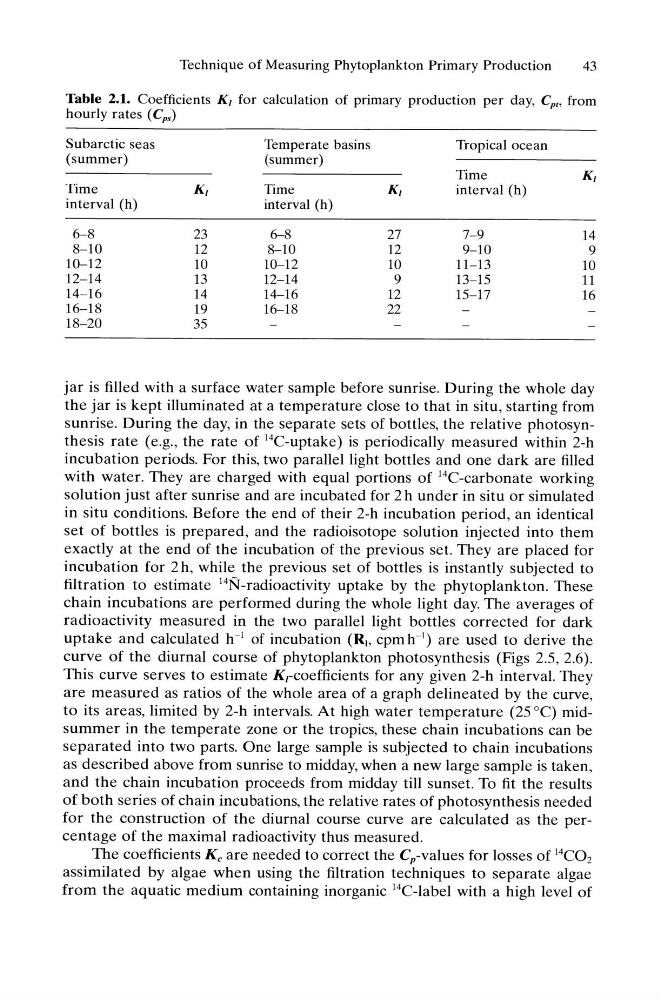
Table 2.1. Coefficients K/ for calculation of primary production per day, Cpt> from
hourly rates (Cps)
Subarctic seas
Temperate basins
Tropical ocean
(summer)
(summer)
Time
K/
Time
K/
Time
K/
interval (h)
interval (h)
interval (h)
6-8
23
6-8
27
7-9
14
8-10
12
8-10
12
9-10
9
10-12
10
10-12
10
11-13
10
12-14
13
12-14
9
13-15
11
14-16
14
14-16
12
15-17
16
16-18
19
16-18
22
18-20
35
jar is filled with a surface water sample before sunrise. During the whole day
the jar is kept illuminated at a temperature close to that in situ, starting from
sunrise. During the day, in the separate sets of bottles, the relative photosynthesis rate (e.g., the rate of 14C-uptake) is periodically measured within 2-h
incubation periods. For this, two parallel light bottles and one dark are filled
with water. They are charged with equal portions of 14C-carbonate working
solution just after sunrise and are incubated for 2h under in situ or simulated
in situ conditions. Before the end of their 2-h incubation period, an identical
set of bottles is prepared, and the radioisotope solution injected into them
exactly at the end of the incubation of the previous set. They are placed for
incubation for 2h, while the previous set of bottles is instantly subjected to
filtration to estimate 14N-radioactivity uptake by the phytoplankton. These
chain incubations are performed during the whole light day. The averages of
radioactivity measured in the two parallel light bottles corrected for dark
uptake and calculated h- 1 of incubation (Rb cpmh- 1 ) are used to derive the
curve of the diurnal course of phytoplankton photosynthesis (Figs 2.5, 2.6).
This curve serves to estimate Krcoefficients for any given 2-h interval. They
are measured as ratios of the whole area of a graph delineated by the curve,
to its areas, limited by 2-h intervals. At high water temperature (25°C) midsummer in the temperate zone or the tropics, these chain incubations can be
separated into two parts. One large sample is subjected to chain incubations
as described above from sunrise to midday, when a new large sample is taken,
and the chain incubation proceeds from midday till sunset. To fit the results
of both series of chain incubations, the relative rates of photosynthesis needed
for the construction of the diurnal course curve are calculated as the percentage of the maximal radioactivity thus measured.
The coefficients Kc are needed to correct the Cp-values for losses of 14C02
assimilated by algae when using the filtration techniques to separate algae
from the aquatic medium containing inorganic 14C-label with a high level of
43
Table 2.1. Coefficients K/ for calculation of primary production per day, Cpt> from
hourly rates (Cps)
Subarctic seas
Temperate basins
Tropical ocean
(summer)
(summer)
Time
K/
Time
K/
Time
K/
interval (h)
interval (h)
interval (h)
6-8
23
6-8
27
7-9
14
8-10
12
8-10
12
9-10
9
10-12
10
10-12
10
11-13
10
12-14
13
12-14
9
13-15
11
14-16
14
14-16
12
15-17
16
16-18
19
16-18
22
18-20
35
jar is filled with a surface water sample before sunrise. During the whole day
the jar is kept illuminated at a temperature close to that in situ, starting from
sunrise. During the day, in the separate sets of bottles, the relative photosynthesis rate (e.g., the rate of 14C-uptake) is periodically measured within 2-h
incubation periods. For this, two parallel light bottles and one dark are filled
with water. They are charged with equal portions of 14C-carbonate working
solution just after sunrise and are incubated for 2h under in situ or simulated
in situ conditions. Before the end of their 2-h incubation period, an identical
set of bottles is prepared, and the radioisotope solution injected into them
exactly at the end of the incubation of the previous set. They are placed for
incubation for 2h, while the previous set of bottles is instantly subjected to
filtration to estimate 14N-radioactivity uptake by the phytoplankton. These
chain incubations are performed during the whole light day. The averages of
radioactivity measured in the two parallel light bottles corrected for dark
uptake and calculated h- 1 of incubation (Rb cpmh- 1 ) are used to derive the
curve of the diurnal course of phytoplankton photosynthesis (Figs 2.5, 2.6).
This curve serves to estimate Krcoefficients for any given 2-h interval. They
are measured as ratios of the whole area of a graph delineated by the curve,
to its areas, limited by 2-h intervals. At high water temperature (25°C) midsummer in the temperate zone or the tropics, these chain incubations can be
separated into two parts. One large sample is subjected to chain incubations
as described above from sunrise to midday, when a new large sample is taken,
and the chain incubation proceeds from midday till sunset. To fit the results
of both series of chain incubations, the relative rates of photosynthesis needed
for the construction of the diurnal course curve are calculated as the percentage of the maximal radioactivity thus measured.
The coefficients Kc are needed to correct the Cp-values for losses of 14C02
assimilated by algae when using the filtration techniques to separate algae
from the aquatic medium containing inorganic 14C-label with a high level of