

Technique of Measuring Phytoplankton Primary Production
45
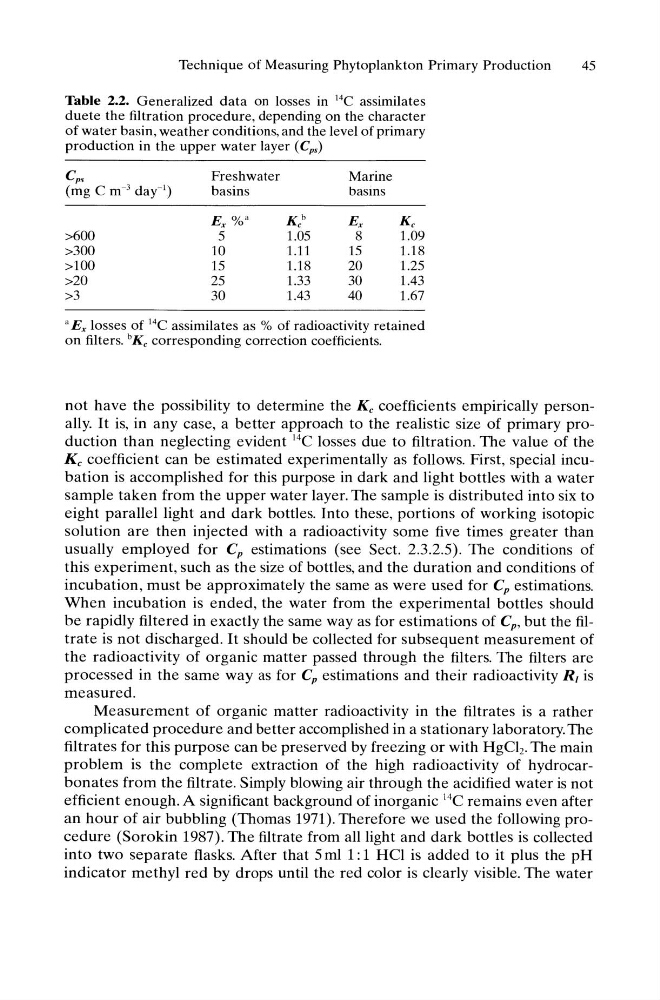
Table 2.2. Generalized data on losses in 14C assimilates
duete the filtration procedure, depending on the character
of water basin, weather conditions, and the level of primary
production in the upper water layer (Cps)
Cp.,
Freshwater
Marine
(mg C m- 3 day-I)
basins
basIns
Ex %a
Kb c
Ex
Kc
>600
5
1.05
8
1.09
>300
10
1.11
15
1.18
>100
15
1.18
20
1.25
>20
25
1.33
30
1.43
>3
30
1.43
40
1.67
a Ex losses of 14C assimilates as % of radioactivity retained
on filters. bKc corresponding correction coefficients.
not have the possibility to determine the Kc coefficients empirically personally. It is, in any case, a better approach to the realistic size of primary production than neglecting evident 14C losses due to filtration. The value of the
Kc coefficient can be estimated experimentally as follows. First, special incubation is accomplished for this purpose in dark and light bottles with a water
sample taken from the upper water layer. The sample is distributed into six to
eight parallel light and dark bottles. Into these, portions of working isotopic
solution are then injected with a radioactivity some five times greater than
usually employed for Cp estimations (see Sect. 2.3.2.5). The conditions of
this experiment, such as the size of bottles, and the duration and conditions of
incubation, must be approximately the same as were used for Cp estimations.
When incubation is ended, the water from the experimental bottles should
be rapidly filtered in exactly the same way as for estimations of Cp , but the filtrate is not discharged. It should be collected for subsequent measurement of
the radioactivity of organic matter passed through the filters. The filters are
processed in the same way as for Cp estimations and their radioactivity R[ is
measured.
Measurement of organic matter radioactivity in the filtrates is a rather
complicated procedure and better accomplished in a stationary laboratory. The
filtrates for this purpose can be preserved by freezing or with HgCI2• The main
problem is the complete extraction of the high radioactivity of hydro carbonates from the filtrate. Simply blowing air through the acidified water is not
efficient enough. A significant background of inorganic 14C remains even after
an hour of air bubbling (Thomas 1971). Therefore we used the following procedure (Sorokin 1987). The filtrate from all light and dark bottles is collected
into two separate flasks. After that 5 mil: 1 HCI is added to it plus the pH
indicator methyl red by drops until the red color is clearly visible. The water
45
Table 2.2. Generalized data on losses in 14C assimilates
duete the filtration procedure, depending on the character
of water basin, weather conditions, and the level of primary
production in the upper water layer (Cps)
Cp.,
Freshwater
Marine
(mg C m- 3 day-I)
basins
basIns
Ex %a
Kb c
Ex
Kc
>600
5
1.05
8
1.09
>300
10
1.11
15
1.18
>100
15
1.18
20
1.25
>20
25
1.33
30
1.43
>3
30
1.43
40
1.67
a Ex losses of 14C assimilates as % of radioactivity retained
on filters. bKc corresponding correction coefficients.
not have the possibility to determine the Kc coefficients empirically personally. It is, in any case, a better approach to the realistic size of primary production than neglecting evident 14C losses due to filtration. The value of the
Kc coefficient can be estimated experimentally as follows. First, special incubation is accomplished for this purpose in dark and light bottles with a water
sample taken from the upper water layer. The sample is distributed into six to
eight parallel light and dark bottles. Into these, portions of working isotopic
solution are then injected with a radioactivity some five times greater than
usually employed for Cp estimations (see Sect. 2.3.2.5). The conditions of
this experiment, such as the size of bottles, and the duration and conditions of
incubation, must be approximately the same as were used for Cp estimations.
When incubation is ended, the water from the experimental bottles should
be rapidly filtered in exactly the same way as for estimations of Cp , but the filtrate is not discharged. It should be collected for subsequent measurement of
the radioactivity of organic matter passed through the filters. The filters are
processed in the same way as for Cp estimations and their radioactivity R[ is
measured.
Measurement of organic matter radioactivity in the filtrates is a rather
complicated procedure and better accomplished in a stationary laboratory. The
filtrates for this purpose can be preserved by freezing or with HgCI2• The main
problem is the complete extraction of the high radioactivity of hydro carbonates from the filtrate. Simply blowing air through the acidified water is not
efficient enough. A significant background of inorganic 14C remains even after
an hour of air bubbling (Thomas 1971). Therefore we used the following procedure (Sorokin 1987). The filtrate from all light and dark bottles is collected
into two separate flasks. After that 5 mil: 1 HCI is added to it plus the pH
indicator methyl red by drops until the red color is clearly visible. The water