

Techniques for the Quantification Density of Microplankton Populations
281
As was mentioned above instead of primuline, the acridine orange staining
might be also applied. The time of staining in this case should be 2-3 times
shorter than due staining of bacterioplankton to get it weaker, not masking
the chlorophyll autofluorescence.
The reliability of measurements of phytoplankton biomass (biovolume Bp ,
mgm- 3 ) with this method (or with the sedimentation method) can be roughly
evaluated by simultaneous estimations of primary production in the same
samples incubated under natural illumination, (Ps. mgCm- 3 day-\ see Sect.
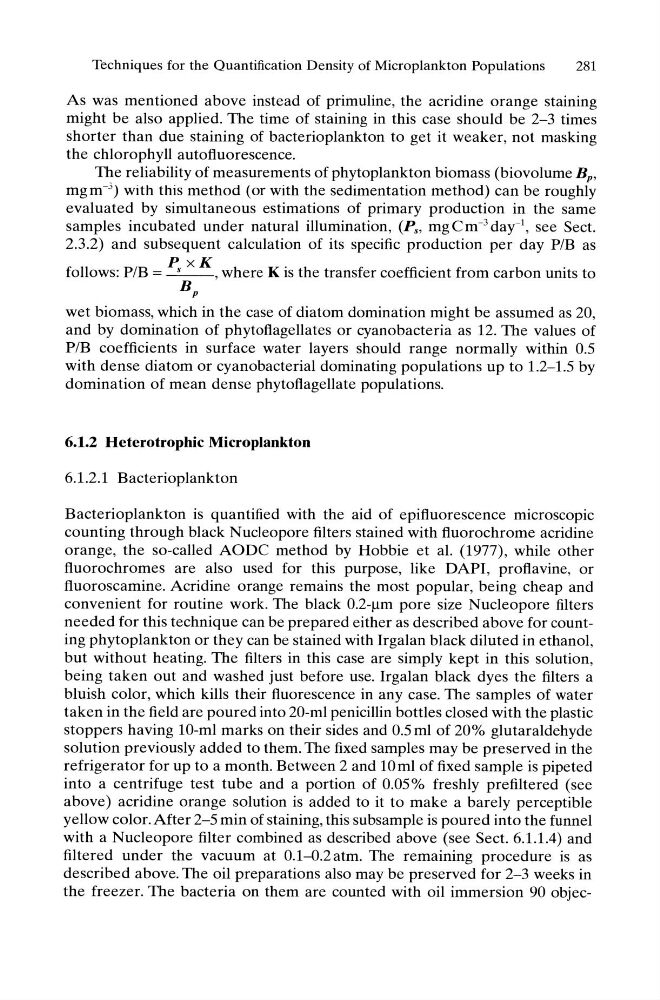
2.3.2) and subsequent calculation of its specific production per day PIB as
follows: PIB = P s x K, where K is the transfer coefficient from carbon units to
Bp
wet biomass, which in the case of diatom domination might be assumed as 20,
and by domination of phytoflagellates or cyanobacteria as 12. The values of
PIB coefficients in surface water layers should range normally within 0.5
with dense diatom or cyanobacterial dominating populations up to 1.2-1.5 by
domination of mean dense phytoflagellate populations.
6.1.2 Heterotrophic Microplankton
6.1.2.1 Bacterioplankton
Bacterioplankton is quantified with the aid of epifluorescence microscopic
counting through black NUcleopore filters stained with fluorochrome acridine
orange, the so-called AODC method by Hobbie et al. (1977), while other
fluorochromes are also used for this purpose, like DAPI, proflavine, or
fluoroscamine. Acridine orange remains the most popular, being cheap and
convenient for routine work. The black 0.2-l1m pore size Nucleopore filters
needed for this technique can be prepared either as described above for counting phytoplankton or they can be stained with Irgalan black diluted in ethanol,
but without heating. The filters in this case are simply kept in this solution,
being taken out and washed just before use. Irgalan black dyes the filters a
bluish color, which kills their fluorescence in any case. The samples of water
taken in the field are poured into 20-ml penicillin bottles closed with the plastic
stoppers having lO-ml marks on their sides and 0.5 ml of 20% glutaraldehyde
solution previously added to them. The fixed samples may be preserved in the
refrigerator for up to a month. Between 2 and lOml of fixed sample is pipeted
into a centrifuge test tube and a portion of 0.05% freshly prefiltered (see
above) acridine orange solution is added to it to make a barely perceptible
yellow color. After 2-5 min of staining, this subsample is poured into the funnel
with a Nucleopore filter combined as described above (see Sect. 6.1.1.4) and
filtered under the vacuum at 0.1-0.2 atm. The remaining procedure is as
described above. The oil preparations also may be preserved for 2-3 weeks in
the freezer. The bacteria on them are counted with oil immersion 90 objec-
281
As was mentioned above instead of primuline, the acridine orange staining
might be also applied. The time of staining in this case should be 2-3 times
shorter than due staining of bacterioplankton to get it weaker, not masking
the chlorophyll autofluorescence.
The reliability of measurements of phytoplankton biomass (biovolume Bp ,
mgm- 3 ) with this method (or with the sedimentation method) can be roughly
evaluated by simultaneous estimations of primary production in the same
samples incubated under natural illumination, (Ps. mgCm- 3 day-\ see Sect.
2.3.2) and subsequent calculation of its specific production per day PIB as
follows: PIB = P s x K, where K is the transfer coefficient from carbon units to
Bp
wet biomass, which in the case of diatom domination might be assumed as 20,
and by domination of phytoflagellates or cyanobacteria as 12. The values of
PIB coefficients in surface water layers should range normally within 0.5
with dense diatom or cyanobacterial dominating populations up to 1.2-1.5 by
domination of mean dense phytoflagellate populations.
6.1.2 Heterotrophic Microplankton
6.1.2.1 Bacterioplankton
Bacterioplankton is quantified with the aid of epifluorescence microscopic
counting through black NUcleopore filters stained with fluorochrome acridine
orange, the so-called AODC method by Hobbie et al. (1977), while other
fluorochromes are also used for this purpose, like DAPI, proflavine, or
fluoroscamine. Acridine orange remains the most popular, being cheap and
convenient for routine work. The black 0.2-l1m pore size Nucleopore filters
needed for this technique can be prepared either as described above for counting phytoplankton or they can be stained with Irgalan black diluted in ethanol,
but without heating. The filters in this case are simply kept in this solution,
being taken out and washed just before use. Irgalan black dyes the filters a
bluish color, which kills their fluorescence in any case. The samples of water
taken in the field are poured into 20-ml penicillin bottles closed with the plastic
stoppers having lO-ml marks on their sides and 0.5 ml of 20% glutaraldehyde
solution previously added to them. The fixed samples may be preserved in the
refrigerator for up to a month. Between 2 and lOml of fixed sample is pipeted
into a centrifuge test tube and a portion of 0.05% freshly prefiltered (see
above) acridine orange solution is added to it to make a barely perceptible
yellow color. After 2-5 min of staining, this subsample is poured into the funnel
with a Nucleopore filter combined as described above (see Sect. 6.1.1.4) and
filtered under the vacuum at 0.1-0.2 atm. The remaining procedure is as
described above. The oil preparations also may be preserved for 2-3 weeks in
the freezer. The bacteria on them are counted with oil immersion 90 objec-