

260
Use of Radioisotopes to Study Biogeochemical Cycling of Elements
Kp
0.9
0.6
0.3
0
..
~ .
; ;
.
.
. . .
.
100
AI
+ 12
8
4
2
• 1
0.5
' 2
200
300 Ps
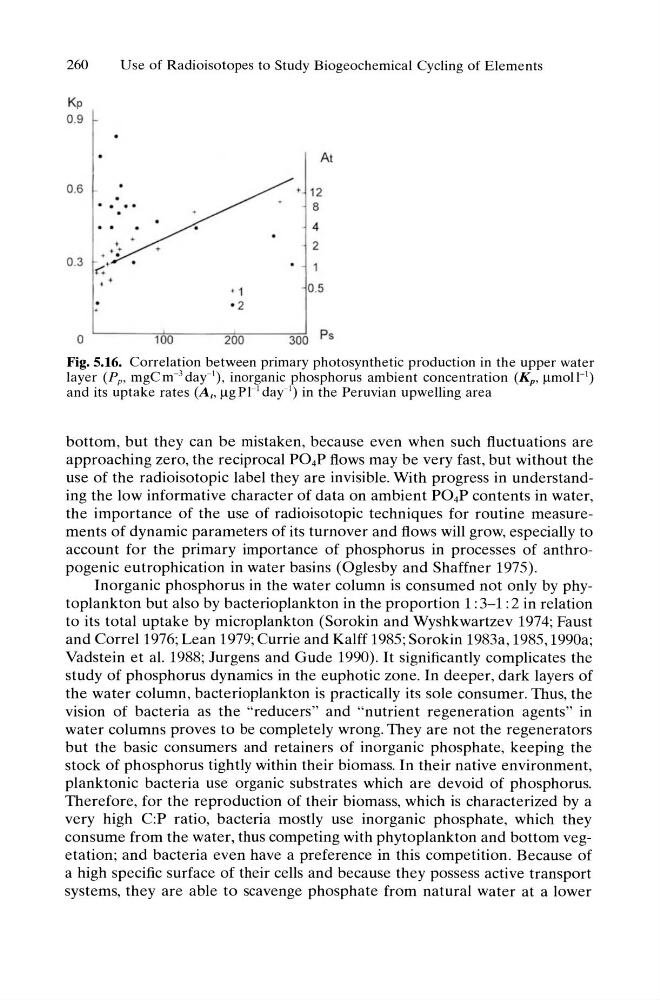
Fig. 5.16. Correlation between primary photosynthetic production in the upper water
layer (Pp , mgC m- 3 day-l), inorganic phosphorus ambient concentration (Kp, /lmoll- 1 )
and its uptake rates (At, /lg P I-I day-I) in the Peruvian upwelling area
bottom, but they can be mistaken, because even when such fluctuations are
approaching zero, the reciprocal P04P flows may be very fast, but without the
use of the radioisotopic label they are invisible. With progress in understanding the low informative character of data on ambient P04P contents in water,
the importance of the use of radioisotopic techniques for routine measurements of dynamic parameters of its turnover and flows will grow, especially to
account for the primary importance of phosphorus in processes of anthropogenic eutrophication in water basins (Oglesby and Shaffner 1975).
Inorganic phosphorus in the water column is consumed not only by phytoplankton but also by bacterioplankton in the proportion 1 : 3-1 : 2 in relation
to its total uptake by microplankton (Sorokin and Wyshkwartzev 1974; Faust
and Corre11976; Lean 1979; Currie and Kalff 1985; Sorokin 1983a, 1985, 1990a;
Vadstein et al. 1988; Jurgens and Gude 1990). It significantly complicates the
study of phosphorus dynamics in the euphotic zone. In deeper, dark layers of
the water column, bacterioplankton is practically its sole consumer. Thus, the
vision of bacteria as the "reducers" and "nutrient regeneration agents" in
water columns proves to be completely wrong. They are not the regenerators
but the basic consumers and retainers of inorganic phosphate, keeping the
stock of phosphorus tightly within their biomass. In their native environment,
planktonic bacteria use organic substrates which are devoid of phosphorus.
Therefore, for the reproduction of their biomass, which is characterized by a
very high CP ratio, bacteria mostly use inorganic phosphate, which they
consume from the water, thus competing with phytoplankton and bottom vegetation; and bacteria even have a preference in this competition. Because of
a high specific surface of their cells and because they possess active transport
systems, they are able to scavenge phosphate from natural water at a lower
Use of Radioisotopes to Study Biogeochemical Cycling of Elements
Kp
0.9
0.6
0.3
0
..
~ .
; ;
.
.
. . .
.
100
AI
+ 12
8
4
2
• 1
0.5
' 2
200
300 Ps
Fig. 5.16. Correlation between primary photosynthetic production in the upper water
layer (Pp , mgC m- 3 day-l), inorganic phosphorus ambient concentration (Kp, /lmoll- 1 )
and its uptake rates (At, /lg P I-I day-I) in the Peruvian upwelling area
bottom, but they can be mistaken, because even when such fluctuations are
approaching zero, the reciprocal P04P flows may be very fast, but without the
use of the radioisotopic label they are invisible. With progress in understanding the low informative character of data on ambient P04P contents in water,
the importance of the use of radioisotopic techniques for routine measurements of dynamic parameters of its turnover and flows will grow, especially to
account for the primary importance of phosphorus in processes of anthropogenic eutrophication in water basins (Oglesby and Shaffner 1975).
Inorganic phosphorus in the water column is consumed not only by phytoplankton but also by bacterioplankton in the proportion 1 : 3-1 : 2 in relation
to its total uptake by microplankton (Sorokin and Wyshkwartzev 1974; Faust
and Corre11976; Lean 1979; Currie and Kalff 1985; Sorokin 1983a, 1985, 1990a;
Vadstein et al. 1988; Jurgens and Gude 1990). It significantly complicates the
study of phosphorus dynamics in the euphotic zone. In deeper, dark layers of
the water column, bacterioplankton is practically its sole consumer. Thus, the
vision of bacteria as the "reducers" and "nutrient regeneration agents" in
water columns proves to be completely wrong. They are not the regenerators
but the basic consumers and retainers of inorganic phosphate, keeping the
stock of phosphorus tightly within their biomass. In their native environment,
planktonic bacteria use organic substrates which are devoid of phosphorus.
Therefore, for the reproduction of their biomass, which is characterized by a
very high CP ratio, bacteria mostly use inorganic phosphate, which they
consume from the water, thus competing with phytoplankton and bottom vegetation; and bacteria even have a preference in this competition. Because of
a high specific surface of their cells and because they possess active transport
systems, they are able to scavenge phosphate from natural water at a lower