

Study of the Dynamics of Phosphorus
261
concentration in comparison with phytoplankton (Table 5.1). So it is quite
obvious that during a study of its dynamics in pelagic communities, it is necessary to estimate the share of bacterioplankton in P04P consumption and
turnover. This goal appears to be quite accessible with the use of radioactive
labels (Sorokin 1985).
Another Important problem requiring the use of the theradioisotopic
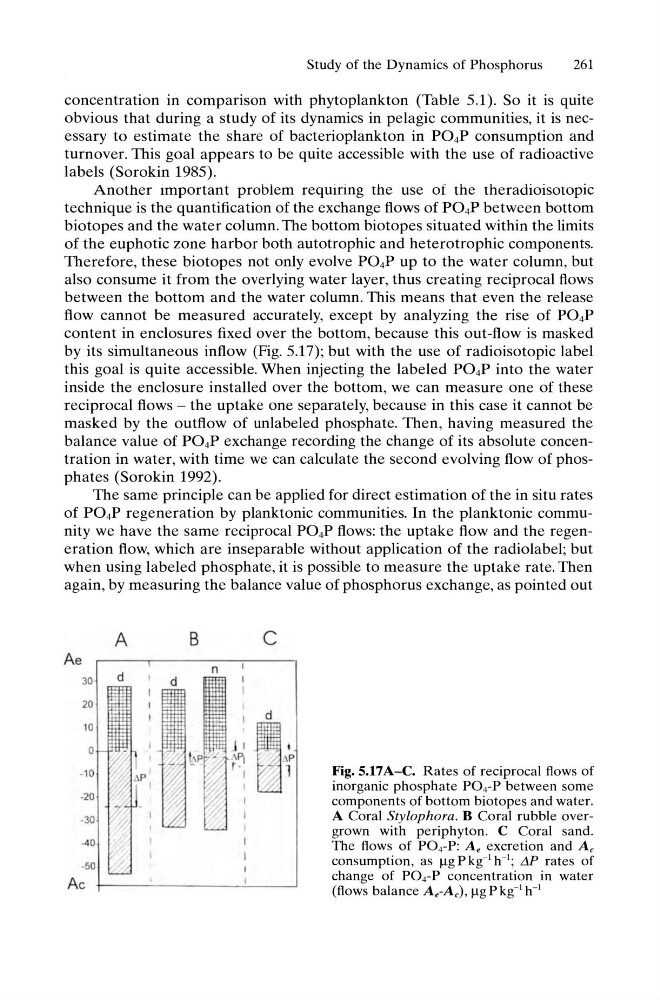
technique is the quantification of the exchange flows of P04P between bottom
biotopes and the water column. The bottom biotopes situated within the limits
of the euphotic zone harbor both autotrophic and heterotrophic components.
Therefore, these biotopes not only evolve P04P up to the water column, but
also consume it from the overlying water layer, thus creating reciprocal flows
between the bottom and the water column. This means that even the release
flow cannot be measured accurately, except by analyzing the rise of P04P
content in enclosures fixed over the bottom, because this out-flow is masked
by its simultaneous inflow (Fig. 5.17); but with the use of radioisotopic label
this goal is quite accessible. When injecting the labeled P04P into the water
inside the enclosure installed over the bottom, we can measure one of these
reciprocal flows - the uptake one separately, because in this case it cannot be
masked by the outflow of unlabeled phosphate. Then, having measured the
balance value of P04P exchange recording the change of its absolute concentration in water, with time we can calculate the second evolving flow of phosphates (Sorokin 1992).
The same principle can be applied for direct estimation of the in situ rates
of P04P regeneration by planktonic communities. In the planktonic community we have the same reciprocal P04P flows: the uptake flow and the regeneration flow, which are inseparable without application of the radiolabel; but
when using labeled phosphate, it is possible to measure the uptake rate. Then
again, by measuring the balance value of phosphorus exchange, as pointed out
Ae
30
20
10
·10
-20
-30
-40
-50
Ac
A
B
d
d
c
n
Fig. S.17A-C. Rates of reciprocal flows of
inorganic phosphate P04-P between some
components of bottom biotopes and water.
A Coral Stylophora. B Coral rubble overgrown with periphyton. C Coral sand.
The flows of P04-P: Ae excretion and Ac
consumption, as Ilg P kg-l h- 1 ; L1P rates of
change of P04-P concentration in water
(flows balance Ae-Ac), Ilg P kg- 1 h- 1
261
concentration in comparison with phytoplankton (Table 5.1). So it is quite
obvious that during a study of its dynamics in pelagic communities, it is necessary to estimate the share of bacterioplankton in P04P consumption and
turnover. This goal appears to be quite accessible with the use of radioactive
labels (Sorokin 1985).
Another Important problem requiring the use of the theradioisotopic
technique is the quantification of the exchange flows of P04P between bottom
biotopes and the water column. The bottom biotopes situated within the limits
of the euphotic zone harbor both autotrophic and heterotrophic components.
Therefore, these biotopes not only evolve P04P up to the water column, but
also consume it from the overlying water layer, thus creating reciprocal flows
between the bottom and the water column. This means that even the release
flow cannot be measured accurately, except by analyzing the rise of P04P
content in enclosures fixed over the bottom, because this out-flow is masked
by its simultaneous inflow (Fig. 5.17); but with the use of radioisotopic label
this goal is quite accessible. When injecting the labeled P04P into the water
inside the enclosure installed over the bottom, we can measure one of these
reciprocal flows - the uptake one separately, because in this case it cannot be
masked by the outflow of unlabeled phosphate. Then, having measured the
balance value of P04P exchange recording the change of its absolute concentration in water, with time we can calculate the second evolving flow of phosphates (Sorokin 1992).
The same principle can be applied for direct estimation of the in situ rates
of P04P regeneration by planktonic communities. In the planktonic community we have the same reciprocal P04P flows: the uptake flow and the regeneration flow, which are inseparable without application of the radiolabel; but
when using labeled phosphate, it is possible to measure the uptake rate. Then
again, by measuring the balance value of phosphorus exchange, as pointed out
Ae
30
20
10
·10
-20
-30
-40
-50
Ac
A
B
d
d
c
n
Fig. S.17A-C. Rates of reciprocal flows of
inorganic phosphate P04-P between some
components of bottom biotopes and water.
A Coral Stylophora. B Coral rubble overgrown with periphyton. C Coral sand.
The flows of P04-P: Ae excretion and Ac
consumption, as Ilg P kg-l h- 1 ; L1P rates of
change of P04-P concentration in water
(flows balance Ae-Ac), Ilg P kg- 1 h- 1