

232
Use of Radioisotopes to Study Biogeochemical Cycling of Elements
in aquatic habitats are measured with the aid of radioisotopic methods, using
sulfur or its compounds labeled with 35S radioisotope for this purpose. The
latter has soft radiation and a good life time (Table 1.1), being among the most
convenient radioisotopes for field work.
The radioisotopic methods for measuring the rates of in situ sulfate reduction to H zS and sulfide oxidation were devised by Ivanov (1956a,b; Ivanov and
Terebkova 1959). Since then, these methods have been repeatedly modified
after use by numerous researchers (Jorgensen 1982, 1990; Urban 1994).
5.5.2 Measuring the Rate of Sulfide Oxidation
Hydrogen sulfide dissolved in water exists in its two ionic forms: ions of sulfide
Sz- and hydrosulfide HS- 1 • The process of hydrogen sulfide oxidation proceeds
in water bodies in the redox zone, where its concentration usually varies within
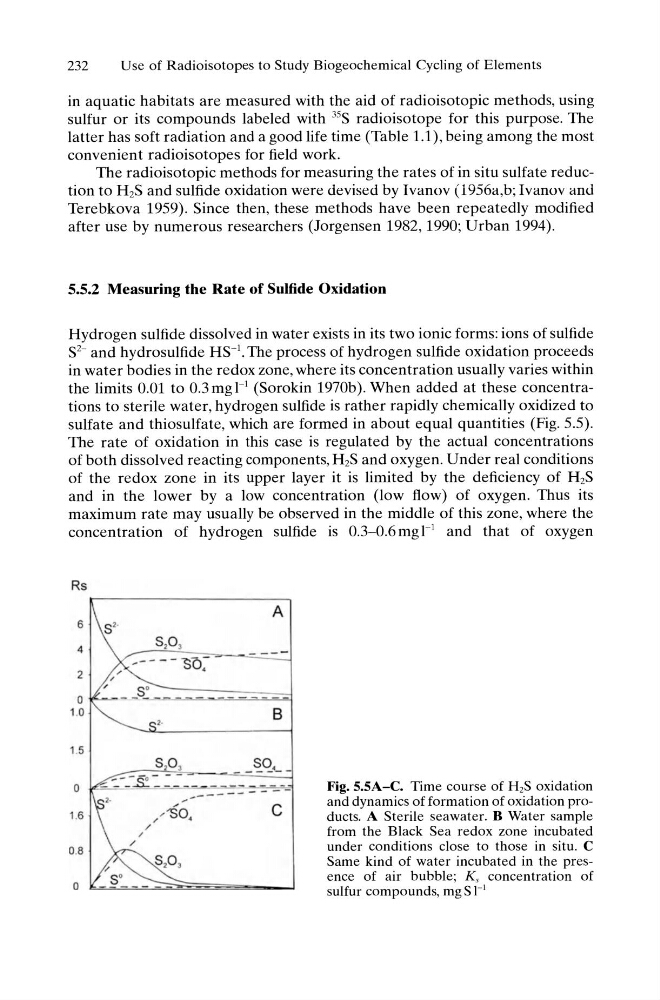
the limits 0.01 to 0.3 mg 1- 1 (Sorokin 1970b). When added at these concentrations to sterile water, hydrogen sulfide is rather rapidly chemically oxidized to
sulfate and thiosulfate, which are formed in about equal quantities (Fig. 5.5).
The rate of oxidation in this case is regulated by the actual concentrations
of both dissolved reacting components, H zS and oxygen. Under real conditions
of the redox zone in its upper layer it is limited by the deficiency of H zS
and in the lower by a low concentration (low flow) of oxygen. Thus its
maximum rate may usually be observed in the middle of this zone, where the
concentration of hydrogen sulfide is 0.3-0.6mgl- 1 and that of oxygen
Rs
6
4
2
o
1.0
1.5
o
1.6
0.8
o
/
/
/
A
8 20 ,
2·
B
-~
- -,
/ -80.
c
Fig. S.SA-C. Time course of H2S oxidation
and dynamics of formation of oxidation products. A Sterile seawater. B Water sample
from the Black Sea redox zone incubated
under conditions close to those in situ. C
Same kind of water incubated in the presence of air bubble; K , concentration of
sulfur compounds, mg S J-I
Use of Radioisotopes to Study Biogeochemical Cycling of Elements
in aquatic habitats are measured with the aid of radioisotopic methods, using
sulfur or its compounds labeled with 35S radioisotope for this purpose. The
latter has soft radiation and a good life time (Table 1.1), being among the most
convenient radioisotopes for field work.
The radioisotopic methods for measuring the rates of in situ sulfate reduction to H zS and sulfide oxidation were devised by Ivanov (1956a,b; Ivanov and
Terebkova 1959). Since then, these methods have been repeatedly modified
after use by numerous researchers (Jorgensen 1982, 1990; Urban 1994).
5.5.2 Measuring the Rate of Sulfide Oxidation
Hydrogen sulfide dissolved in water exists in its two ionic forms: ions of sulfide
Sz- and hydrosulfide HS- 1 • The process of hydrogen sulfide oxidation proceeds
in water bodies in the redox zone, where its concentration usually varies within
the limits 0.01 to 0.3 mg 1- 1 (Sorokin 1970b). When added at these concentrations to sterile water, hydrogen sulfide is rather rapidly chemically oxidized to
sulfate and thiosulfate, which are formed in about equal quantities (Fig. 5.5).
The rate of oxidation in this case is regulated by the actual concentrations
of both dissolved reacting components, H zS and oxygen. Under real conditions
of the redox zone in its upper layer it is limited by the deficiency of H zS
and in the lower by a low concentration (low flow) of oxygen. Thus its
maximum rate may usually be observed in the middle of this zone, where the
concentration of hydrogen sulfide is 0.3-0.6mgl- 1 and that of oxygen
Rs
6
4
2
o
1.0
1.5
o
1.6
0.8
o
/
/
/
A
8 20 ,
2·
B
-~
- -,
/ -80.
c
Fig. S.SA-C. Time course of H2S oxidation
and dynamics of formation of oxidation products. A Sterile seawater. B Water sample
from the Black Sea redox zone incubated
under conditions close to those in situ. C
Same kind of water incubated in the presence of air bubble; K , concentration of
sulfur compounds, mg S J-I