

Studying Sulfur Cycling with the Aid of 35S
231
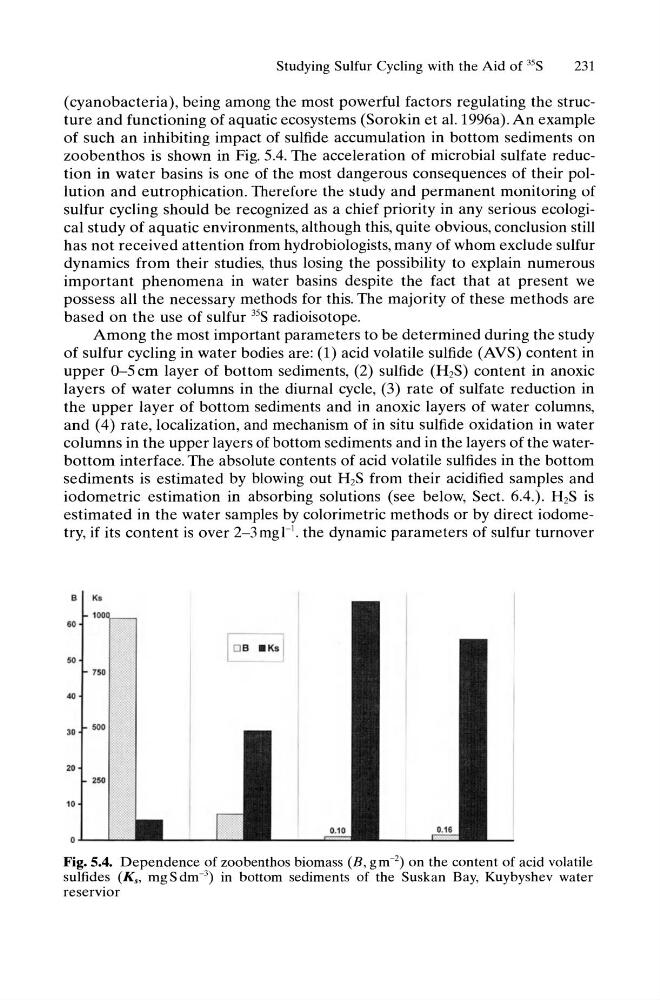
(cyanobacteria), being among the most powerful factors regulating the structure and functioning of aquatic ecosystems (Sorokin et al.1996a).An example
of such an inhibiting impact of sulfide accumulation in bottom sediments on
zoobenthos is shown in Fig. 5.4. The acceleration of microbial sulfate reduction in water basins is one of the most dangerous consequences of their pollution and eutrophication. Therdore the study and permanent monitoring of
sulfur cycling should be recognized as a chief priority in any serious ecological study of aquatic environments, although this, quite obvious, conclusion still
has not received attention from hydro biologists, many of whom exclude sulfur
dynamics from their studies, thus losing the possibility to explain numerous
important phenomena in water basins despite the fact that at present we
possess all the necessary methods for this. The majority of these methods are
based on the use of sulfur 35S radioisotope.
Among the most important parameters to be determined during the study
of sulfur cycling in water bodies are: (1) acid volatile sulfide (AVS) content in
upper 0-5 cm layer of bottom sediments, (2) sulfide (H2S) content in anoxic
layers of water columns in the diurnal cycle, (3) rate of sulfate reduction in
the upper layer of bottom sediments and in anoxic layers of water columns,
and (4) rate, localization, and mechanism of in situ sulfide oxidation in water
columns in the upper layers of bottom sediments and in the layers of the waterbottom interface. The absolute contents of acid volatile sulfides in the bottom
sediments is estimated by blowing out H 2S from their acidified samples and
iodometric estimation in absorbing solutions (see below, Sect. 6.4.). H 2S is
estimated in the water samples by colorimetric methods or by direct iodometry, if its content is over 2-3 mg 1-1. the dynamic parameters of sulfur turnover
B
K.
60
50
E .Ksj
750
40
30
SOD
20
250
10
0
Fig. 5.4. Dependence of zoobenthos biomass (8, gm- 2 ) on the content of acid volatile
sulfides (K" mg S dm- 3 ) in bottom sediments of the Suskan Bay, Kuybyshev water
reservior
231
(cyanobacteria), being among the most powerful factors regulating the structure and functioning of aquatic ecosystems (Sorokin et al.1996a).An example
of such an inhibiting impact of sulfide accumulation in bottom sediments on
zoobenthos is shown in Fig. 5.4. The acceleration of microbial sulfate reduction in water basins is one of the most dangerous consequences of their pollution and eutrophication. Therdore the study and permanent monitoring of
sulfur cycling should be recognized as a chief priority in any serious ecological study of aquatic environments, although this, quite obvious, conclusion still
has not received attention from hydro biologists, many of whom exclude sulfur
dynamics from their studies, thus losing the possibility to explain numerous
important phenomena in water basins despite the fact that at present we
possess all the necessary methods for this. The majority of these methods are
based on the use of sulfur 35S radioisotope.
Among the most important parameters to be determined during the study
of sulfur cycling in water bodies are: (1) acid volatile sulfide (AVS) content in
upper 0-5 cm layer of bottom sediments, (2) sulfide (H2S) content in anoxic
layers of water columns in the diurnal cycle, (3) rate of sulfate reduction in
the upper layer of bottom sediments and in anoxic layers of water columns,
and (4) rate, localization, and mechanism of in situ sulfide oxidation in water
columns in the upper layers of bottom sediments and in the layers of the waterbottom interface. The absolute contents of acid volatile sulfides in the bottom
sediments is estimated by blowing out H 2S from their acidified samples and
iodometric estimation in absorbing solutions (see below, Sect. 6.4.). H 2S is
estimated in the water samples by colorimetric methods or by direct iodometry, if its content is over 2-3 mg 1-1. the dynamic parameters of sulfur turnover
B
K.
60
50
E .Ksj
750
40
30
SOD
20
250
10
0
Fig. 5.4. Dependence of zoobenthos biomass (8, gm- 2 ) on the content of acid volatile
sulfides (K" mg S dm- 3 ) in bottom sediments of the Suskan Bay, Kuybyshev water
reservior