

Studying Sulfur Cycling with the Aid of 35S
233
0.05-0.015 mgl~l (Sorokin 1983b; Sorokin et al. 1995a). Concerning the mechanism of H 2S oxidation in situ in the water bodies where the redox zone is situated below the boundary of photosynthesis, most often it remains practically
the same as in sterile water, e.g., the oxidation of dissolved H 2S proceeds most
often as a purely chemical reaction (Sorokin 1970b, 1972b). Only in those
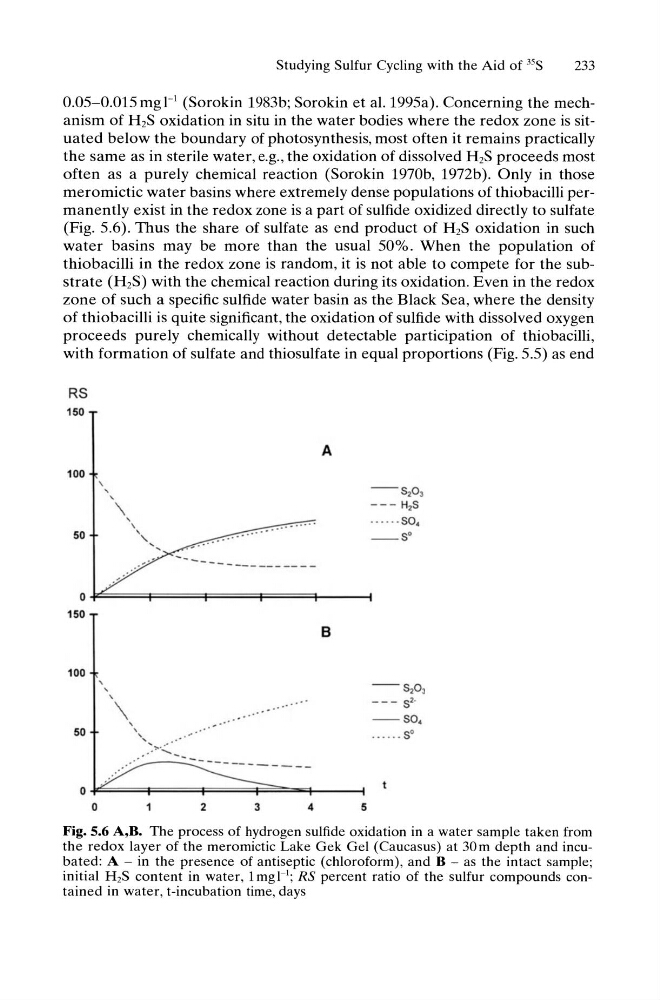
meromictic water basins where extremely dense populations of thiobacilli permanently exist in the redox zone is a part of sulfide oxidized directly to sulfate
(Fig. 5.6). Thus the share of sulfate as end product of H 2S oxidation in such
water basins may be more than the usual 50%. When the population of
thiobacilli in the redox zone is random, it is not able to compete for the substrate (H2S) with the chemical reaction during its oxidation. Even in the redox
zone of such a specific sulfide water basin as the Black Sea, where the density
of thiobacilli is quite significant, the oxidation of sulfide with dissolved oxygen
proceeds purely chemically without detectable participation of thiobacilli,
with formation of sulfate and thiosulfate in equal proportions (Fig. 5.5) as end
RS
150
100
50
\
,
A
- - S20 3
- - - H2S
.. ... ·so,
__ so
O~====T=====T=====~====~--~
150
100
50
, ,
\ , , ,
',~""'.::....
B
~-O~====F===~F===~~~~----~
o
2
3
4
5
- - S,0 3
-- - S2.
- - so,
...... s'
Fig. 5.6 A,B. The process of hydrogen sulfide oxidation in a water sample taken from
the redox layer of the meromictic Lake Gek Gel (Caucasus) at 30m depth and incubated: A - in the presence of antiseptic (chloroform), and B - as the intact sample;
initial H 2S content in water, 1 mg 1-\ RS percent ratio of the sulfur compounds contained in water, t-incubation time, days
233
0.05-0.015 mgl~l (Sorokin 1983b; Sorokin et al. 1995a). Concerning the mechanism of H 2S oxidation in situ in the water bodies where the redox zone is situated below the boundary of photosynthesis, most often it remains practically
the same as in sterile water, e.g., the oxidation of dissolved H 2S proceeds most
often as a purely chemical reaction (Sorokin 1970b, 1972b). Only in those
meromictic water basins where extremely dense populations of thiobacilli permanently exist in the redox zone is a part of sulfide oxidized directly to sulfate
(Fig. 5.6). Thus the share of sulfate as end product of H 2S oxidation in such
water basins may be more than the usual 50%. When the population of
thiobacilli in the redox zone is random, it is not able to compete for the substrate (H2S) with the chemical reaction during its oxidation. Even in the redox
zone of such a specific sulfide water basin as the Black Sea, where the density
of thiobacilli is quite significant, the oxidation of sulfide with dissolved oxygen
proceeds purely chemically without detectable participation of thiobacilli,
with formation of sulfate and thiosulfate in equal proportions (Fig. 5.5) as end
RS
150
100
50
\
,
A
- - S20 3
- - - H2S
.. ... ·so,
__ so
O~====T=====T=====~====~--~
150
100
50
, ,
\ , , ,
',~""'.::....
B
~-O~====F===~F===~~~~----~
o
2
3
4
5
- - S,0 3
-- - S2.
- - so,
...... s'
Fig. 5.6 A,B. The process of hydrogen sulfide oxidation in a water sample taken from
the redox layer of the meromictic Lake Gek Gel (Caucasus) at 30m depth and incubated: A - in the presence of antiseptic (chloroform), and B - as the intact sample;
initial H 2S content in water, 1 mg 1-\ RS percent ratio of the sulfur compounds contained in water, t-incubation time, days