

226
Use of Radioisotopes to Study Biogeochemical Cycling of Elements
practical approach could be to use this direct method for the calibration of
a simpler method, based on the estimation of the rate of formation of end
products of methane oxidation with correction on the use of a part of carbon
of the methane thus oxidized by bacteria for their growth. In natural water
samples it is about 10% (Nesterov and Ivanov 1983).
Experiments using labeled mdhant gas art ptrfurmed as follows; lOO-ml
serum bottles are used for this purpose. Their serum rubber stopper is supplied with a syringe needle as shown in Fig. 5.1. From each water sample three
bottles are filled passing 2-3 volumes, as for the estimation of O 2 content, to
preserve the original redox potential and O 2 content. The bottles are closed
without air bubbles under the corks. After sampling on the vertical profile has
ended, one bottle from each subsample series is injected with 0.5ml of 5%
NaOH solution and serves as killed control for the estimation of the initial
radioactivity of methane added (Ro). Then all subsamples of the series are
charged with equal 0.1-cm 3 volumes of labeled methane gas, taken from its
working stock and injected into the bottles through the serum stoppers with
a micro syringe. The needles are removed from the corks, and the subsamples
thoroughly mixed. They are incubated in the dark at the in situ temperature
for 20 h if it is over 15°C, and for 1-2 days if it is less, being placed on their
sides. After incubation, the experimental bottles are injected with 0.5 ml 5%
NaOH to fix the labeled CO2 formed and to stop reaction. Then 10ml of water
is taken out from all the bottles to make space for subsequent bubbling with
air to extract the labeled methane. The water is taken out by passing a long
needle down to the bottom of bottle through the serum plug. A small syringe
needle is also inserted (Fig. 5.3) to let air in. When the lO-ml syringe is filled,
it is disconnected with the needle and the water from it discharged. The small
needle is connected with a device for burning methane and the large one
with the CO2 absorber to clean air from the carbon dioxide. Then the bottle is
bubbled for 1 h with air flow free of CO2. The methane gas blown out from the
bottle with this air passes through the burner's quartz tube containing copper
oxide as the catalyzer and heated to 800°C (Fig. 5.3). After this, the flow of
air is passed through a CO2 absorber filled with a solution of ammonium-base
phenethylamine in a toluene scintillation cocktail (500ml of cocktail + 100mi
of concentrated phenethylamine + 200ml of methanol + 40ml of distilled
water). When the distillation procedure is finished, the absorbing liquid is
discharged into a centrifuge test tube, its volume is adjusted with methanol to
10ml, and 1 ml of the absorbing liquid is transferred into the scintillation vial
and radioassayed. The decrease in 14CH4 radioactivity between the fixed control
bottle and the experimental bottle thus measured is used as evidence of the
methane oxidation rate in the water samples under in situ conditions. The
inverse specific radioactivity of methane (Cr) in the working stock needed
for calculation of its absolute values are measured by direct combustion and
radioassay of the portion taken from the stock and expressed as cm 3 cpm- 1 .
. . .
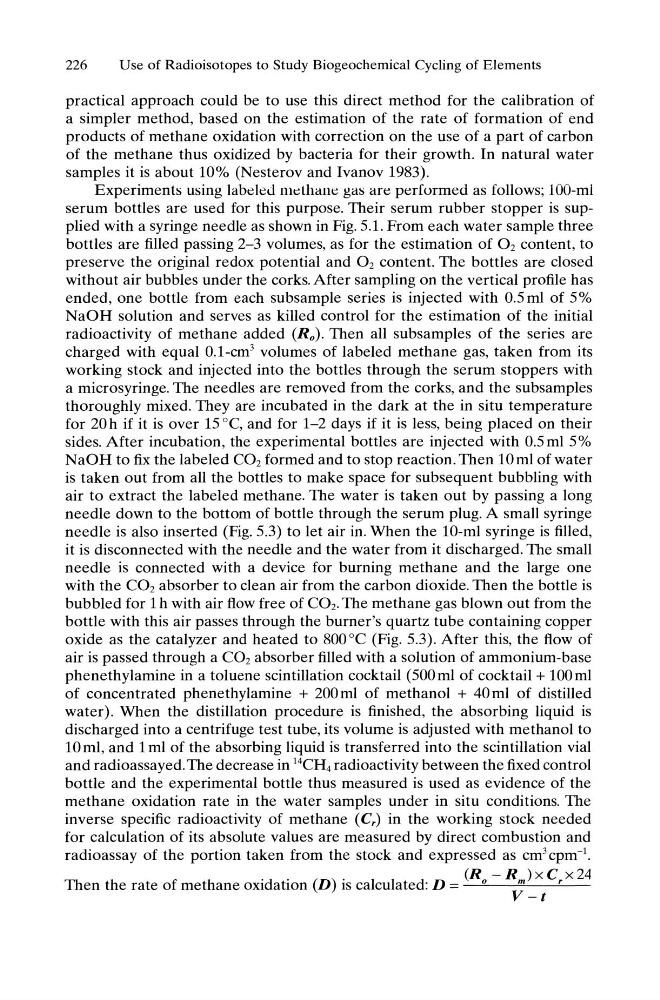
(R - R ) x C x 24
Then the rate of methane OXIdatIOn CD) IS calculated: D == 0
m
r
V -{
Use of Radioisotopes to Study Biogeochemical Cycling of Elements
practical approach could be to use this direct method for the calibration of
a simpler method, based on the estimation of the rate of formation of end
products of methane oxidation with correction on the use of a part of carbon
of the methane thus oxidized by bacteria for their growth. In natural water
samples it is about 10% (Nesterov and Ivanov 1983).
Experiments using labeled mdhant gas art ptrfurmed as follows; lOO-ml
serum bottles are used for this purpose. Their serum rubber stopper is supplied with a syringe needle as shown in Fig. 5.1. From each water sample three
bottles are filled passing 2-3 volumes, as for the estimation of O 2 content, to
preserve the original redox potential and O 2 content. The bottles are closed
without air bubbles under the corks. After sampling on the vertical profile has
ended, one bottle from each subsample series is injected with 0.5ml of 5%
NaOH solution and serves as killed control for the estimation of the initial
radioactivity of methane added (Ro). Then all subsamples of the series are
charged with equal 0.1-cm 3 volumes of labeled methane gas, taken from its
working stock and injected into the bottles through the serum stoppers with
a micro syringe. The needles are removed from the corks, and the subsamples
thoroughly mixed. They are incubated in the dark at the in situ temperature
for 20 h if it is over 15°C, and for 1-2 days if it is less, being placed on their
sides. After incubation, the experimental bottles are injected with 0.5 ml 5%
NaOH to fix the labeled CO2 formed and to stop reaction. Then 10ml of water
is taken out from all the bottles to make space for subsequent bubbling with
air to extract the labeled methane. The water is taken out by passing a long
needle down to the bottom of bottle through the serum plug. A small syringe
needle is also inserted (Fig. 5.3) to let air in. When the lO-ml syringe is filled,
it is disconnected with the needle and the water from it discharged. The small
needle is connected with a device for burning methane and the large one
with the CO2 absorber to clean air from the carbon dioxide. Then the bottle is
bubbled for 1 h with air flow free of CO2. The methane gas blown out from the
bottle with this air passes through the burner's quartz tube containing copper
oxide as the catalyzer and heated to 800°C (Fig. 5.3). After this, the flow of
air is passed through a CO2 absorber filled with a solution of ammonium-base
phenethylamine in a toluene scintillation cocktail (500ml of cocktail + 100mi
of concentrated phenethylamine + 200ml of methanol + 40ml of distilled
water). When the distillation procedure is finished, the absorbing liquid is
discharged into a centrifuge test tube, its volume is adjusted with methanol to
10ml, and 1 ml of the absorbing liquid is transferred into the scintillation vial
and radioassayed. The decrease in 14CH4 radioactivity between the fixed control
bottle and the experimental bottle thus measured is used as evidence of the
methane oxidation rate in the water samples under in situ conditions. The
inverse specific radioactivity of methane (Cr) in the working stock needed
for calculation of its absolute values are measured by direct combustion and
radioassay of the portion taken from the stock and expressed as cm 3 cpm- 1 .
. . .
(R - R ) x C x 24
Then the rate of methane OXIdatIOn CD) IS calculated: D == 0
m
r
V -{