

Study of Microbial Methane Oxidation Using 14C
225
two groups: two bottles from each sample are taken to the group of experimental bottles to be incubated with methane gas and one from each sample
is taken to the background group. The bottles from this latter group are
charged one by one with equal 0.2-0.4-ml portions of the working solution of
14C-carbonate and are instantly inserted into a black sack or dark box. After
this, the experimental buttles are charged. Onc by one the bottles are opened
and the same portion of working isotope solution is added to them. The bottles
are closed with serum stoppers, into which a fine syringe needles is inserted
and 1 ml of methane is injected. The bottles are shaked to saturate water with
gases and instantly placed in dark. After incubation for 12-15 h at 20-22 °C,
all the samples are fixed with Lugol solution (a pale yellow color) and filtered
through 0.45 Millipore membrane filters, being discolored just before filtration
by the addition of several drops of 3% thiosulfate solution to kill the iodine.
The filters are rinsed subsequently with 3 ml of filtered water, with 3 ml of 0.05
and 0.01 solutions of HCl. The wet filters are placed into the scintillation vial
and radioassayed. The Rm values are calculated for each sample as the mean
of two parallel experimental incubations with methane minus the background
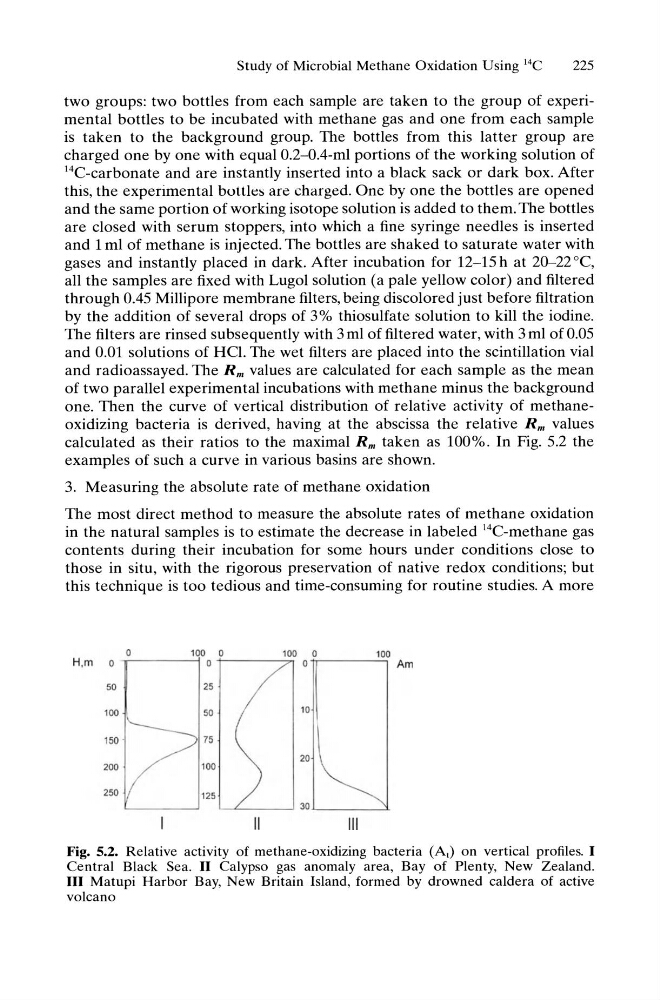
one. Then the curve of vertical distribution of relative activity of methaneoxidizing bacteria is derived, having at the abscissa the relative Rm values
calculated as their ratios to the maximal Rm taken as 100%. In Fig. 5.2 the
examples of such a curve in various basins are shown.
3. Measuring the absolute rate of methane oxidation
The most direct method to measure the absolute rates of methane oxidation
in the natural samples is to estimate the decrease in labeled 14C-methane gas
contents during their incubation for some hours under conditions close to
those in situ, with the rigorous preservation of native redox conditions; but
this technique is too tedious and time-consuming for routine studies. A more
0
100 0
100
0
100
H.m
0
0
0
Am
50
25
100
50
10
150
75
20
200
100
250
125
30
II
III
Fig. 5.2. Relative activity of methane-oxidizing bacteria (A,) on vertical profiles. I
Central Black Sea. II Calypso gas anomaly area, Bay of Plenty, New Zealand.
III Matupi Harbor Bay, New Britain Island, formed by drowned caldera of active
volcano
225
two groups: two bottles from each sample are taken to the group of experimental bottles to be incubated with methane gas and one from each sample
is taken to the background group. The bottles from this latter group are
charged one by one with equal 0.2-0.4-ml portions of the working solution of
14C-carbonate and are instantly inserted into a black sack or dark box. After
this, the experimental buttles are charged. Onc by one the bottles are opened
and the same portion of working isotope solution is added to them. The bottles
are closed with serum stoppers, into which a fine syringe needles is inserted
and 1 ml of methane is injected. The bottles are shaked to saturate water with
gases and instantly placed in dark. After incubation for 12-15 h at 20-22 °C,
all the samples are fixed with Lugol solution (a pale yellow color) and filtered
through 0.45 Millipore membrane filters, being discolored just before filtration
by the addition of several drops of 3% thiosulfate solution to kill the iodine.
The filters are rinsed subsequently with 3 ml of filtered water, with 3 ml of 0.05
and 0.01 solutions of HCl. The wet filters are placed into the scintillation vial
and radioassayed. The Rm values are calculated for each sample as the mean
of two parallel experimental incubations with methane minus the background
one. Then the curve of vertical distribution of relative activity of methaneoxidizing bacteria is derived, having at the abscissa the relative Rm values
calculated as their ratios to the maximal Rm taken as 100%. In Fig. 5.2 the
examples of such a curve in various basins are shown.
3. Measuring the absolute rate of methane oxidation
The most direct method to measure the absolute rates of methane oxidation
in the natural samples is to estimate the decrease in labeled 14C-methane gas
contents during their incubation for some hours under conditions close to
those in situ, with the rigorous preservation of native redox conditions; but
this technique is too tedious and time-consuming for routine studies. A more
0
100 0
100
0
100
H.m
0
0
0
Am
50
25
100
50
10
150
75
20
200
100
250
125
30
II
III
Fig. 5.2. Relative activity of methane-oxidizing bacteria (A,) on vertical profiles. I
Central Black Sea. II Calypso gas anomaly area, Bay of Plenty, New Zealand.
III Matupi Harbor Bay, New Britain Island, formed by drowned caldera of active
volcano