

224
Use of Radioisotopes to Study Biogeochemical Cycling of Elements
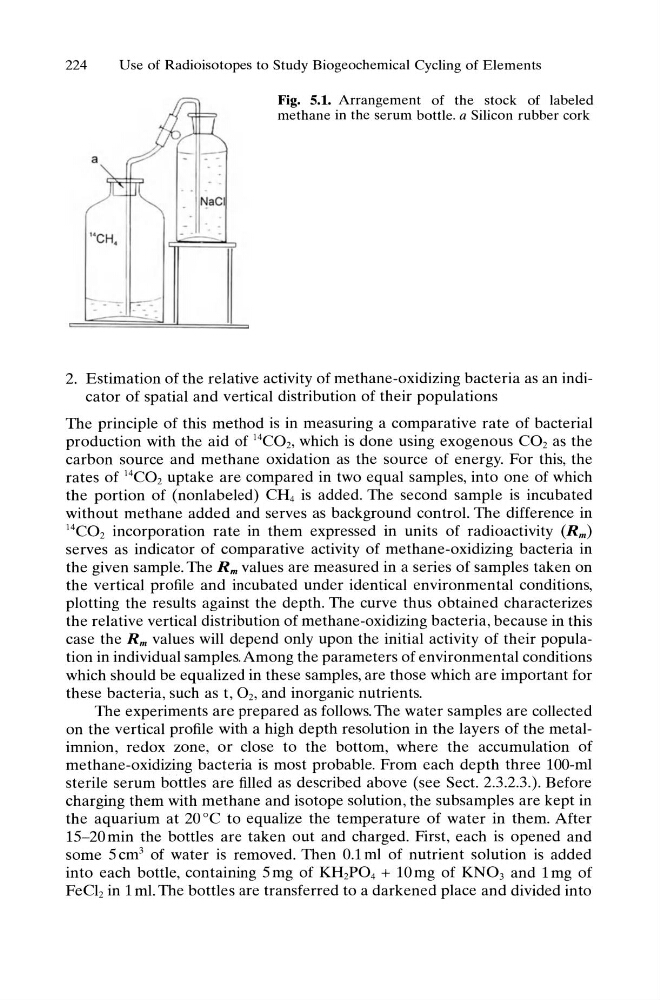
"CH.
Fig. 5.1. Arrangement of the stock of labeled
methane in the serum bottle. a Silicon rubber cork
2. Estimation of the relative activity of methane-oxidizing bacteria as an indicator of spatial and vertical distribution of their populations
The principle of this method is in measuring a comparative rate of bacterial
production with the aid of 14C02, which is done using exogenous CO2 as the
carbon source and methane oxidation as the source of energy. For this, the
rates of 14C02 uptake are compared in two equal samples, into one of which
the portion of (nonlabeled) CH4 is added. The second sample is incubated
without methane added and serves as background control. The difference in
14C02 incorporation rate in them expressed in units of radioactivity (Rm)
serves as indicator of comparative activity of methane-oxidizing bacteria in
the given sample. The Rm values are measured in a series of samples taken on
the vertical profile and incubated under identical environmental conditions,
plotting the results against the depth. The curve thus obtained characterizes
the relative vertical distribution of methane-oxidizing bacteria, because in this
case the Rm values will depend only upon the initial activity of their population in individual samples. Among the parameters of environmental conditions
which should be equalized in these samples, are those which are important for
these bacteria, such as t, O2, and inorganic nutrients.
The experiments are prepared as follows. The water samples are collected
on the vertical profile with a high depth resolution in the layers of the metalimnion, redox zone, or close to the bottom, where the accumulation of
methane-oxidizing bacteria is most probable. From each depth three 100-ml
sterile serum bottles are filled as described above (see Sect. 2.3.2.3.). Before
charging them with methane and isotope solution, the subsamples are kept in
the aquarium at 20°C to equalize the temperature of water in them. After
15-20 min the bottles are taken out and charged. First, each is opened and
some 5 cm 3 of water is removed. Then 0.1 ml of nutrient solution is added
into each bottle, containing 5mg of KH2P04 + lOmg of KN03 and 1mg of
FeCl2 in 1 ml. The bottles are transferred to a darkened place and divided into
Use of Radioisotopes to Study Biogeochemical Cycling of Elements
"CH.
Fig. 5.1. Arrangement of the stock of labeled
methane in the serum bottle. a Silicon rubber cork
2. Estimation of the relative activity of methane-oxidizing bacteria as an indicator of spatial and vertical distribution of their populations
The principle of this method is in measuring a comparative rate of bacterial
production with the aid of 14C02, which is done using exogenous CO2 as the
carbon source and methane oxidation as the source of energy. For this, the
rates of 14C02 uptake are compared in two equal samples, into one of which
the portion of (nonlabeled) CH4 is added. The second sample is incubated
without methane added and serves as background control. The difference in
14C02 incorporation rate in them expressed in units of radioactivity (Rm)
serves as indicator of comparative activity of methane-oxidizing bacteria in
the given sample. The Rm values are measured in a series of samples taken on
the vertical profile and incubated under identical environmental conditions,
plotting the results against the depth. The curve thus obtained characterizes
the relative vertical distribution of methane-oxidizing bacteria, because in this
case the Rm values will depend only upon the initial activity of their population in individual samples. Among the parameters of environmental conditions
which should be equalized in these samples, are those which are important for
these bacteria, such as t, O2, and inorganic nutrients.
The experiments are prepared as follows. The water samples are collected
on the vertical profile with a high depth resolution in the layers of the metalimnion, redox zone, or close to the bottom, where the accumulation of
methane-oxidizing bacteria is most probable. From each depth three 100-ml
sterile serum bottles are filled as described above (see Sect. 2.3.2.3.). Before
charging them with methane and isotope solution, the subsamples are kept in
the aquarium at 20°C to equalize the temperature of water in them. After
15-20 min the bottles are taken out and charged. First, each is opened and
some 5 cm 3 of water is removed. Then 0.1 ml of nutrient solution is added
into each bottle, containing 5mg of KH2P04 + lOmg of KN03 and 1mg of
FeCl2 in 1 ml. The bottles are transferred to a darkened place and divided into